
 KOR
KOR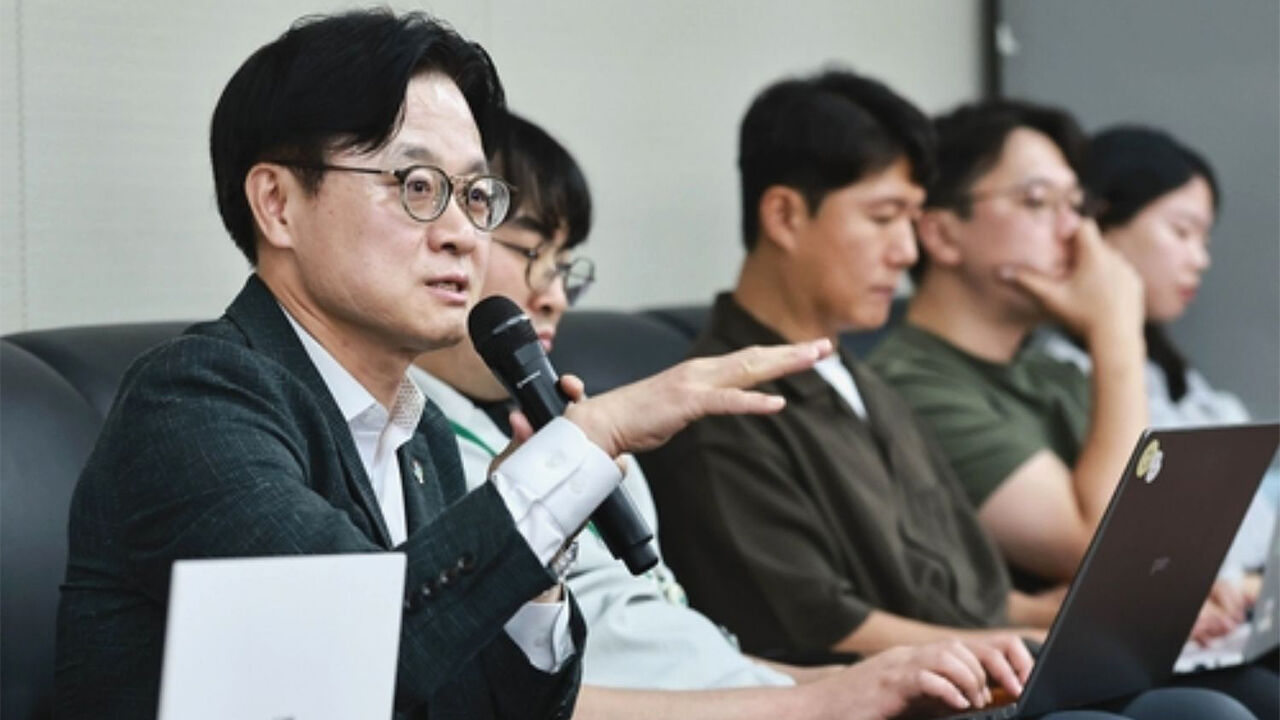
▲ Minister of Trade, Industry and Energy Kim Jung-gwan holding a background briefing
Amid rising speculation in political circles and elsewhere about the potential establishment of a semiconductor factory in the Honam region, Minister of Trade, Industry and Energy Kim Jung-gwan has raised the necessity of a new semiconductor complex.
During a background briefing with reporters at the Government Complex Sejong yesterday, June 22, Minister Kim emphasized, "We must make efforts to quickly preempt the rapidly expanding semiconductor market," adding, "Existing plans to invest in semiconductors should be carried out as soon as possible."
He continued, "I also wonder if that alone will be enough, and whether a new complex is needed."
However, regarding rumors of attracting a factory to the Honam region, he avoided a direct answer, saying, "I will speak on that at an appropriate opportunity."
Regarding the growing demands for "bonuses based on N% of operating profit," which recently began in the semiconductor industry, Minister Kim expressed his stance, saying, "Personally, I do not think bonuses should be a subject of labor disputes."
"Regarding operating profit, there are not only management and labor unions, but also investors," Minister Kim said. "Compensation for investors who take on risks should be guaranteed differently from that of unions and management." He added that institutional improvements are needed to reflect the voices of investors.
Minister Kim, who completed a tour of Kazakhstan, Europe, and the Middle East this month, stated that he achieved significant results in negotiations with the European Union (EU) over steel tariff-rate quotas (TRQ).
To protect its domestic steel industry, the EU will reduce its tariff-free quota for imported steel products by about 46%, from the current 33.82 million tons to 18.35 million tons, starting July 1. It will also increase tariffs on imports exceeding the quota from 25% to 50%.
In response, the government has been negotiating to secure as much of the quota as possible.
"Our quota is around 2.58 million tons, and there was a consensus that even if the overall figure is reduced, it will not be cut by as much as 46%," Minister Kim said.
He did not disclose specific figures.
When asked if South Korea had made any concessions in return, Minister Kim explained, "We are not giving anything special to the EU," adding, "We strongly pointed out that (this measure) violates the Free Trade Agreement (FTA) and that we could also take retaliatory action."
The government plans to prepare and announce support measures for steel companies once the quota is finalized.
Regarding the first investment project in the United States, Minister Kim remained cautious, saying, "Since the Korea-U.S. Strategic Investment Corporation has been launched, we are following the relevant procedures. I will speak on whether it will be a single first project or if several will be announced together after observing the situation."
Regarding the bid for Canada's next-generation submarine project, where South Korea is competing with Germany, he said, "We are waiting for the results with anticipation."
Amid local speculation that the announcement of the contractor could be delayed to July, and rumors that Germany and South Korea might split the project, Minister Kim said, "Since we have not received anything official, we are waiting until the end of June."
He noted that if Canada prioritizes strengthening cooperation with the North Atlantic Treaty Organization (NATO), it could disadvantage South Korea, but emphasized, "I believe we are superior in terms of the competitiveness of the submarines themselves and the competitiveness of our industrial package."
Regarding reconstruction projects in the Middle East, Minister Kim said, "I met with our companies on the ground in the Middle East, and they expressed a strong willingness to participate when opportunities arise." However, he added, "As for Iran, financial and EU sanctions remain in place, and negotiations with the U.S. are sluggish, so we are monitoring the situation as we do not know what risks may exist."
He added that once the risk factors are resolved to some extent, the government will also need to consider ways to participate in the reconstruction efforts.
Meanwhile, Minister Kim explained that the government is considering when to end the maximum petroleum price system, which has been in place since March, and that there is an incentive to lower the maximum price as international oil prices have partially declined.
(Photo: Courtesy of the Ministry of Trade, Industry and Energy, Yonhap News)
※ Please note: This article was translated by AI and may contain errors.


 Video News
 Video News
 Video News
![Death Threats and a 48-Hour Response: How Other Countries Handle Teacher Protection [Fact Check]](http://img.sbs.co.kr/newimg/news/20260626/202196688_300.jpg) Video News
Video News