
 KOR
KOR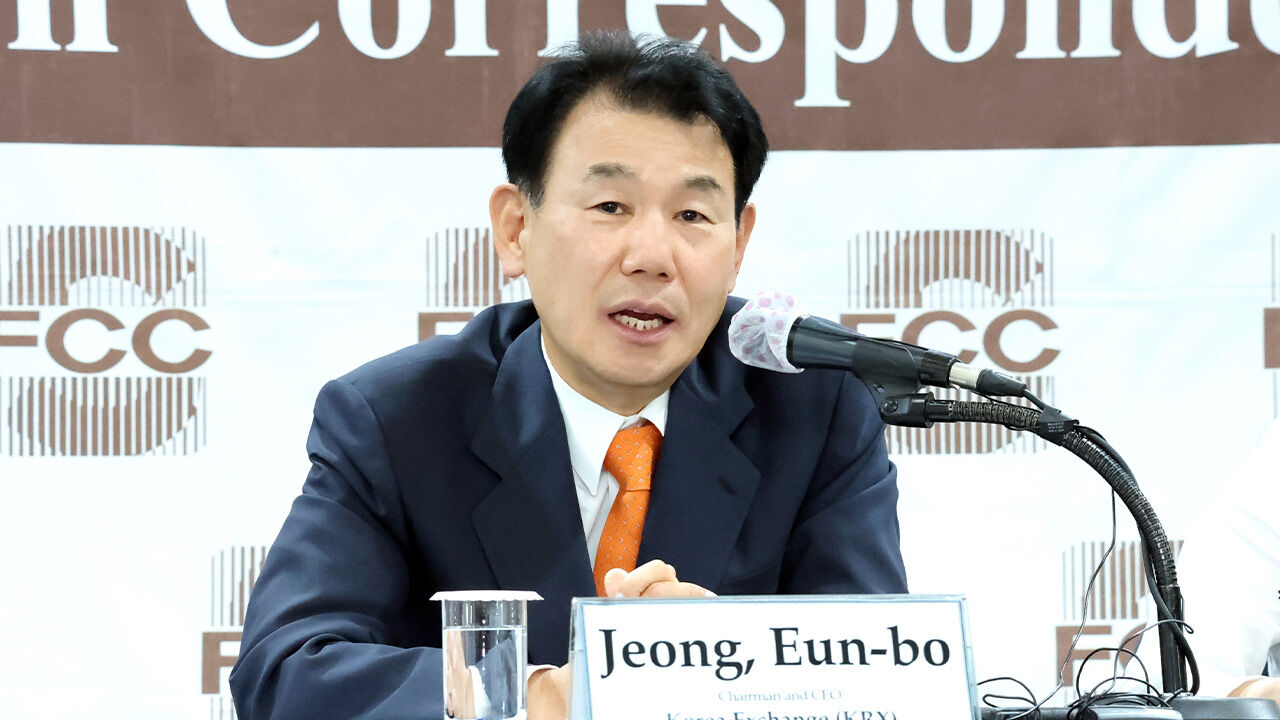
▲ Korea Exchange (KRX) Chairman Jung Eun-bo attends a press conference at the Seoul Foreign Correspondents' Club.
Jung Eun-bo, Chairman of the Korea Exchange (KRX), stated that he believes the "Korea discount" on the domestic stock market has been resolved to a significant degree.
During a press conference held at the Korea Press Center in Jung-gu, Seoul, on Monday (June 22), Chairman Jung said, "The KOSPI rose by approximately 80% last year and has shown a growth rate of nearly 100% or more this year." He added, "These achievements have been driven by two major factors: efforts to enhance trust among capital market investors and the international competitiveness of our key industries."
Highlighting efforts to boost domestic investor confidence through the Corporate Value-up Program, Jung remarked, "In particular, as foreign investors have begun to evaluate the government's visible efforts, I believe it has naturally created an opportunity to secure investor trust in the Korean capital market."
He also cited the case of Japan, where the ratio of household assets shifted from real estate to financial assets in 2020. "As of 2024, real estate accounts for 65% of household assets in Korea, while financial assets make up about 35%. In the mid-to-long term, we expect this ratio to eventually reverse, just as it did in Japan," he said, expressing optimism for the revitalization of the financial market.
When asked about the potential inclusion of the Korean market in the MSCI (Morgan Stanley Capital International) Developed Markets Index, Chairman Jung replied, "We have made significant efforts to improve access for foreign investors, and I understand that MSCI is evaluating these efforts quite positively." He added, "However, I am aware that MSCI still perceives certain constraints regarding the opening of the 24-hour foreign exchange market, which begins next month."
Regarding a question on whether the recent market rally, centered on semiconductors, should be viewed as speculation, he drew a line, stating, "I don't think it is appropriate to preemptively label it as speculation."
Chairman Jung explained, "I understand that the Price-to-Earnings Ratio (PER) for Samsung Electronics and SK Hynix, based on expected earnings for this year, is below 7 to 8, whereas the PER for U.S.-based Micron exceeds 10." He continued, "Considering that the market capitalization of Samsung Electronics and SK Hynix each exceeds 2 quadrillion won and they have over 5 million investors, I do not believe this is an abnormal trading situation."
On the issue of market concentration in these two stocks, he acknowledged, "It is true that there is a concentration phenomenon." However, he explained, "In Taiwan, TSMC accounts for more than 50% of the market capitalization, and in the Netherlands, ASML makes up the majority of the stock market."
He added, "In that sense, I believe this is a result of the natural price discovery process based on supply and demand. We will continue to make efforts to foster industries beyond semiconductors through productive financing."
Addressing the volatility of the domestic stock market, he stated, "It is true that the Korean economy is highly dependent on overseas markets compared to other major economies, and given our economic structure centered on memory semiconductors, the volatility is somewhat high." He added, "The government authorities are also working on institutional and market management aspects to smooth out such volatility."
(Photo: Provided by Korea Exchange, Yonhap News)
※ Please note: This article was translated by AI and may contain errors.

![[단독] "비번 XXXX" 누르자 '쓱'…아파트 줄줄이 뚫렸다](http://img.sbs.co.kr/newimg/news/20260622/202195139_300.jpg) Video News
Video News
 Video News
![[단독] "도와주세요" 몸엔 참혹한 흔적…농장 반전 정체](http://img.sbs.co.kr/newimg/news/20260622/202195141_300.jpg) Video News
Video News
 Video News
