
 KOR
KOR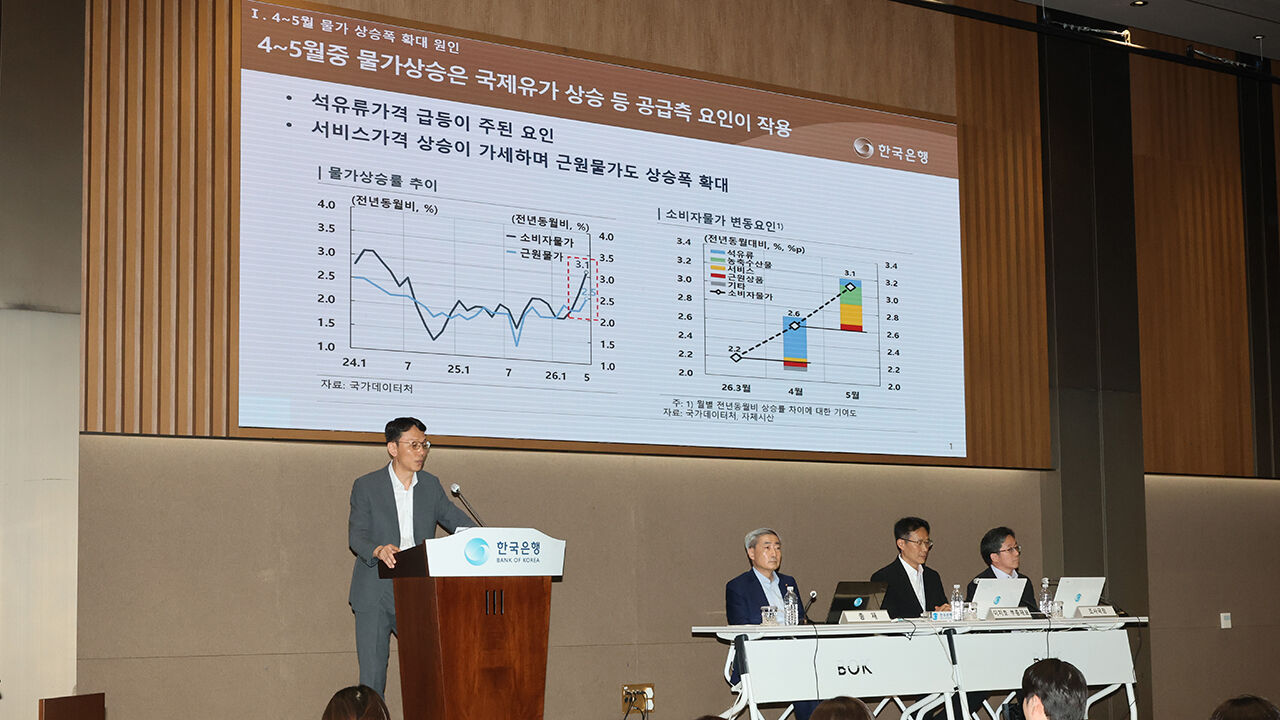
▲ A report is being presented at a press conference reviewing the operational status of the price stability target for the first half of 2026, held at the Bank of Korea's annex in Jung-gu, Seoul, on June 17.
Bank of Korea Governor Shin Hyun-song on Wednesday (June 17) repeatedly signaled interest rate hikes, warning that inflation will remain high despite the agreement to end the Middle East war, while drawing the line at the possibility of a "big step" (a 50-basis-point rate hike).
During a press conference reviewing the operational status of the price stability target held at the BOK headquarters this afternoon, Governor Shin said, "Consumer prices will continue to rise at a high level for a considerable period," adding, "Inflationary pressures from the wage and demand sides have also strengthened."
"It is expected to take a long time for the energy supply chain to normalize to pre-Middle East war levels and for international oil prices to stabilize," he said.
"While crude oil supply may become active in the short term, experts generally believe it will be difficult for crude production to return to pre-war levels," Shin said. "It is likely to take a considerable amount of time for the supply itself to recover to pre-war levels."
He assessed that despite the agreement between the United States and Iran to end the war, the economic situation itself has not changed significantly from when the Monetary Policy Board made its monetary policy decision in May.
Even with international oil prices dropping sharply immediately after the agreement, he emphasized, "At times like this, we must not be swayed by market prices but look at the economy itself from a mid- to long-term perspective."
"In the last day or two, oil prices have fallen, and other asset prices, such as stocks and bonds, seem to have entered a risk-on state," he said. "However, rather than reacting to daily fluctuations in the financial markets, we must make judgments by looking at long-term fundamentals."
He added, "Since oil prices fluctuate heavily based on risk appetite, similar to financial assets, we need to wait and see how long the downward trend in oil prices will last."
He went on to emphasize, "The impact of high oil prices can spill over not only to energy but also to other items," adding, "The mid- to long-term secondary spillover effects are crucial."
Governor Shin also diagnosed that inflationary pressures driven by wage increases, particularly at semiconductor exporting companies, and growing demand have intensified.
"Demand-side pressure is expected to gradually rise as the domestic economy improves," he said. "There are also concerns that wage increases could further drive up inflationary pressures from both the cost and demand sides."
"Inflationary pressures from wages and demand have become stronger than they were during last month's monetary policy meeting," Shin explained. "As wage negotiations continue, while we have emphasized cost-side pressures so far, the force pulling up prices from the demand side has also grown stronger."
Regarding concerns that the government's expansionary fiscal policy could increase inflationary pressures and clash with monetary policy, he assessed, "I do not believe the supplementary budget earlier this year affected demand-side inflation." He added, "Since South Korea's current fiscal condition is sound and there is no need to issue additional bonds, there is little upward pressure on bond yields."
On the growing outlook for surplus tax revenue driven by strong semiconductor exports, he said, "This can be seen as a very good opportunity for the Korean economy to take a leap forward."
However, he drew the line at the possibility of a "big step," where the BOK would raise the benchmark interest rate by a large 50 basis points (1 bp = 0.01 percentage point) at once.
"When talk of a big step emerged, the market was in a difficult situation," he said. "Bond yields were also very high, which is in stark contrast to today's situation."
He emphasized, "When market conditions are extremely difficult, speculation naturally arises about whether the central bank might take exceptional measures. However, when implementing monetary policy, we do not react to daily market conditions but look at the underlying, important trends."
Governor Shin emphasized that the BOK will actively respond to the economic burden placed on the public, including low-income households, due to rising prices.
"Following the Middle East war, international oil prices surged, causing petroleum product prices to rise by more than 20%, and core inflation has also risen to the mid-2% range," Shin said. "In particular, as the cost of living felt by the public has risen faster than consumer prices, the burden of living expenses on low-income households has increased."
He added, "The BOK deeply recognizes that the economic burden on the public could intensify due to rising prices. We will closely monitor future inflation trends and actively respond until we are confident that prices will stabilize at our target level."
(Photo: Yonhap News)
※ Please note: This article was translated by AI and may contain errors.

![[단독] 해외 출장마다 배우자 동행…철저히 숨긴 선관위](http://img.sbs.co.kr/newimg/news/20260617/202193703_300.jpg) Video News
Video News
![[단독] 친부 때문에 사망한 아이…블랙박스에 충격 장면](http://img.sbs.co.kr/newimg/news/20260617/202193736_300.jpg) Video News
Video News
 Video News
 Video News
 Video News