
 KOR
KOR
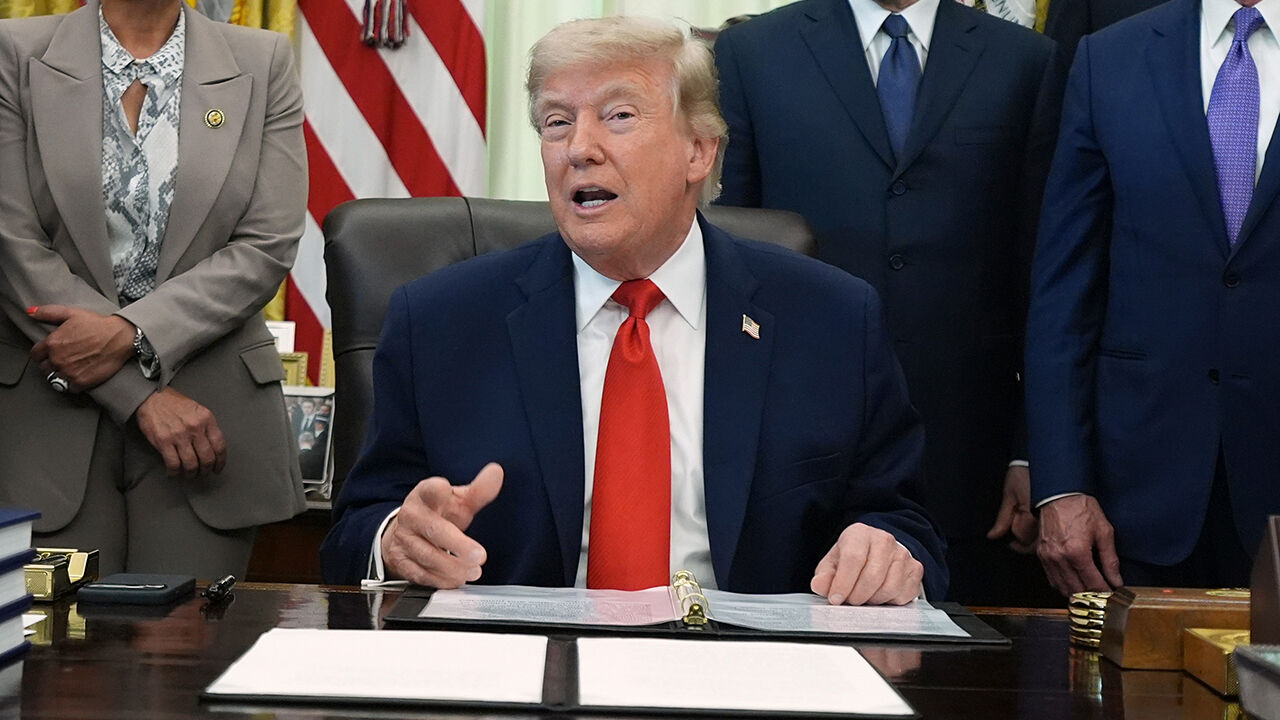
▲ US President Donald Trump
Amid the signing of a memorandum of understanding (MOU) to end the war between the United States and Iran, controversy is brewing over a reconstruction fund for Iran, reportedly worth $300 billion (453 trillion won).
This is because it could appear as though other countries are footing the bill for a massive fund that is essentially reparations, even though it was the U.S. that fought the war.
Criticism is also growing within the U.S. that President Donald Trump, who has fiercely criticized the Barack Obama administration for handing over bundles of cash to Iran, is allowing massive financial support to Iran without any clear denuclearization achievements.
According to foreign media reports, including Reuters, the MOU agreement between the U.S. and Iran reportedly includes provisions to establish a $300 billion private fund that Iran can access.
Citing sources, Reuters reported that more than half of the total amount has already been committed, mentioning companies from South Korea, Japan, Singapore, Malaysia, and the U.S.
Vice President JD Vance also made remarks that seemed to acknowledge the existence of the $300 billion fund.
President Trump stated that no U.S. money would be involved.
Since labeling it as reparations or a reconstruction fund could give the impression that the U.S. was the defeated nation, the Trump administration appears to be trying to frame it in the guise of a private investment fund.
However, from Iran's perspective, there is a high likelihood it will be perceived as war reparations.
Since the outbreak of the war, Iran had refused to back down on its demand for reparations for war damages during negotiations, suggesting that a compromise may have ultimately been reached in the form of a private fund.
Even if the "label" of the fund is up for negotiation, the fact that this fund is being raised primarily from U.S. allies, including the Gulf states, is being pointed out as a problem.
Critics point out that after starting a war with Iran without consulting its allies, the U.S. is now pressuring those allies to raise a fund that is suspected of being reparations.
Given President Trump's tendency to retaliate if his demands are not met, it is difficult to see the participation of various countries in raising the fund as entirely voluntary.
This is virtually identical to President Trump's logic early in the war, when he urged countries to send warships to help open the Strait of Hormuz after Iran blocked it in March.
At the time, critics also pointed out that the U.S. had caused the blockage of the Strait of Hormuz by starting the war, yet was trying to shift the responsibility for resolving it onto others.
Within the U.S., concerns are also growing that the Trump administration may be offering "giveaway-style" compensation before even securing achievements in Iran's denuclearization.
While President Trump repeatedly promotes that Iran has agreed not to develop or acquire nuclear weapons, neither the U.S. public nor the international community seems to believe yet that this will lead to actual action.
Iran's actual willingness to denuclearize can be gauged through concrete actions such as the disposal of highly enriched uranium, the duration of enrichment suspension, the dismantling of nuclear facilities, and the acceptance of international inspections. However, the nuclear negotiations to discuss these matters will only begin after the MOU signing ceremony.
This is the background behind the harsh assessment that, in reality, all President Trump has secured is the reopening of the Strait of Hormuz—which was open before the war—and Iran's word that it "will not acquire nuclear weapons."
The Trump administration maintains the position that it cannot unfreeze Iranian assets in exchange for signing the MOU.
Iran, on the other hand, counters that some of its frozen assets must be released before it can enter subsequent negotiations.
The Trump administration argues that easing sanctions on Iran is only possible on an "action-for-action" basis, in line with the scope and implementation of Iran's nuclear abandonment.
However, U.S. media reports have emerged suggesting that the U.S. will waive existing sanctions to allow Iran to sell oil during the 60-day nuclear negotiation period following the MOU.
If true, this measure contradicts the Trump administration's claim that sanctions relief is linked to nuclear abandonment.
It also gives the impression of being linked to Iran's agreement not to collect transit fees in the Strait of Hormuz for 60 days.
While it could be a trust-building attempt and a "carrot" by the U.S. to extract maximum nuclear abandonment measures during the negotiation period, it is expected to face significant backlash within the U.S. for easing the financial pressure on Iran.
In particular, President Trump, who has fiercely criticized the Obama administration for handing over bundles of cash to Iran, is bound to face the exact same criticism.
Although the Trump administration emphasizes that "no U.S. money is being spent," strictly speaking, during the Obama administration, the funds transferred were either Iran's unfrozen assets or weapon payments that the U.S. originally owed to Iran.
CNN pointed out that during the Obama administration's 2015 Iran nuclear deal, the amount of frozen Iranian assets released was about $50 billion, yet President Trump had criticized that $150 billion went to Iran. Now, the Trump administration is discussing a much larger sum of $300 billion to support Iran.
Furthermore, there is a strong sentiment among Republican hardliners in the U.S. that "no matter whose money it is, the financial lifeline of a terrorist state like Iran must not be unlocked."
While President Trump emphasizes that "no U.S. money is flowing," critics may point out that whether the money Iran will receive is U.S. money or not is beside the point, given that the purpose of the sanctions on Iran was to cut off the funding it could use to develop nuclear weapons or support terrorist groups.
Marc Thiessen, known as an advisor to President Trump, criticized, "Giving $300 billion to Iran under any circumstances is a disaster," adding, "It is like offering a Marshall Plan to rebuild Germany while the Nazis are in power."
In effect, President Trump's fierce criticism of Obama's Iran nuclear deal is coming back to haunt him like a boomerang.
※ Please note: This article was translated by AI and may contain errors.



 Video News
 Video News
 Video News