
 KOR
KOR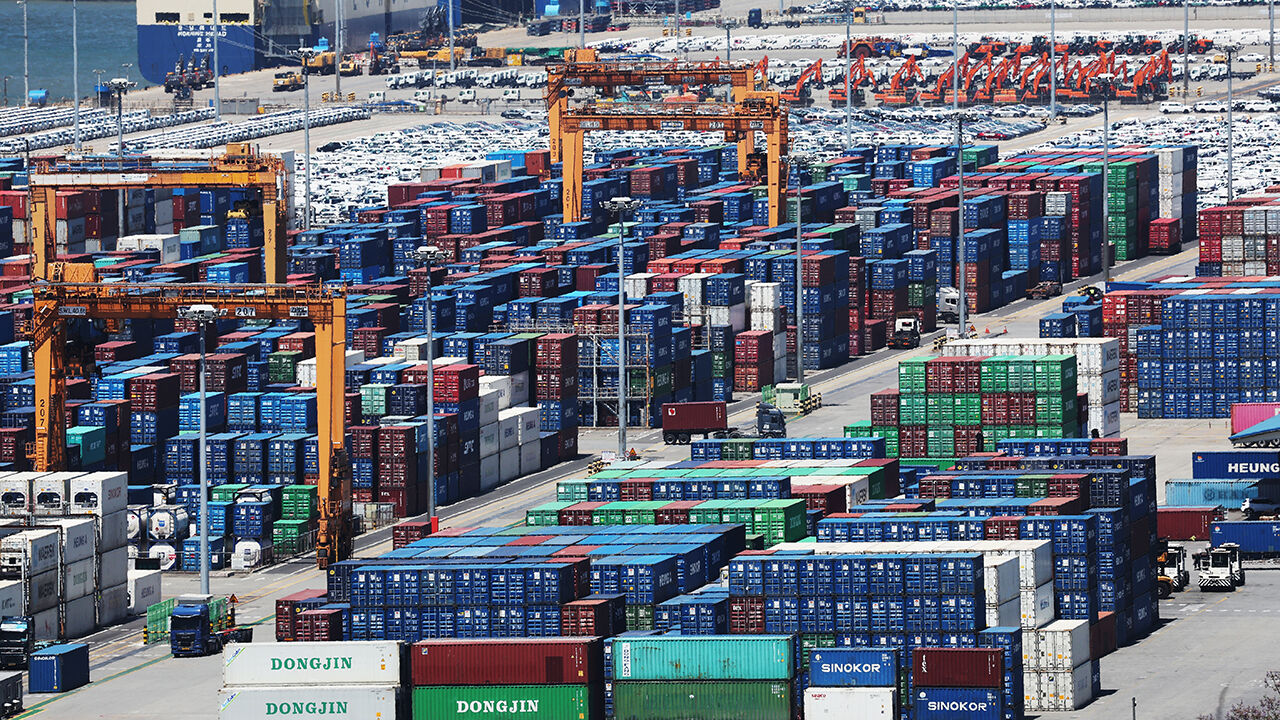
▲ Containers stacked at Pyeongtaek Port in Gyeonggi Province.
Export prices rose for the 11th consecutive month in May as demand for memory semiconductors and non-ferrous metals increased due to expanding investments in artificial intelligence (AI).
On the other hand, import prices fell for the second consecutive month, influenced by falling international oil prices.
According to the export and import price index statistics released by the Bank of Korea on June 16, the export price index for May (preliminary, in won terms, base year 2020 = 100) stood at 188.58, up 0.3% from April (188.02).
Although the month-on-month growth rate was lower than in April (7.5%), the year-on-year growth rate rose from 41.3% in April to 46.9%.
By item, agricultural, forestry, and marine products rose 1.8% month-on-month due to increased demand for fish species such as tuna.
Manufactured goods rose 0.3%, driven by computers, electronic and optical equipment, and primary metal products.
In particular, the export price index for computers, electronic and optical equipment in May was 208.98, the highest in 15 years and 10 months since July 2010 (217.32).
Among specific items, DRAM (7.6%), flash memory (19.5%), refined copper (5.0%), and aluminum plates (3.5%) saw significant month-on-month increases.
Compared to the same month last year, DRAM surged 259.7% and flash memory skyrocketed 223.0%.
Silver bullion (149.4%), jet fuel (114.2%), and diesel (105.8%) also rose sharply.
Lee Moon-hee, head of the price statistics team at the Bank of Korea, explained, "Demand for AI investment continues steadily, and a situation where supply is insufficient compared to demand, especially for memory semiconductors, persists. For the time being, this supply-demand imbalance is expected to affect the upward trend of export prices."
Lee analyzed that exports of primary metal products are also increasing as demand for non-ferrous metals required for building AI infrastructure rises.
The rise in the won-dollar exchange rate also affected the increase in export prices.
The average exchange rate rose 0.2% from 1,487.39 won in April to 1,490.11 won in May.
Compared to the same month last year, it rose 6.9%.
The import price index (in won terms) for May was 168.05, down 0.3% from April (168.49), marking a decline for the second consecutive month.
This was due to falling prices of mining products, coal, and petroleum products as international oil prices declined.
Raw materials fell 1.0%, led by mining products such as crude oil, while intermediate goods remained flat month-on-month as coal and petroleum products fell but were offset by the rise in primary metal products.
Capital goods and consumer goods each rose 0.3% month-on-month.
By specific item, crude oil (-1.9%), naphtha (-7.5%), diesel (-19.2%), and butadiene (-27.9%) fell month-on-month.
On the other hand, refined copper (5.0%), computer storage devices (5.6%), and secondary batteries (1.5%) rose.
International oil prices, based on Dubai crude, averaged $103.15 per barrel in May, down 2.4% from April's average of $105.70.
However, compared to the same month last year, it was up 61.9%.
In the May trade index (in dollar terms), the export volume index and import volume index rose 14.7% and 5.2% year-on-year, respectively.
The export value index and import value index also rose 56.8% and 21.3%, respectively.
The net terms of trade index rose 18.7% year-on-year as the increase in export prices outpaced that of import prices.
The income terms of trade index also rose 36.1% as both the net terms of trade index and the export volume index increased.
(Photo: Yonhap News)
※ Please note: This article was translated by AI and may contain errors.

 Video News


 Video News
