
 KOR
KOR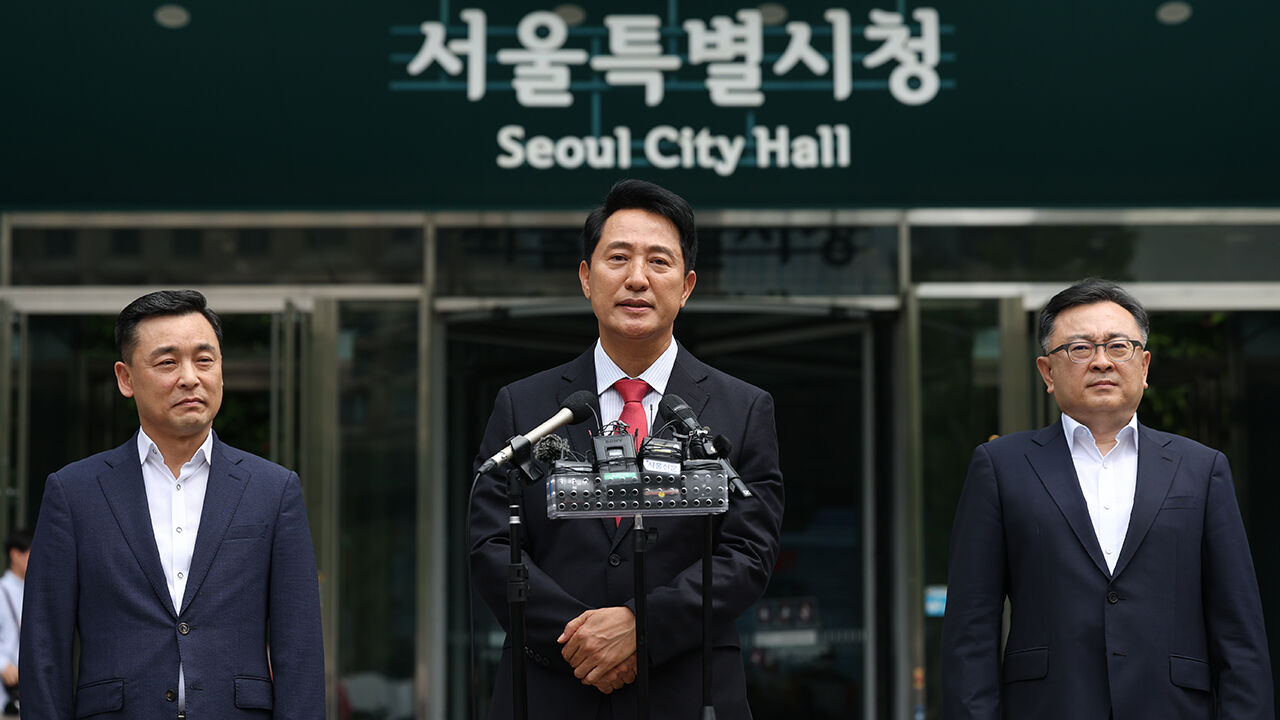
▲ Seoul Mayor Oh Se-hoon giving opening remarks upon entering City Hall
The Ministry of Land, Infrastructure and Transport (MOLIT) expressed regret on Thursday (June 11) regarding a social media post by Seoul Mayor Oh Se-hoon, which criticized President Lee Jae-myung’s remarks on the disappearance of the *jeonse* (lump-sum housing lease) system. The Ministry stated, "The shift from *jeonse* to monthly rent is not the result of specific government policies, but a phenomenon stemming from structural changes in the rental market."
In an explanatory statement released today, the Ministry said, "Housing construction has significantly shrunk due to the real estate project financing (PF) crisis from 2022 to 2024 and the sharp rise in construction costs following the Russia-Ukraine war." It added, "The resulting decrease in the number of new homes available for move-in is acting as a primary cause for the current rise in *jeonse* and monthly rent prices in Seoul and the metropolitan area."
According to the Ministry, the number of new apartments available for move-in in Seoul was 27,000 in 2023, 22,000 in 2024, 27,000 in 2025, and is projected at 27,000 in 2026, which is significantly lower than the 10-year average of 40,000 units.
This explanation from the Ministry is a rebuttal to Mayor Oh’s social media post on the 8th, where he criticized President Lee’s remarks during his one-year anniversary press conference, stating, "The disappearance of *jeonse* is not a normalization process, but a policy disaster where the housing ladder for the working class has collapsed."
Previously, regarding the recent *jeonse* shortage caused by a decrease in available listings, President Lee had mentioned, "It is a process of normalization," and added, "It is natural that the volume of *jeonse* listings has decreased."
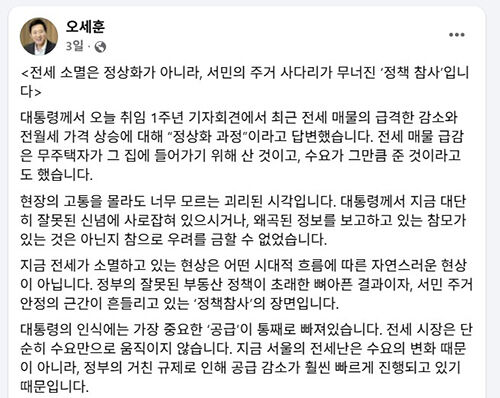
▲ A portion of Seoul Mayor Oh Se-hoon's social media post
In response, Mayor Oh argued, "The disappearance of *jeonse* is not a natural phenomenon, but a painful result caused by the government's misguided real estate policies," adding, "The *jeonse* crisis in Seoul is progressing much faster due to the government's excessive regulations, which are stifling supply."
The Ministry explained, "The shift to monthly rent is the result of long-term structural changes in the rental market, such as the increase in the proportion of single-person households and tenants' growing preference for monthly rent in the wake of *jeonse* fraud cases," adding that "the proportion of monthly rent in *jeonse* and monthly rent transactions in the metropolitan area is also continuously increasing."
The Ministry continued, "It is regrettable that the Seoul Metropolitan Government, which holds virtually full authority over housing supply permits including redevelopment and reconstruction projects, is shifting the blame for the current rise in rental prices solely onto the central government without considering this context."
The Ministry emphasized, "The government is striving to expand supply, such as by announcing a supply plan on September 7 last year that includes the construction of 1.35 million homes in the metropolitan area over the next five years," adding, "It is more important than anything else for local governments, including Seoul, and the central government to cooperate closely to expand housing supply with speed."
(Photo: Captured from Seoul Mayor Oh Se-hoon's social media, Yonhap News)
※ Please note: This article was translated by AI and may contain errors.

 Video News
 Video News
 Video News
 Video News
 Video News