
 KOR
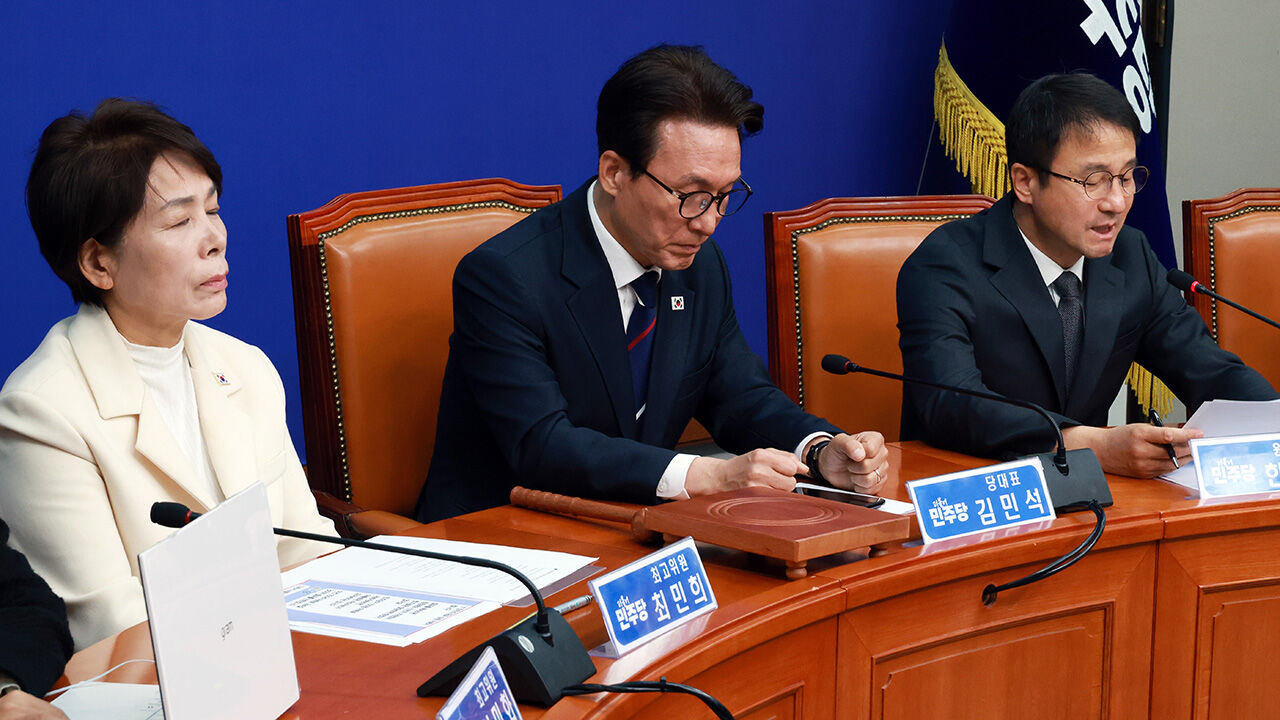
▲ Democratic Party of Korea Floor Leader Han Byung-do speaks during a Supreme Council meeting at the National Assembly on November 6.
Factional strife within the Democratic Party of Korea appears to be intensifying following the viewing of internal investigation findings regarding allegations of collective party enrollment by members of the Shincheonji religious sect.
While the pro-Lee Jae-myung party leadership highlighted that the investigation meaningfully confirmed related suspicions and focused on institutional improvements rather than internal infighting, the pro-Jung Chung-rae faction stepped up pressure for accountability, asserting that the probe proved groundless the so-called "three-way alliance between anti-Lee figures, divisionists, and Shincheonji" that Party Leader Kim Min-seok had raised against former Leader Jung during the party convention.
From today (November 6) through November 13, the Democratic Party began allowing incumbent lawmakers and regional committee heads to review the investigation findings into the Shincheonji allegations at the party's Secretary-General's office.
The party originally planned to report the investigation findings during a closed-door general meeting of lawmakers on November 3, but changed how the findings were shared to prevent escalating internal discord.
At the time, Leader Kim apologized for raising the Shincheonji allegations and canceled the briefing on the investigation results.
Following his apology the previous day, he reiterated on November 6, "I offer my apologies once again to everyone who was hurt and to all party members who love our party."
However, immediately after Leader Kim's remarks, Supreme Council Member Lee Sung-yoon, aligned with the pro-Jung faction, lashed out at mainstream leadership-aligned lawmakers who praised Kim's apology as a "decisive move."
"Some lawmakers distort the essence of the allegations as if the leader made a patriotic sacrifice, claiming he made a decision for the sake of the party and that suspicions about Shincheonji still remain," Lee said. "They are inflicting secondary harm on party members who are already hurt."
Supreme Council Member Choi Min-hee also joined in, stating, "The picture I hope for is that Leader Kim and former Leader Jung Chung-rae meet, discuss the issue in depth, and explain it to party members."
In this regard, former Leader Jung wrote on Facebook, "This is not some assault incident that happened while two people were drinking together," adding, "This is not an issue for a few lawmakers to collude and resolve in a backroom. The real victims are the voting party members and supporters."
The confrontation between the two sides escalated as they offered opposing interpretations of the reviewed materials.
The reviewed materials reportedly included regional figures for general and fee-paying party members cross-referenced between Shincheonji rosters and Democratic Party membership lists, along with testimonies from Shincheonji officials, indicating that roughly 10,000 party members, including around 8,000 fee-paying members, were Shincheonji followers.
In response, party leadership spokesperson Cho Gye-won said, "A considerable amount of data and testimonies were collected," adding, "There were quite meaningful figures, and the situation in South Jeolla, Gwangju, and North Jeolla was rather serious."
Spokesperson Cho emphasized the need for institutional safeguards to prevent religious groups from meddling in politics, stating, "It made me realize that religious organizations could institutionally intervene in a political party's democratic decision-making and election processes."
Defending Leader Kim, Cho added, "Conducting the review behind closed doors was the right choice. I could understand that Leader Kim made that judgment in this context, anticipating that it could trigger another enormous controversy."
On the other hand, members of the pro-Jung faction emphasized after reviewing the same materials that there was no evidence of a three-way secret alliance or organized Shincheonji intervention in the national convention.
Supreme Council Member Choi Min-hee wrote on Facebook, "The pro-Kim Min-seok faction acted as if there was something huge, but if that were so, shouldn't they avoid covering it up? There was no evidence of a secret alliance, and the number of Shincheonji fee-paying members was at a level that could easily be made public."
Supreme Council Member Han Min-soo pointed out, "There is no evidence that Shincheonji joined hands with anti-Lee factions and divisionists to systematically and collectively intervene in this August 17 national convention. There should be evidence showing who gave orders, how, how many people, at what point, and through what route they infiltrated the Democratic Party or systematically joined, but none of this was confirmed at all."
Regarding the scale of Shincheonji fee-paying members, Han asked, "Is that a number that could have influenced a specific candidate?" He then warned, "If lawmakers holding major party posts continue to speak as if Shincheonji systematically intervened in the party, imply connections to a specific politician, or suggest the 'three-way secret alliance' was not a false claim despite the party leader's apology, I will disclose the figures."
Lawmaker Lim O-kyeong said after the review, "It just makes me laugh. It has nothing to do with the party convention," adding, "It makes me angry that the task force prepared this as their report."
As factional conflict over the Shincheonji issue persisted, voices of concern emerged from within the party.
Five-term lawmaker Park Ji-won advised Leader Kim on Facebook the same day, saying, "Enough is enough, and I hope the party leader himself will no longer bring up the Shincheonji issue."
Park wrote, "The leader offered a necessary and sufficient apology at the general meeting of lawmakers and the Supreme Council, and Secretary-General Han Jeoung-ae is even making the investigation materials available for viewing," adding, "We cannot burn down the entire house to catch a flea. We must put the party before personal interests."
Lawmaker Jeong Seong-ho also appeared on MBC Radio on November 6 and said, "Should the ruling party, which is responsible for people's livelihoods, really be fighting each other over this [Shincheonji controversy]?" adding that Leader Kim and former Leader Jung must meet to settle the matter.
(Photo: Yonhap News)
※ Please note: This article was translated by AI and may contain errors.


 Video News
 Video News


 Video News