KOR
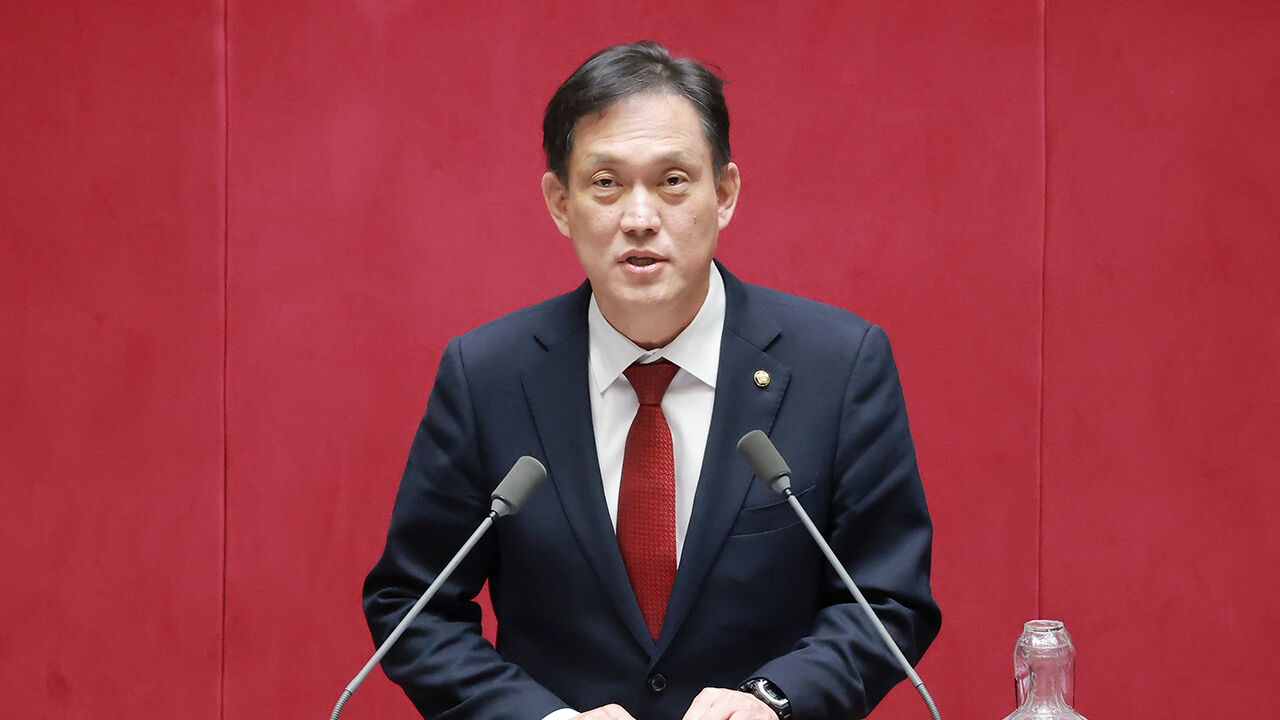
▲ People Power Party Representative Kim Tae-gyu
The National Assembly has passed a resolution urging the expulsion of People Power Party Representative Kim Tae-gyu, who sparked controversy over remarks deemed as "denying insurrection," led by the broader ruling bloc.
In a plenary session today (November 5), the National Assembly passed the resolution urging the expulsion of Representative Kim, with 166 in favor and one invalid vote out of 167 cast.
The People Power Party did not participate in the vote.
The resolution stated that Representative Kim violated a lawmaker's duty to uphold the Constitution and maintain dignity by remarking on a YouTube broadcast that the actions of former Presidents Chun Doo-hwan and Yoon Suk-yeol "were not insurrection."
Representative Cheon Jun-ho, senior deputy floor leader of the Democratic (MINJU) Party of Korea who sponsored the resolution, urged its passage during the plenary session, saying, "(Representative Kim) undermined the rule of law and made unconstitutional, outrageous remarks under the pretext of historical reassessment, even denying the Supreme Court ruling that finalized Chun Doo-hwan's conviction as the ringleader of insurrection through three trials."
Cheon added, "This is an anti-historical act that insults the victims and bereaved families of the May 18 Democratization Movement, who sacrificed themselves for the constitutional history and development of democracy in the Republic of Korea, inflicting secondary harm on them. Furthermore, it is a mockery of the people and the history of the Republic of Korea, seeking to divide public opinion by denying historical truth and judicial decisions while disseminating sophistry."
This marks the second time a resolution urging the expulsion of a lawmaker has passed a plenary session in the 22nd National Assembly.

Earlier in August, the Democratic (MINJU) Party also spearheaded the passage of a resolution in a plenary session urging the expulsion of People Power Party Representative Lee Jin-sook over controversy regarding the distortion of the May 18 movement.
However, to actually expel the two lawmakers, separate disciplinary motions must be passed in the plenary session.
Under current law, expelling a lawmaker requires the approval of at least two-thirds of all sitting members.
Along with this, the National Assembly also passed, led by the broader ruling bloc, a resolution to establish a "Special Committee on Mega-Regional Strategic Industrial Special Zones for Locally-Led Growth" to support three mega projects promoted by the government.
The vote result showed that out of 163 lawmakers present, 145 voted in favor, 10 opposed, and eight abstained.
While most People Power Party lawmakers did not participate in the voting, 10 lawmakers, including Kim Sung-won (WONI), Kim Seung-su, and Park Jeong-ha, cast dissenting votes.
Progressive Party lawmakers Yoon Jong-o, Jeong Hye-gyeong, and Sohn Sol, along with Basic Income Party lawmaker Yong HYEIN, were among those who abstained.
The resolution calls for establishing the Special Committee on Mega-Regional Strategic Industrial Special Zones within the National Assembly to review and process related legislation.
The special committee will consist of 18 members, including the chairperson: 10 from the Democratic (MINJU) Party, six from the People Power Party, and two from non-negotiating blocs (The Point Men).
Its operational period runs through January 31 of next year.
Although the People Power Party opposed the committee's formation starting from the standing committee review stage, it did not stage a filibuster (unlimited debate to lawfully obstruct proceedings) at the plenary session.
Earlier, the People Power Party had warned that it would launch a filibuster against all agenda items if the "Special Counsel Bill on Distorted Indictments" promoted by the Democratic (MINJU) Party was introduced to the plenary session.
However, the party decided not to conduct a filibuster against the resolution forming this special committee.
Mediation by National Assembly Speaker Cho Jeong-sik is reported to have played a role in this outcome.
Nonetheless, People Power Party Senior Deputy Floor Leader Kim Seung-su raised questions regarding procedural legitimacy during the opposition debate.
Regarding the special committee's composition, Kim argued, "The structure effectively secures a majority for the Democratic Party, laying the ground to process all bills unilaterally."
He also expressed the position that because the relevant legislation addresses matters overseen by various government agencies, including the Ministry of Trade, Industry and Energy and the Ministry of Land, Infrastructure and Transport, it should be discussed first within each relevant standing committee.
He went on to point out, "Does forming a special committee first while bypassing this process not mean an intention to incapacitate the deliberation functions and expertise of the existing standing committees?"
In response, Representative Jeon Eun-soo of the Democratic (MINJU) Party rebutted, "The Mega-Regional Special Zones Act genuinely requires discussions that transcend individual standing committees. The special committee is not a body that replaces the authority of existing standing committees, but rather a venue for cooperation to produce more complete legislation by bringing together the expertise of each committee."
Regarding the committee's composition, Jeon also stated, "As a matter of principle, it is based on the number of seats, and the composition ratio likewise presents no problem because it will consist of members with relevant expertise."
(Photo: Yonhap News)
※ Please note: This article was translated by AI and may contain errors.



 Video News

 Video News