
 KOR
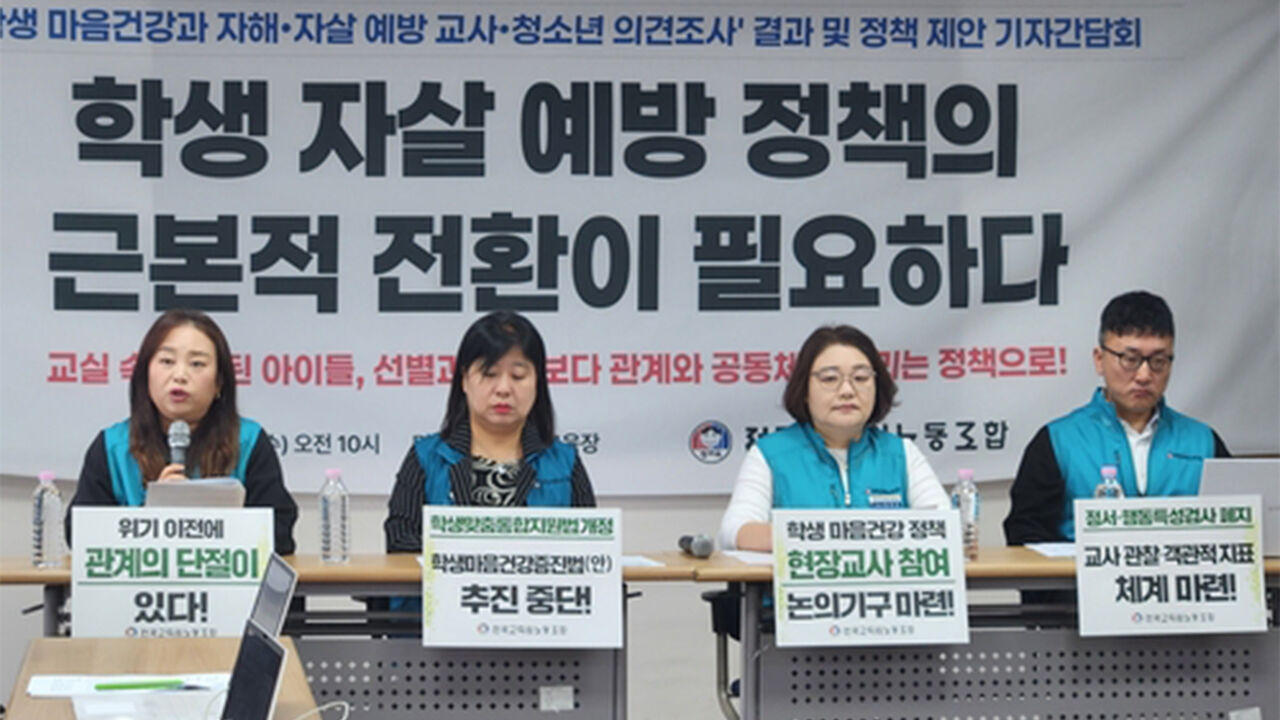
▲ Results of the Korean Teachers and Education Workers Union's survey on student mental health and prevention of self-harm and suicide among teachers and students
One out of seven middle and high school students frequently experiences disruptions in their daily lives due to emotional difficulties, and the rate of feeling isolated at school among these students was found to be more than five times higher than that of others, a survey showed.
In particular, as there is a significant difference in the degree of emotional distress depending on whether students feel isolated at school—even when facing heavy academic stress—experts point out that student mental health measures should focus not only on academic pressure but also on the issue of severed relationships.
The Korean Teachers and Education Workers Union (KTU) announced the results of the "Survey on Teachers' and Students' Opinions on Student Mental Health and Prevention of Self-Harm and Suicide" at the Korean Confederation of Trade Unions education hall in Jung-gu, Seoul, on November 4.
The online teacher survey, conducted from October 15 to 27, involved 1,017 teachers and educators from elementary, middle, high, and special schools, as well as education (support) offices and Wee Centers nationwide. The student survey, conducted from October 13 to 27, gathered responses from 3,414 middle and high school students across the country.
Notably, in the survey targeting students, 14.4% reported that they "frequently" or "almost daily" suffered from emotional distress that made everyday life difficult over the past month.
Classifying these students as those "experiencing significant emotional distress," the KTU analyzed that isolation within the school environment has a greater impact on creating at-risk students than academic grades do.
Among students facing severe emotional difficulties, 30.4% reported frequently feeling alone at school, which is 5.6 times higher than the isolation rate of "other students."
When asked about the factors that make them struggle to the point of wanting to give up on life (multiple choices allowed), pressure from entrance examinations and grade competition ranked high at 73.6%, followed by career anxiety at 69.1%.
However, among students who worried heavily about grades and studying but did not feel alone at school, 20.6% experienced difficulties severe enough to disrupt their daily lives. In contrast, for students who frequently or almost daily felt alone at school, this proportion surged to 57.9%.
Additionally, 38.7% of students who did not worry much about grades but felt isolated suffered from difficulties in their daily lives.
On the other hand, when students had a trustworthy adult at school or friends to share their innermost feelings with, the proportion of those experiencing daily life difficulties dropped to just 8.7%.
In this regard, the KTU emphasized, "While academic stress can heighten emotional distress, the biggest dividing line for crisis is isolation and severed relationships. We need to move away from the paradigm that 'students commit suicide because of academic stress' and implement measures focused on isolated students in crisis."
※ If you or someone you know is struggling with depression or other difficult concerns, professional counseling is available 24/7 through the suicide prevention hotline (109) or the suicide prevention social media counseling service 'Madlen'.
(Photo provided by KTU, Yonhap News)
※ Please note: This article was translated by AI and may contain errors.





 Video News
 Video News