
 KOR
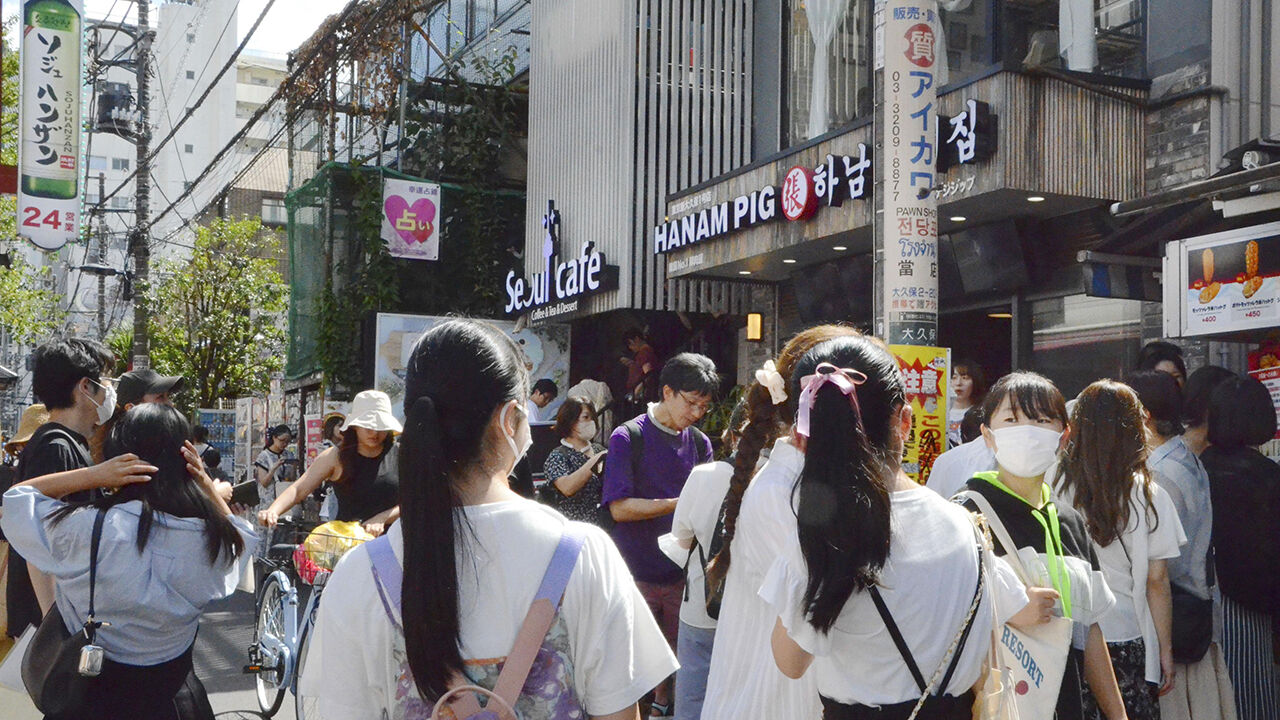
▲ Japanese youths visit Shin-Okubo, the Korea Town in Tokyo, Japan
In a Japanese TV car commercial, a model naturally says "gwaenchanayo" (it's okay) in Korean, and in a Japanese drama, a male lead casually delivers lines in Korean.
Instances of local Generation Z using Korean words or slightly modified versions in Japanese pop culture, commercials, and everyday conversations are on the rise.
This reflects the spreading phenomenon of "Hanbon-eo," a newly coined term combining the Korean and Japanese languages.
The U.S. daily The New York Times highlighted this trend in an article on November 1 titled "The Surprising Origin of Japan’s New Slang: Korean."
Comparing it to the history of about 100 years ago during the Japanese colonial period when the Korean language was suppressed, The New York Times reported that the increase in Korean language usage in Japan today is evidence of the global appeal of South Korean culture.
The analysis suggests that thanks to the success and influence of South Korean culture, including K-pop, K-dramas, and K-beauty, the Korean language has deeply permeated the culture of Japan's younger generation.
The New York Times pointed out that starting around 2018, when BTS and BLACKPINK sparked a global craze, a clear tendency emerged among Japanese youths to accept and enjoy the Korean language without reluctance.
Moeka Takamatsu, a university student and K-pop fan living in Tokyo, told The New York Times that she frequently mixes Korean words like "진짜" (jinjjja - really) and "미안해" (mianhae - sorry) into her daily conversations.
She stated, "I don't know anything about South Korea, but because it's trending on social media, I find myself using the word 'gwaenchanayo' (it's fine) a lot."
Experts attribute this background to the low linguistic barriers, noting that the phonological systems of Korean and Japanese are similar and the two countries are geographically close.
In particular, during the COVID-19 pandemic, increased time spent staying at home led to greater opportunities to encounter South Korean content.
In addition, because Japanese lacks exact equivalents for terms of address like "hyung" (older brother for males) and "unnie" (older sister for females), people have imported and widely used them as they are in Japan.
Choi Eun-kyung, a professor in the Department of Korean Language at Kansai University in Japan, said, "Korean has become a language that anyone can easily use, even if they are not of Korean descent," explaining that using Korean is "a way of expressing affection for K-pop and K-culture."
(Photo: Yonhap News)
※ Please note: This article was translated by AI and may contain errors.


 Video News

 Video News
 Video News
 Video News