
 KOR
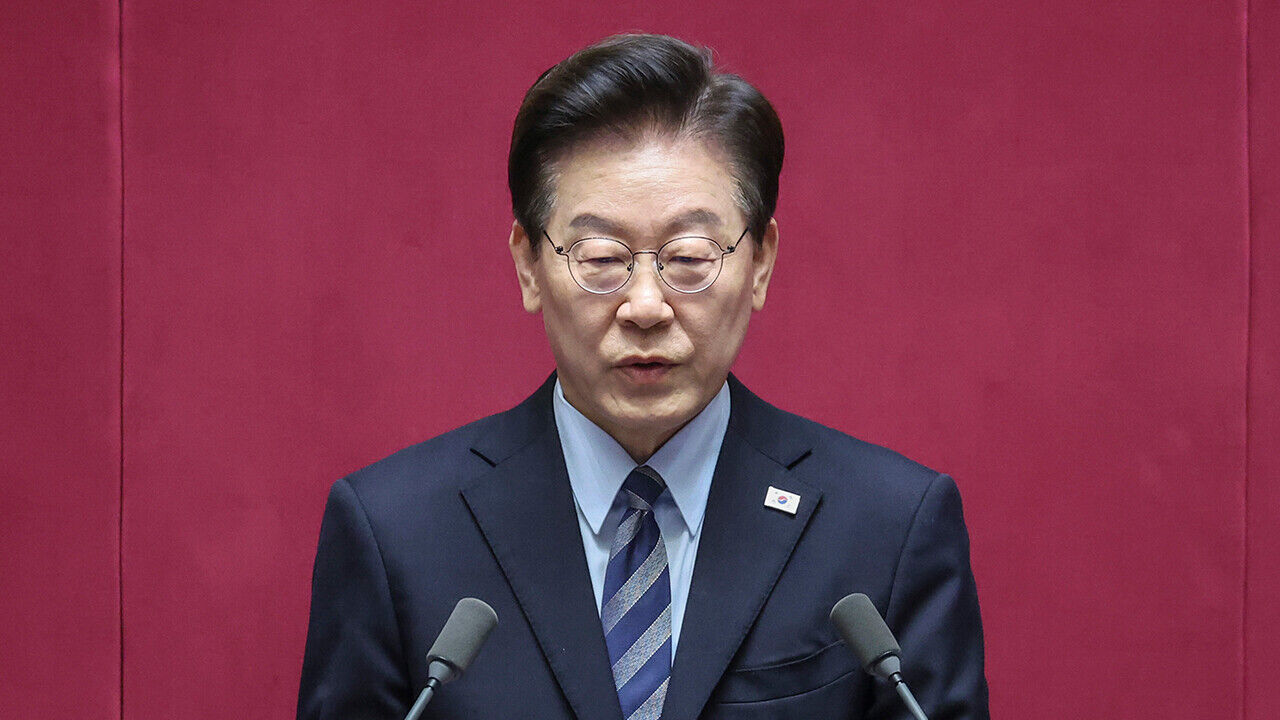
▲ President Lee Jae-myung delivers a budget speech for fiscal year 2027 at the National Assembly on November 2.
President Lee Jae-myung said today (November 2), "We must make a great transition from 'growth for the few,' where the opportunities and fruits of growth are concentrated in specific regions, classes, and a small number of corporations, to 'growth for all,' where every region and all citizens evenly enjoy the opportunities and outcomes of growth."
Delivering an address on next year's budget bill at the National Assembly that day, President Lee stated, "To overcome the limitations of 'K-shaped growth,' in which inequality and polarization deepen, we must move beyond the outdated dichotomous debate between growth and distribution and apply a new growth formula suited to changed times and circumstances."
Addressing the administration's economic achievements over the past year and five months, President Lee assessed, "Through two supplementary budgets and an expansionary main budget, the government strengthened the proactive role of fiscal policy and protected our economy and people's livelihoods from the shock of the Middle East war. As a result, our economy continues a distinct V-shaped recovery."
Specifically, he explained, "Forecasts suggest our potential growth rate will rebound for two consecutive years for the first time in some 40 years, and achieving $1 trillion in annual exports has come into view. Per capita gross national income is also projected to surpass $40,000, making South Korea the world's sixth nation with a population of 50 million or more to enter the '50-40 Club.'"
He continued, "Next year, all public funds injected during the foreign exchange crisis will be repaid, completing the overcome of the IMF crisis after 30 years," expressing gratitude by adding, "This is a precious accomplishment achieved together by the National Assembly, which cooperated proactively amid compound crises, and by the citizens, business leaders, and workers who gave their all."
Still, President Lee noted, "Despite these achievements, a deep shadow of inequality and polarization still hangs over our society. The barrier to first jobs for young people remains high, the worries of small business owners run deep, and the recovery of regional economies is sluggish. It is time to answer the question: What is the point of the nation's economy improving if my life does not get better?"
He also stressed the need to focus on resolving polarization, saying, "We must build a country where not only Seoul and the capital area prosper, but regional areas thrive together as well—a country where opportunities, not just the results of growth, are given to everyone."
Mentioning the three major livelihood projects pursued by the government—job creation, finance for low-income citizens, and housing stabilization—President Lee called them "the first step toward realizing" the resolution of polarization, projecting that "the 'Three Mega Projects' and 'Seven Seeds' will also achieve even greater impact built upon the foundation of these three livelihood projects."

Meanwhile, President Lee characterized next year's budget bill as "a future-securing budget aimed at creating a leading nation aspiring to an irreplaceable Republic of Korea, as well as a growth-diffusing budget that links national growth to people's growth," saying, "It will lay the foundation for a great leap forward and allow the opportunities and fruits of growth to be shared evenly."
During this, he also emphasized the importance of launching the Future Response Fund and deploying surplus tax revenues.
President Lee said, "The newly established Future Response Fund is a strategic investment platform that supports a rebound in potential growth and an innovative fiscal stabilization device that copes with widening volatility in tax revenue." He added, "We will concentrate investments from the surplus tax revenues secured through national efforts into four pillars: youth, future growth engines, regions, and education and talent."
He added, "By using surplus funds to reinforce fiscal capacity during tax revenue shortages, we will prepare for the worst-case scenario of having to cut spending in recessions when the role of fiscal policy is most urgent, while also helping stabilize the market by curbing new issuances of government bonds."
He also introduced three principles of budget formulation.
President Lee stated, "We formulated the budget on the principles of investing boldly without wasting on inefficiencies, prioritizing fiscal expenditure over tax expenditure, and favoring regional areas for balanced national development," adding, "Accordingly, we reexamined all projects from scratch."
He continued, "We carried out vigorous expenditure restructuring totaling 107.2 trillion won across 6,476 projects, including the abolition of some 2,100 projects, and converted 1.9 trillion won in tax expenditures into direct fiscal support. We also substantially increased regional preferential projects that provide greater support the farther an area is from the capital region."
President Lee said, "Next year's total spending is 820.9 trillion won, up 12.8% from this year, marking the highest growth rate on record and the largest-ever fiscal investment. Befitting the economic achievements we have made, we enlarged the scale of government spending to simultaneously elevate the standard of living citizens should enjoy and the nation's future capabilities."
In addition, he added, "The fiscal fundamentals are also growing stronger. The national debt-to-GDP ratio will decline from 51.6% to 48.3%, and international organizations and major credit rating agencies are evaluating the improvement in fiscal balance and the role of the Future Response Fund very positively. This demonstrates trust in our fiscal management."
(Photo: Yonhap News)
※ Please note: This article was translated by AI and may contain errors.


 Video News

 Video News
 Video News
 Video News