
 KOR
⚡ Quick Summary
The Tesla Roadster Rocket model incorporates SpaceX's high-velocity compressed air thruster technology to execute mid-air flips and brief flight maneuvers.
Ground vehicles are heavy due to safety structures and have low flight efficiency, presenting fundamental physical and aerodynamic hurdles in developing a flying car.
To address worsening urban traffic congestion costs, the Urban Air Mobility (UAM) market—centered on electric vertical takeoff and landing (eVTOL) aircraft that require no runways—is growing rapidly worldwide.
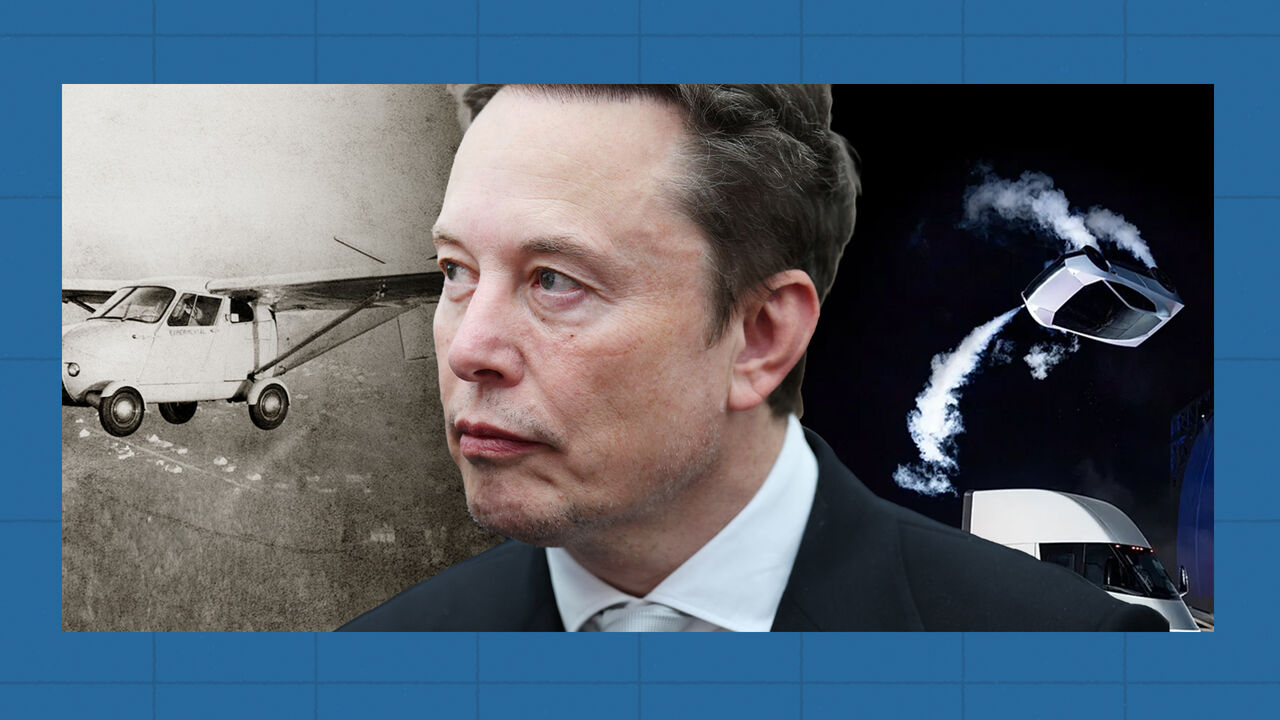
Last week, Tesla's Roadster undoubtedly dominated YouTube and the news. On October 15, Elon Musk unveiled a Roadster prototype at a Tesla event. Hanging upside down from an inclined structure, spinning in mid-air before landing on the ground, and even executing flips over vehicles—he literally showed us a flying car in the Roadster.
In fact, the Roadster can be considered a love-hate vehicle for Tesla. The first-generation Roadster, sold from 2008 to 2012, garnered considerable attention despite its steep price tag of over $100,000. What drew consumers' interest was that it was a high-performance electric sports car, a rarity at the time.

Then came the long-awaited second generation. Although it was revealed in 2017, nine years ago, production delays persisted. When it was unveiled in 2017, Tesla announced it would launch in 2020, but the release date kept getting pushed back. The second-generation Roadster was not released in 2021, nor in 2022. Prominent American tech YouTuber Marques Brownlee even commented on this in 2022.

First, the most affordable Performance model is a street-legal two-seater vehicle. It is equipped with an underbody fan that was used in the mid-air suspension demonstration.
Next is the Thrust model, designed for circuit driving. In addition to the underbody fan, rear gas thrusters are added to enhance acceleration performance.

Tesla actively applied technologies used by SpaceX to this Roadster. You have probably seen spacecraft firing gas thrusters to change direction or adjust orientation. That high-velocity compressed air thruster system is applied to the Roadster Rocket model. From Elon Musk's perspective, he proactively combined the technologies at his disposal into an automobile.
While it might seem that such tremendous cutting-edge technology is required for a car to fly, the emergence of flying cars in human history actually happened much earlier than one might think.
In 1783, the Montgolfier brothers of France built the first hot air balloon. In 1804, the steam locomotive emerged, marking the beginning of modern railway history.

And in 1903, the Wright brothers succeeded in the first powered flight in human history, ushering in the true era of airplanes. Since then, human aviation technology has advanced at an extraordinary pace. In 1947, an aircraft broke the sound barrier; in 1957, the first artificial satellite was launched; and in 1961, the first crewed spacecraft took flight. In 1969, humanity even set foot on the moon.

'Flying Cars' Dreamed of for a Century
Let us travel back to Paris, France, in April 1900. Here, the Paris Exposition was held to wrap up the 19th century and welcome the upcoming 20th century. How did people back then imagine life 100 years later—in the year 2000?

Seventeen years after this illustration was drawn, serious attempts to build a flying car began. In 1917, American inventor Glenn Curtiss invented a flying car called the Autoplane. Being a car, it had an enclosed cabin and wheels; being a plane, it had wings and a rear propeller. However, because the body was too heavy for its engine output, it failed to achieve success.
In 1937, the 'Aerobile,' built by American inventor Waldo Waterman, made its debut. Waterman succeeded in making the first test flight with the Aerobile. Although he created the world's first practical flying car, it once again failed to win over consumers, with production stopping at just five units. Later attempts followed, such as the Airphibian in 1946 and the Aerocar in 1949, but none reached commercialization.
In fact, if the goal is to travel by air, one could simply take an airplane. Why, then, do we strive to build flying cars? Airplanes have inherent limitations: specifically, the need for infrastructure such as runways and airports. By contrast, a car can be boarded right in front of one's home. What if roads and skies could be seamlessly connected? Convenience in mobility would improve dramatically. It was precisely this potential that drove countless inventors to take on the challenge.

A car operating on the ground must possess certain essential elements. For instance, for passenger safety, it requires safety structures to absorb impact energy in a collision. It also needs pillars to sturdy the body and roof, preventing the roof from collapsing in a rollover accident. In addition, there are many basics to equip, such as suspension systems, brake discs, and differential gears. Inevitably, weight must increase.
What about airplanes? An airplane must make every component of its airframe as light as possible so that it can fly more efficiently. In the end, outfitting a vehicle with all the safety structures required for an automobile adds weight, which inevitably reduces flight efficiency.
There are also conflicting aerodynamic factors. Ground vehicles are shaped to generate downforce so that the body does not lift off at high speeds. Conversely, airplanes are designed to generate lift to raise the aircraft. When considering a car, downward force is needed; when considering an airplane, upward lifting force is required.
Despite these daunting challenges, flying cars continue to be built. Companies like PAL-V and Alef are pursuing flying car projects to this day.
Yet the reason flying cars are drawing renewed attention today is not merely because of humanity's long-held dream. It is because ground transportation networks are increasingly running up against their limits. As people flock to major cities, car numbers grow accordingly. However, roads cannot be expanded indefinitely. Ultimately, as more cars crowd onto limited roads, traffic congestion worsens.
The resulting social costs are also far too significant to ignore. There is an indicator known as traffic congestion cost, which represents the socioeconomic losses caused by road congestion. In the United States, drivers wasted an average of 49 hours in traffic jams last year. This resulted in a congestion cost of $894 per driver. Looking at the U.S. as a whole, the annual traffic congestion cost in 2025 reached a staggering $85.8 billion—exceeding 113 trillion Korean won.
South Korea's traffic congestion costs are also substantial.

As the social costs of ground traffic congestion mount, efforts to break away from a transportation system reliant solely on roads and create new travel routes in the sky are gaining traction. This is 'Urban Air Mobility' (UAM).
Opening the Skyways... The Start of an 'Air Taxi' War?
Urban Air Mobility, as the term implies, is a concept to transport passengers and cargo using an aerial transportation system within urban areas. It can extend beyond intra-city travel to inter-regional transit as well.
There are various ways to utilize the skies. As examined earlier, flying cars that travel on both roads and in the air represent one approach.
However, some companies take a slightly different approach: focusing entirely on air travel rather than attempting to make a car fly. Let us consider the requirements for flying within a city. First, it must be able to operate without expansive infrastructure such as runways. Furthermore, operating in densely populated downtown areas demands lower noise and emissions.

Since ground traffic congestion is not unique to any single country, many nations are pursuing UAM policies and the development of eVTOL aircraft. The United States began preparations as early as 2020 by drafting operational guidelines for UAM. Companies such as Joby Aviation and Beta Technologies have entered the electric aircraft development space.
The same holds true not only for the U.S., but also for Europe and South Korea. South Korea also established a UAM roadmap in 2020, and in July this year, it unveiled its first domestically developed UAM aircraft.
Although the market has not yet opened in earnest, expectations for its future growth potential are exceedingly high.

While many countries are jumping into the UAM market, one country has taken the earliest step toward actual commercialization: China. Just as China is strong in electric vertical takeoff and landing drones, its prowess in the UAM market is substantial. As covered in a previous drone delivery episode, China began fostering its 'low-altitude economy' at the national level in 2021.

China has already entered commercial operations in the air taxi sector ahead of the United States. There is a company called EHang. Beyond mere test flights, EHang's uncrewed air taxi has secured commercial operating certification to carry passengers and charge fares. Of course, this is not a large-scale air taxi network used for daily commutes; at present, it remains at the level of experiential sightseeing flights that depart from and return to designated areas.
Then what about Tesla's Roadster? Could the Roadster also become a future air taxi? In some quarters, the recent demonstration has sparked speculation that Tesla might be entering the UAM market. However, there are still many obstacles to viewing the Roadster as a form of transit like an air taxi.

Tesla made a car leap into the air, while other companies are creating entirely new airborne transportation modes. Although aiming for the same sky, they are challenging the future of mobility in different ways. The dream of a flying car has endured for more than a century. Will the day come first when the familiar automobile takes to the sky, or will drone-like air taxis become our new mode of transportation? That is all for today's OhGraph. Thank you very much for reading this long piece to the end.
References
- Tesla | YouTube
- Timeline of Flight | Library of Congress
- Lost Futures: A 19th-Century Vision of the Year 2000 | The Public Domain Review, 2012
- Waterman Aerobile | Smithsonian National Air and Space Museum
- Taylor Aerocar III | The Museum of Flight
- Traffic Is Back: Insights from the 2025 INRIX Global Traffic Scorecard | INRIX
- 2025 National Transport Policy Evaluation Indicator Project Vol. 3 Traffic Congestion Costs (2023) | The Korea Transport Institute
- Advanced Air Mobility & eVTOLs | Federal Aviation Administration
- Korean Urban Air Mobility (K-UAM) Roadmap
- eVTOL/Urban Air Mobility TAM Update: A Slow Take-Off, But Sky's the Limit | Morgan Stanley
- Outline of the National Comprehensive Multidimensional Transportation Network | Ministry of Transport of the People's Republic of China
Written by: An Hye-min Design: Ahn Jun-seok Intern: Shin Yeon-seong
※ Please note: This article was translated by AI and may contain errors.


 Video News
 Video News
 Video News
 Video News
 Video News