
 KOR
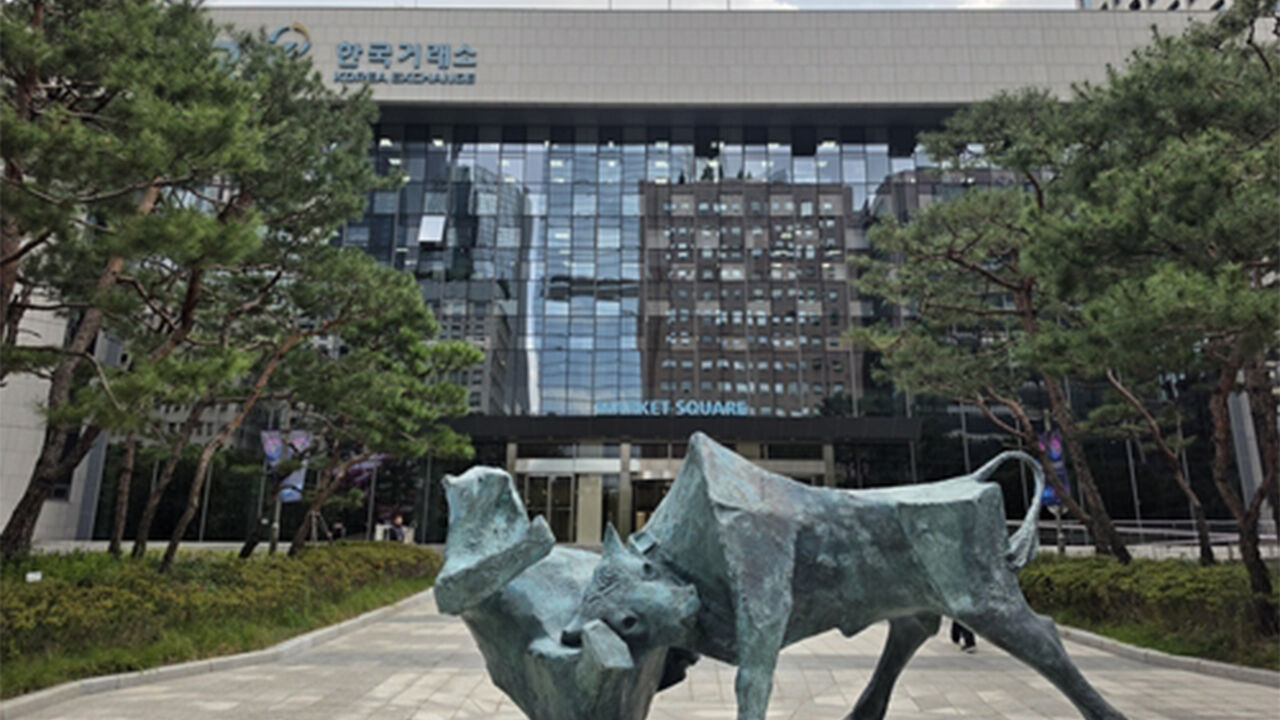
▲ Korea Exchange
The Korea Exchange (KRX) released a list of 151 companies on November 1 that have remained in the lower tier of price-to-book ratios (PBR) by sector on the domestic stock market over the past three years, initiating efforts to encourage corporate value enhancement.
This move aims to pressure companies to boost their corporate value by publishing the list of low-PBR firms to shareholders and investors through a "naming and shaming" approach.
The exchange plans to provide customized consulting for all the low-PBR companies on the newly released list to help drive substantial improvements in their PBRs.
The low-PBR companies unveiled by the exchange on this day total 151 firms, consisting of 96 from the Kospi market and 55 from the Kosdaq market.
While 185 companies met the low-PBR criteria—115 on Kospi and 70 on Kosdaq—34 firms that disclosed corporate value-up plans, including PBR improvements, by October 22 were excluded from the published list.
A simple average of the PBRs for these companies stands at approximately 0.25x, a stark contrast to the average PBR of listed companies on the domestic market, which is around 1.8x.
PBR is the ratio of a stock's price to its book value per share (BPS), and a figure below 1x means that a company's market capitalization falls short of its liquidation value.
This is interpreted as a sign that the market valuation relative to assets is excessively low.
Companies become subject to public disclosure as low-PBR firms if their PBR fell into the bottom 25% for Kospi or the bottom 10% for Kosdaq by GICS industry classification for six consecutive half-years or six out of the past seven half-years.
The list of these companies can be found on the Value-up Page within the exchange's KIND (Korea Investment Network for Disclosure) system, and brokerage trading systems will also display a "Low PBR" tag for the corresponding stocks.
The disclosure period runs from November 2 until May 4 of next year, which is the next announcement date.
The exchange discloses the list of low-PBR companies every May and November.
Looking at the Kospi disclosure list first, it included major firms with market capitalizations exceeding 1 trillion won, such as Hyundai Steel (PBR of 0.19x as of October 22), Hanwha Life Insurance (0.27x), Lotte Shopping (0.17x), Lotte Chemical (0.18x), and E-Mart (0.15x).
By sector, the materials sector, which has a large number of companies, had 23 firms disclosed, including Korea Wire, Dongil Industries, SeAH Holdings, Young풍, and Taekwang Industrial. They were followed by industrials with 22 firms, such as LX Holdings, Pan Ocean, Kolong, and Hanjin, and consumer discretionary with 18 firms, including Nexen, Lotte Himart, and Ilshin Spinning.
Additionally, 12 companies in the consumer staples sector, including Nongshim Holdings, Samyang Sa, Crown Haitai Holdings, HiteJinro Holdings, and Hyundai Corporation Holdings, were included on the list.
Looking at the sectoral averages of their PBRs, the real estate sector was the lowest at 0.11x.
Utilities (0.25x), consumer discretionary and materials (0.27x each), and energy (0.28x) fell below 0.3x, while information technology (0.63x) and healthcare (0.51x) exceeded 0.5x.
On the Kosdaq market, listed companies with market capitalizations exceeding 100 billion won, such as KCC Construction, Wonik, Spigen Korea, Korea Capital, Dongwon Development, IDIS Holdings, Sunkwang, and Daehan New Pharm, were also placed on the list.
By sector, 17 companies were disclosed in the information technology sector, including Mobase, Sejoong, and HK, while industrials such as Nexturn Bio, Seohan, and Shinwon C&C, and healthcare firms such as Kyung Nam Pharm, Sama Pharmaceutical, and KM had 10 companies each.
The sectoral PBR averages were lowest in real estate and energy (0.17x). Except for consumer discretionary (0.25x) and materials (0.28x), sectors like industrials, consumer staples, financials, and communication services (0.31x each) all exceeded 0.3x.
Healthcare recorded the highest at 0.51x.
Companies that disclose a low-PBR improvement plan up to seven trading days before the list disclosure are exempt from being published for one year.
However, companies that meet the low-PBR criteria for 12 consecutive half-years or 12 out of 13 half-years are included on the list even if they disclose a plan.
A total of 62 companies—34 on Kospi and 28 on Kosdaq—disclosed improvement plans by October 22. Excluding 15 companies that were ineligible for the disclosure exemption, the rest were left off this list.
Among them, 13 companies no longer fell under the low-PBR category.
The exchange plans to support all companies unveiled this time with 1:1 customized PBR improvement consulting starting next year, helping them analyze the causes of low PBR, set targets, and establish plans.
The exchange explained, "Some companies were unable to submit improvement plans because they faced difficulties in accurately diagnosing the causes of their low PBR or devising concrete improvement measures, even though they could have been excluded from the disclosure target by submitting a PBR improvement plan."
It emphasized, "We plan to closely analyze the causes of low PBR for each company, suggest improvement measures tailored to corporate characteristics—such as enhancing capital efficiency, expanding shareholder returns, and improving corporate governance—along with domestic and overseas best practices, and support them all the way through setting concrete targets and establishing execution plans."
Furthermore, the exchange plans to encourage active shareholder engagement activities by institutional investors who have invested in low-PBR companies.
The Financial Services Commission is pushing to revise stewardship code guidelines and discover best practices to promote shareholder engagement by institutional investors in low-PBR companies.
The exchange stated, "Institutional investors also need to more actively engage in corporate value enhancement from the perspective of fiduciary duty," adding, "We plan to closely monitor whether substantive engagement—such as actual dialogues with management, demands for improvement, and the exercise of voting rights—actually takes place moving forward."
(Photo: Yonhap News)
※ Please note: This article was translated by AI and may contain errors.


 Video News
 Video News
 Video News
 Video News
 Video News