
 KOR
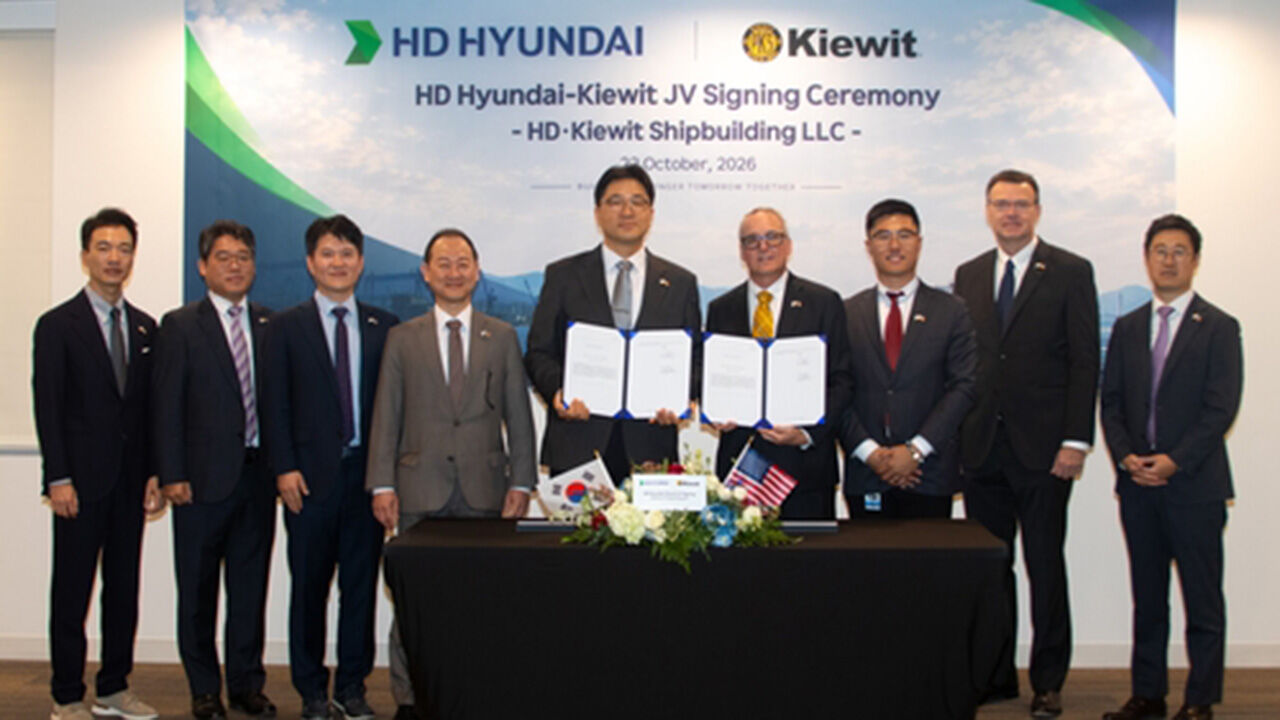
▲ HD Hyundai announced on October 23 that it signed an agreement with Kiewit, the largest U.S. construction, engineering, and infrastructure company, on October 22 (local time) to establish a shipbuilding joint venture in Houston, Texas.
HD Hyundai announced that it is currently discussing order volumes with the U.S. Navy regarding its planned joint venture shipyard in the United States.
"The scale of our local U.S. investment will be determined by how much volume we can secure," said Jung Woo-man, Senior Vice President of the Naval and Medium-Sized Ship Planning Division at HD Hyundai Heavy Industries, during the Q3 earnings conference call for HD Korea Shipbuilding & Offshore Engineering (KSOE) today (October 28).
"We are having detailed discussions with the U.S. administration and the Navy regarding the volume we can secure moving forward," Senior VP Jung explained. "We are initially targeting orders for auxiliary vessels such as product tankers and roll-on/roll-off (Ro-Ro) ships from the U.S. Navy or the Maritime Administration (MARAD), while warships require further discussion."
Product tankers are oil tankers capable of supplying fuel and cargo to auxiliary ships at sea, while Ro-Ro ships are cargo vessels that allow wheeled cargo to be driven on and off the ship under its own power.
This is interpreted as prioritizing auxiliary vessels in consideration of the stricter local procurement requirements for combatants.
Regarding the decision to build a local shipyard, Senior VP Jung said, "We kept in mind that we cannot secure business opportunities without establishing a local production base," adding, "We also factored in the U.S. administration's statement that the Finland model could be applied exclusively to foreign shipyards making local investments."
The Finland model refers to a case where an exemption was applied to the Burns-Tollefson Amendment—which in principle bans the foreign construction of U.S. military vessels—allowing U.S. icebreakers to be built in Finland.
HD Hyundai also formalized its intention to participate in the government's nuclear-powered submarine development project.
It is projected to compete for orders against Hanwha Ocean, forming a duopoly in the domestic specialized ship market going forward.
"A special bill for nuclear-powered submarines has been submitted to the National Assembly, and we expect initial projects to kick off starting next year," said Choi Tae-bok, Senior Vice President of the Naval and Medium-Sized Ship Business Division at HD Hyundai Heavy Industries. "We are preparing to participate in the project."
"Given the nature of the project's duration and scale, there is a limit to what a single company can handle, and the focus is shifting toward mobilizing total national capabilities," Senior VP Choi said. "We plan to propose to the government that not only shipyards but also system integrators participate together."
In the commercial shipping sector, the company projected that solid performance would continue beyond this year.
"Global newbuilding markets from January to September this year recorded historic order volumes, surpassing the level of the same period in 2007, which recorded the previous maximum order volume," said Kim Kwang-woo, Senior Vice President of the Strategic Marketing Division at HD Korea Shipbuilding & Offshore Engineering. "Global newbuilding investments approached last year's annual level by the third quarter."
He added, "Next year's newbuilding market will decrease compared to this year, but it will still maintain a solid trend compared to typical years," and forecasted, "Even if the war in the Middle East ends, expectations that the current supply chain disruption will become the new normal mean that changes in maritime cargo traffic will not easily occur."
Meanwhile, regarding the wage increase agreed upon this year, HD Korea Shipbuilding & Offshore Engineering stated, "75% of the additionally incurred costs were reflected in advance during the third quarter, and the remainder is scheduled to be partially reflected in the fourth quarter."
(Photo provided by HD Hyundai, Yonhap News)
※ Please note: This article was translated by AI and may contain errors.


 Video News
 Video News
 Video News
 Video News
 Video News