
 KOR
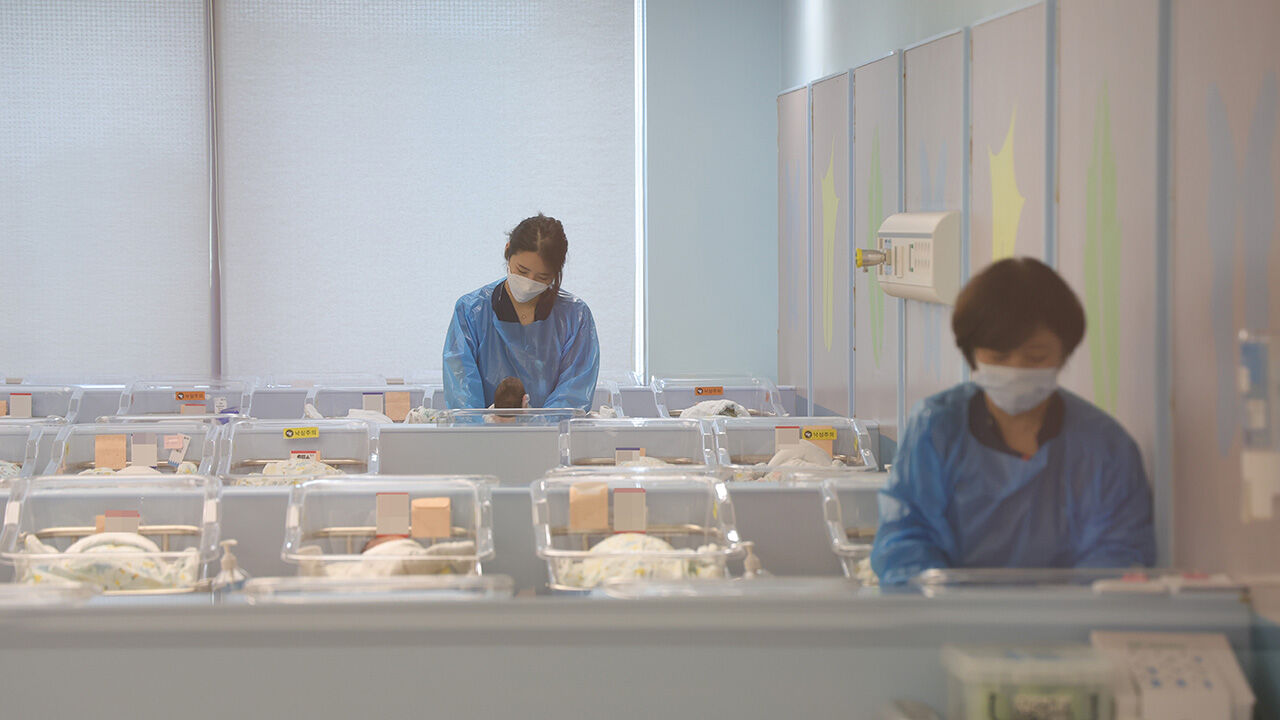
▲ Nurses care for newborns in the neonatal unit at CHA Bundang Medical Center, CHA University, in Ilsandong-gu, Goyang, Gyeonggi Province, on the afternoon of July 29. (Photo: Yonhap News)
The number of babies born in August reached its highest level for the month in seven years.
With the number of newborns steadily increasing, the cumulative number of births for this year has also neared the 200,000 mark.
According to the August Population Trends released by the Statistics Korea today (the 28th), the number of newborns in August stood at 23,703, up 13.0% from a year earlier.
This is the highest figure for August since 2019, when 24,371 babies were born.
Following 2019, the number of newborns in August steadily declined through 2023, even dropping below 20,000.
However, figures have rebounded for three consecutive years starting in 2024, continuing through last year and this year.
Notably, the newborn growth rate for August this year recorded 13.0%, marking the second highest on record following the 17.6% surge in 2007, the Year of the Golden Pig.
The cumulative number of newborns from January to August this year reached 193,783, the highest since 2019 when 208,018 babies were born.
Surging 14.5% from 169,211 during the same period last year, it recorded the highest growth rate on record.
The steady rise in newborns appears to be driven by a recent upward trend in marriages and the population in their 30s, coupled with positive shifts in public perception regarding childbirth.
The total fertility rate for August, which represents the average number of children a woman is expected to have over her lifetime, stood at 0.87, an increase of 0.09 from a year earlier.
As the upward trend in newborn numbers continues, attention is focusing on whether the annual total fertility rate can recover to the 0.90 mark this year.
Looking at the composition of newborns by birth order, first-born children accounted for 63.8%, expanding by 1.6 percentage points.
Conversely, second-born children dropped 1.0 percentage point to 30.5%, while third-born and higher children contracted by 0.6 percentage points to 5.7%.
The number of marriages, a leading indicator of childbirth, stood at 19,218, down 1.2% from a year earlier.
This marks the first decline in the number of marriages in three months, following a 6.4% decrease last May.
However, the cumulative number of marriages from January to August this year reached 165,874, up 5.2% from the same period last year.
By region, marriages increased in 13 cities and provinces, including Daejeon and Ulsan, while decreasing in 3 regions, including Gyeonggi and Sejong.
The number of divorces stood at 7,510, a 4.4% increase from a year earlier.
Divorces increased in 11 cities and provinces, including Ulsan and Busan, but decreased in 5 regions, including Sejong and North Gyeongsang Province.
The number of deaths in August was 30,308, up 4.9% from a year earlier.
By region, deaths increased in 13 cities and provinces, including Sejong and Daegu, while decreasing in only 3 regions, including Daejeon and North Gyeongsang Province.
As deaths outnumbered newborns, the population experienced a natural decline of 6,605 in August.
The population increased naturally in only 4 cities and provinces, including Sejong and Gyeonggi, while declining naturally in 12 regions, including North Jeolla Province and North Gyeongsang Province.
(Photo: Yonhap News)
※ Please note: This article was translated by AI and may contain errors.


 Video News
 Video News
 Video News
 Video News
 Video News