
 KOR
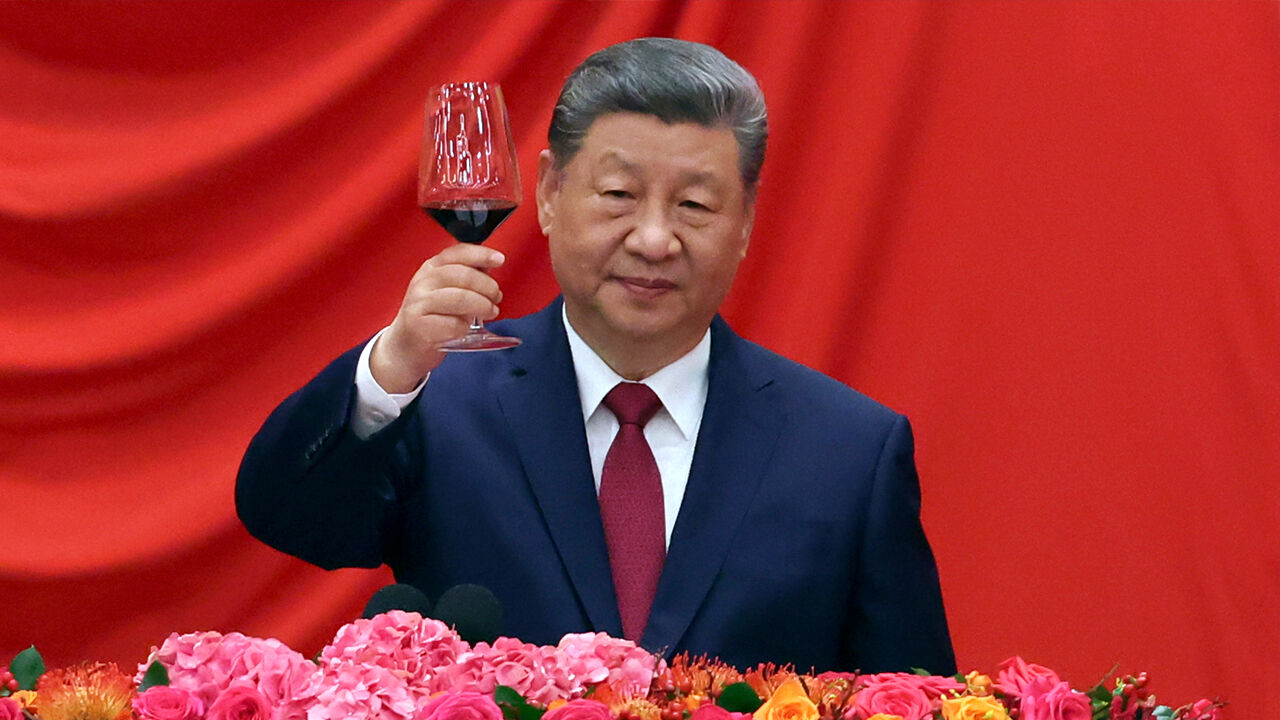
▲ Chinese President Xi Jinping
The Chinese Communist Party opened a plenary session today to discuss ways to strengthen "comprehensive and strict governance of the party," ahead of next year's party congress where President Xi Jinping is widely expected to secure a fourth term as general secretary.
The state-run Xinhua News Agency reported that the Fifth Plenary Session of the 20th Central Committee of the Chinese Communist Party (20th Central Committee Plenum) began in Beijing.
In his capacity as general secretary of the party's Central Committee, Xi delivered a work report and explained the agenda item titled "Decision of the Central Committee of the Communist Party of China on Several Major Issues for Continuously Promoting Comprehensive and Strict Governance of the Party."
During a speech on October 22 marking the 90th anniversary of the victory of the Long March, Xi stated, "To walk well on the path of the new Long March, we must firmly uphold the leadership of the party, strengthen party building, and steadily advance comprehensive and strict governance of the party."
While the Chinese Communist Party typically discusses the next five-year plan for economic and social development during its fifth plenums, the basic direction for the 15th Five-Year Plan was already finalized at last year's fourth plenum. As a result, tightening party discipline and controlling cadres are expected to be the main agenda items this time.
Lianhe Zaobao, a Chinese-language media outlet, analyzed that while initial observations suggested the agenda of "comprehensive and strict governance of the party" would focus primarily on anti-corruption when it was first disclosed, the actual scope may be much broader.
The outlet added that the Chinese Communist Party seeks to comprehensively strengthen supervision and constraints on the performance of officials, with a high likelihood of refining evaluation mechanisms.
The Associated Press assessed that while deepening anti-corruption efforts, Xi is demanding loyalty and reliability from officials while targeting underperformance and corruption.
It added that punishments citing formalism, bureaucracy, and inaction have been on the rise recently.
AFP also cited expert views that Xi aims to strengthen supervision and discipline over officials while maximizing loyalty and work efficiency.
Expectations are also rising that the current plenum could announce additional disciplinary measures targeting high-ranking officials who fell due to corruption allegations or the military, which has undergone intense anti-corruption inspections.
The South China Morning Post (SCMP) reported, "The plenum is expected to formalize one of the most extensive high-level personnel turnovers in modern Chinese political history."
According to SCMP's tally, around 20 of the 205 full members and about 7 of the 171 alternate members of the Central Committee are under investigation for corruption and are awaiting expulsion from the Central Committee.

▲ Closing of China's Fourth Plenum last year
The outlet interpreted that since about 35 full and alternate members who were absent during last year's fourth plenum remain unseen recently, their political standing may also be in jeopardy.
Neil Thomas, a senior fellow at the US think tank Asia Society, and others projected that 291 out of the 376 full and alternate members would attend this plenum, bringing the attendance rate below 80 percent at 77 percent and marking a record low.
It is projected that 44 full members and 41 alternate members will be absent.
The previous record low was set at last year's fourth plenum, where 315 members attended, resulting in an attendance rate of 83.8% देवताओं.
The Asia Society also reported that 42 out of 44 military-linked members elected to the Central Committee have been purged or disappeared.
SCMP also noted that preparations are expected to be made during this plenum to determine hundreds of key positions ahead of next year's party congress, drawing attention to potential changes in the composition of the Chinese leadership, such as the emergence of the "Qilinghou" (post-1970s generation).
The Chinese Communist Party has traditionally used around the age of 65 as a conventional benchmark for replacing Central Committee members at party congresses.
Applying this benchmark, about two-thirds of the current Central Committee members could be up for replacement at next year's congress.
However, some projections suggest that appointments to major positions will have to wait until next year's party congress.
The People's Daily, the official newspaper of the Chinese Communist Party, published a commentary on its front page titled "Continuously Promoting Comprehensive and Strict Governance of the Party on the New Long March," discussing Xi's political achievements alongside the era of former leader Mao Zedong.
The commentary noted that the 1935 Zunyi Conference served as a turning point during a life-or-death crisis for the party, stating, "It began to establish the correct Marxist line, with Comrade Mao as the principal representative, in a leading position within the party Central Committee.
It began to form the first generation of the central collective leadership of the party with Comrade Mao as the core."
It continued, "Since the 18th Party Congress [in 2012 when Xi took power], socialism with Chinese characteristics has entered a new era," emphasizing that "the greatest political achievement of the new era is the establishment of Comrade Xi's core position in the party Central Committee and the entire party, and the establishment of the guiding position of Xi Jinping Thought on Socialism with Chinese Characteristics for a New Era."
It further stated that the key to comprehensively building a socialist modernized country and comprehensively advancing the great rejuvenation of the Chinese nation lies with the party, and that the party must be managed strictly.
The commentary pointed out past issues where the party's leadership had weakened and diluted, noting that strengthening the centralized and unified leadership of the party during Xi's tenure has been made a political responsibility of the entire party, and that firm action has been taken against corruption, described as "the greatest threat facing the party."
It also pointed out that facing the "four tests" of governance, reform and opening up, the market economy, and the external environment, alongside the "four dangers" of mental lethargy, lack of capacity, detachment from the masses, and passive corruption, comprehensive and strict governance of the party is a journey with no end.
(Photo: AP, Yonhap News)
※ Please note: This article was translated by AI and may contain errors.


 Video News
 Video News
 Video News
 Video News
 Video News