
 KOR
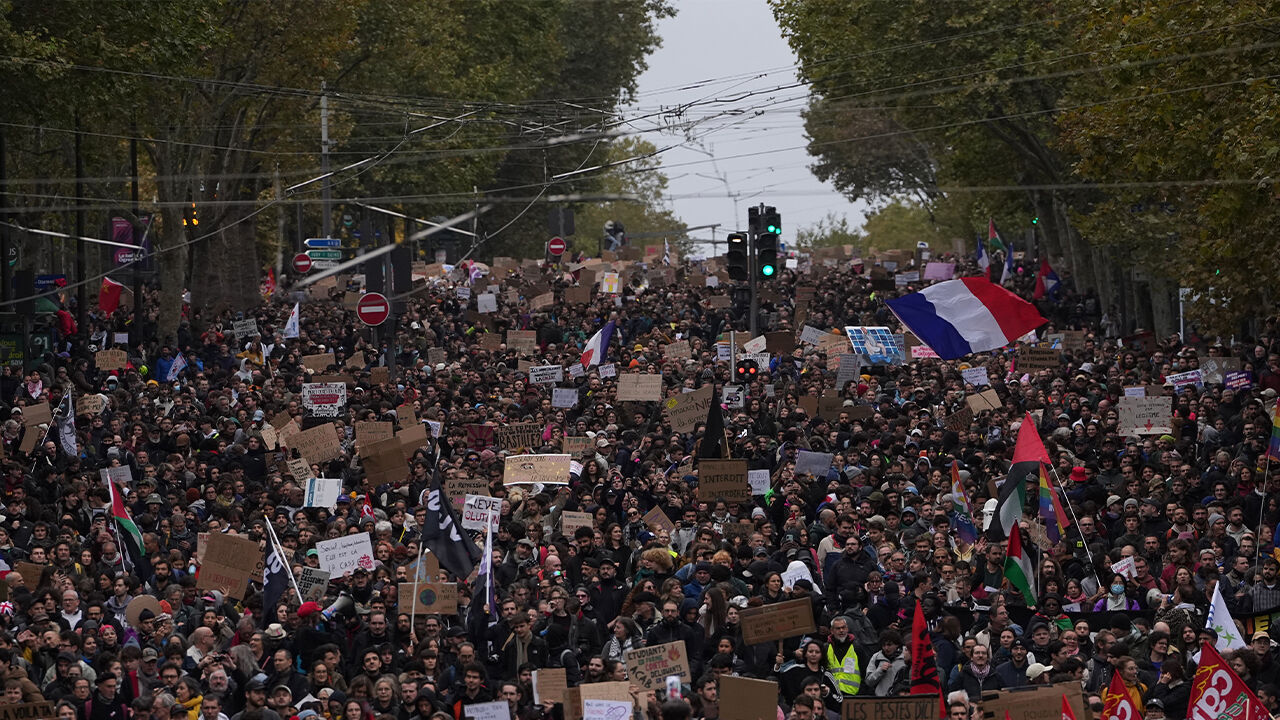
▲ Demonstrators march against the rising cost of living in Paris, France, on the 24th local time.
Massive protests erupted across European countries, including France, Spain, Italy, and Albania, on the 24th (local time).
Protesters demanded that their governments improve the quality of life, protesting poor conditions such as a lack of investment in public sectors including education, high prices for energy and other goods, high housing costs, and housing shortages.
As demonstrations intensified and turned violent in various places, governments resorted to crackdowns, but public discontent showed no signs of subsiding.
In France, where student protests over poor educational conditions spilled into anti-inflation demonstrations, 410,000 people (estimated by police) took to the streets nationwide despite authorities' restrictions on protests.
The protest was held with authorities deploying 70,000 police officers, helicopters, and armored vehicles alongside a ban on demonstrations to prevent a recurrence of violence. While the turnout was smaller than the 550,000 on the 17th, a large crowd still poured into the streets.
Sporadic clashes between police and protesters also broke out in Paris and several other regions.
Camille Chesnier, 27, told the Associated Press that despite holding a bachelor's and a master's degree in engineering, she could not find a job, adding, "There are a huge number of people in the same situation, and many have been left out on the streets without any privileges."
The authorities' restrictions on protests fueled grievances that the government was only trying to suppress people's demands rather than listen to them, and protesters vented their anger at the government of Emmanuel Macron.
Sumaya Abe, a 58-year-old nurse wearing the vest of the CGT union, the organizer of the protest, criticized the authorities, saying that although she had participated in union protests for about 30 years, it was the first time she had marched in the suburbs rather than the city center.
She said, "They are using what happened last week (the violence) to muzzle protesters," adding, "That will not stop the movement, nor will it stop students demanding better schools."
Anti-government protests demanding improved educational conditions also took place in Brussels, Belgium.
Although turnout was lower than the previous week, protesters clashed again with police, who responded with tear gas and pepper spray.
Reuters reported that demonstrators fell on the street while fleeing, and one person was witnessed being kicked by police officers.
Some protesters threw road signs and set scooters and bicycles on fire.

Ahead of next month's general election in Spain, protests over the housing crisis have continued for a month, and as observations of national pension reform have emerged and surfaced as an election issue, opposition movements have also risen.
Demonstrators, including the elderly, marched from Madrid's Atocha Station to the major shopping street Gran Vía, carrying signs that read, "Protect and guarantee our pensions" and "Pay proper pensions today and in the future."
There were also signs demanding the right to a livelihood and freedom with the words, "Bread, roof (housing rights), freedom."
In Lisbon, Portugal, people also marched through the city center on this day to hold protests demanding government improvements to the housing crisis.
Protesters protested against the government's recent announcement of policies easing the upper limit on annual housing rent increases and simplifying eviction procedures for tenants in rent arrears.
In Milan, Italy, a crowd consisting mostly of young people gathered to stage anti-government protests, carrying signs reading "Against the lies of the state" and other messages.
Local broadcasts reported that a group visited the energy regulator's building, threw filth, and burned mock utility bills.
To prepare for violence similar to the previous week, shops including luxury stores on Milan's streets boarded up their windows with wooden panels or closed early.
In the Albanian capital of Tirana, high school and university students continued their protests on this day, demanding increased educational investment, lower tuition fees, the eradication of corruption in the education sector, and the resignation of Prime Minister Edi Rama.
In Albania, street protests that arose against a resort development by the son-in-law of U.S. President Donald Trump have spread into demands by university students for improved educational environments.
Police deployed water cannons to disperse the protesters, and clashes escalated as some protesters set fire to government buildings and fired projectiles at the police.
(Photo: AP, Yonhap)
※ Please note: This article was translated by AI and may contain errors.




 Video News