
 KOR
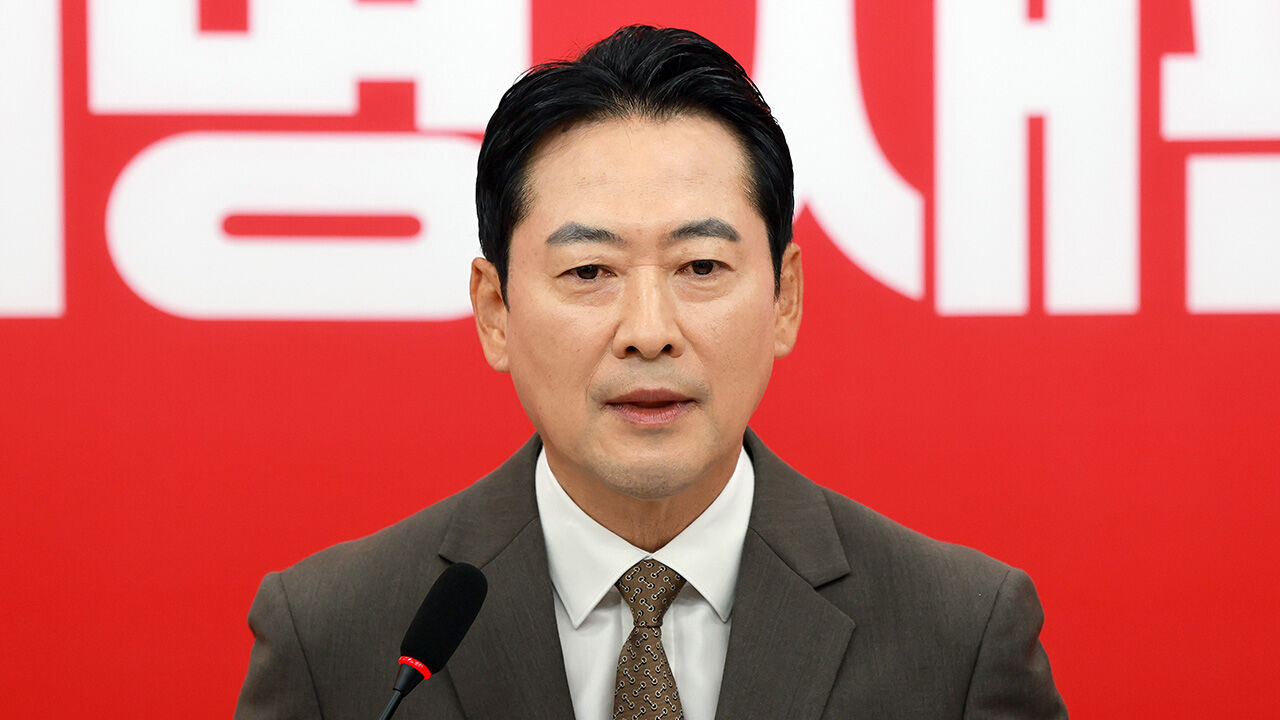
How does his tenure compare when including the PPP's predecessors—the Grand National Party, Saenuri Party, Liberty Korea Party, and United Future Party? Where does Jang's tenure rank among all leaders in conservative party history?
SBS Fact Check "Fact Is" looked into the numbers.

The turning point when the party ended its single-leader system, which had concentrated power in one "party president," and established the current consultative "representative supreme council member (party leader)" leadership structure was May 2002, during the era of the former Grand National Party.
Until then, the party operated under a single-leadership system centered on an imperial "president." At that time, internal demands for party democratization and the abolition of the imperial party presidency intensified. Eventually, as then-Grand National Party President Lee Hoi-chang resigned from the party presidency to run for president of South Korea, the party revised its constitution and rules to abolish the presidency and establish a collective leadership structure. At the national party convention held in May of that year, Lawmaker Suh Chung-won was elected as the party's first "representative supreme council member."
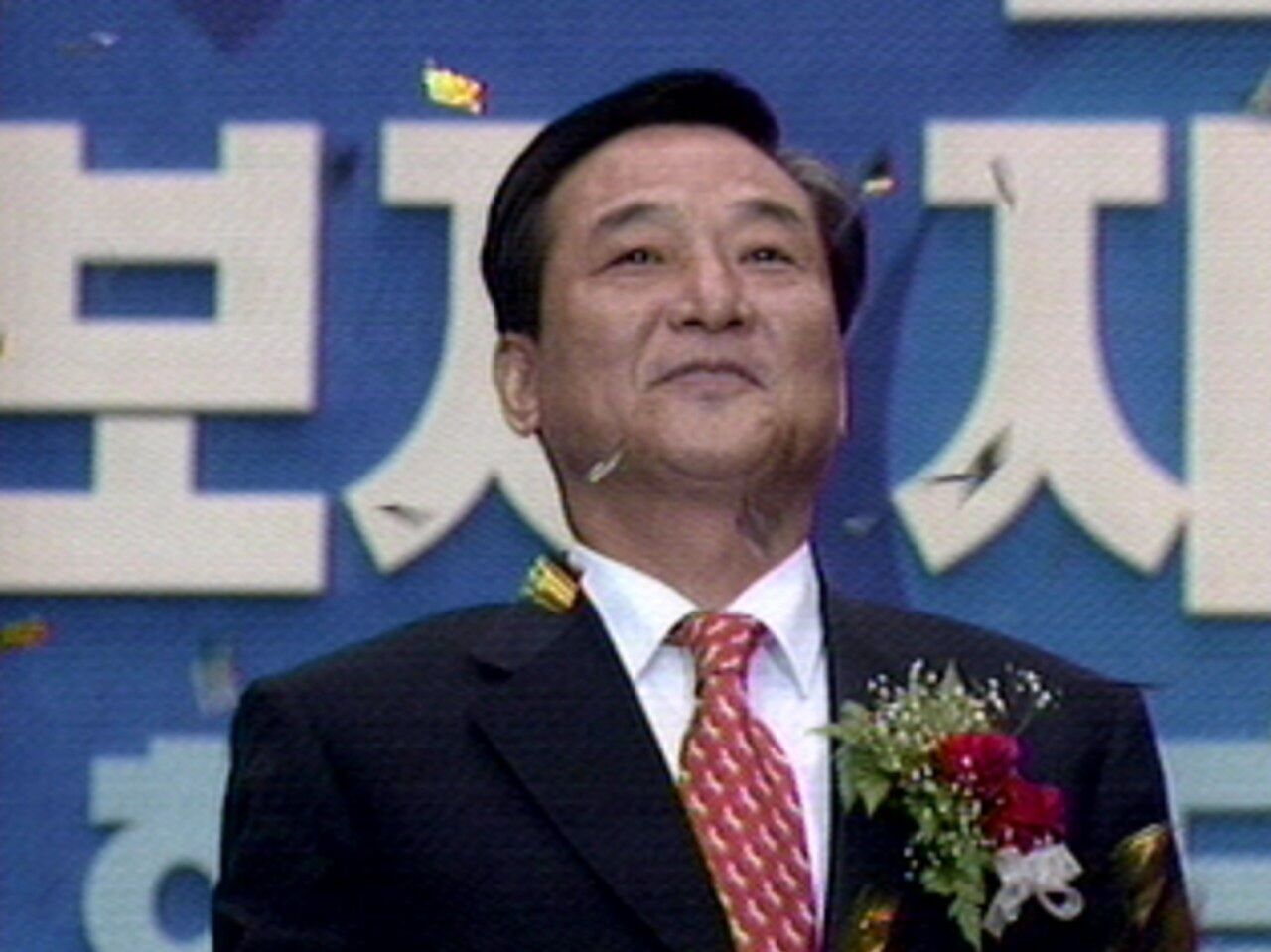
Former lawmaker Suh Chung-won was elected leader of the Grand National Party in May 2002.
The terms of all party leaders after the establishment of the current leadership system—specifically since May 2002—were calculated.
The analysis also included chairs of emergency response committees. When a vacancy occurs, such as through a leader's resignation, an emergency response committee is established, and under Article 98 of the party constitution, an emergency committee chair holds the same status and authority as a regular party leader. However, acting party leaders were excluded. Acting leaders serve merely as "temporary caretakers" who maintain party stability until a new official leader or emergency committee chair is selected.
People Power Party website (History): www.peoplepowerparty.kr/about/history
Because dates such as election days and inauguration days vary slightly across media reports, the dates listed in the history section of the People Power Party website were used as the standard, based on the judgment that the party's officially announced timeline is the most accurate.
The findings are as follows.
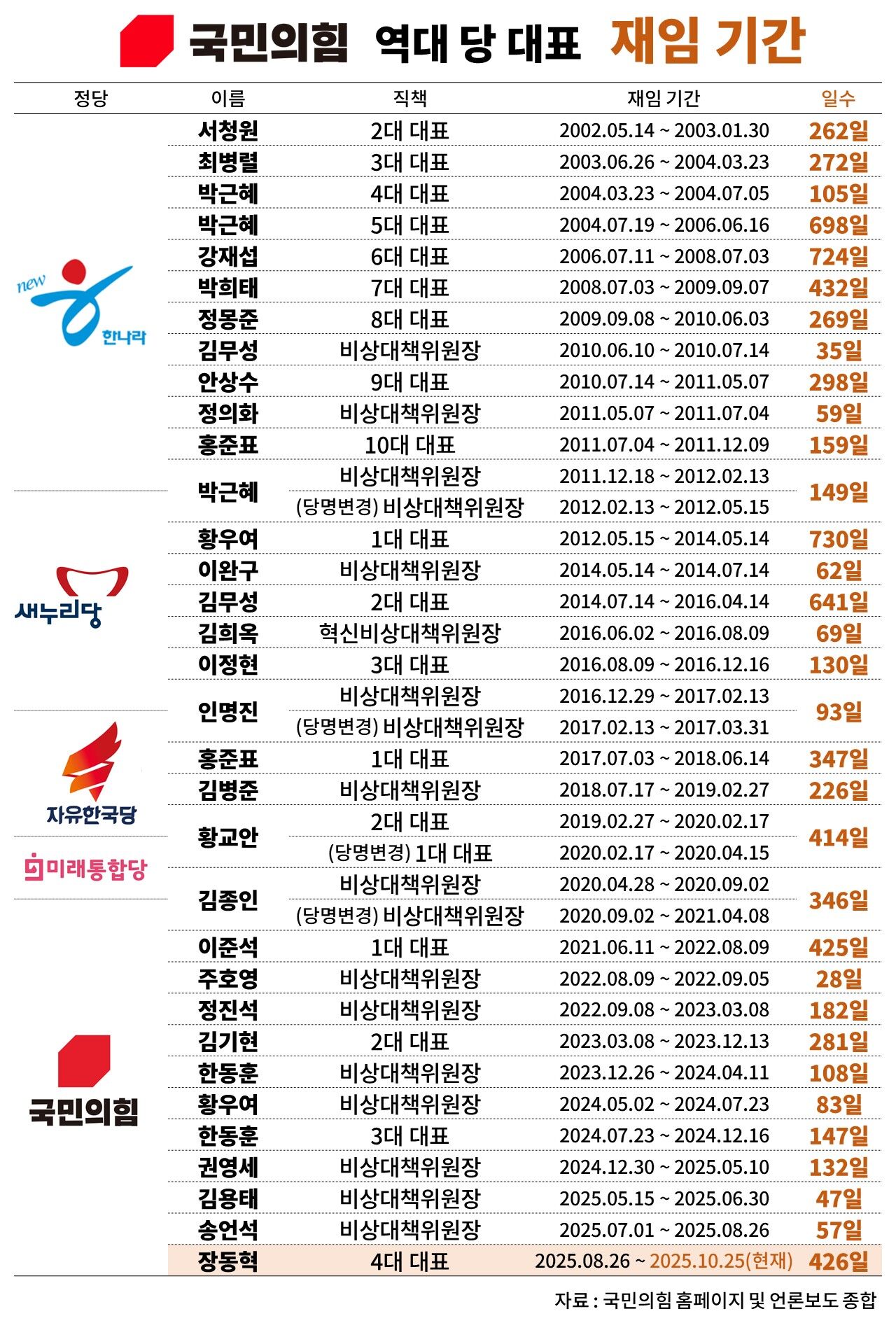
As the party rebranded itself four times—from the Grand National Party to the Saenuri Party, Liberty Korea Party, United Future Party, and finally the People Power Party—there have been a total of 33 party leaders and emergency response committee chairs (including duplicate tenures). This covers the period from former Grand National Party leader Suh Chung-won in May 2002 to current leader Jang Dong-hyeok.
Their average tenure was calculated at 256 days, just over eight months.
Only three party leaders successfully completed the full two-year term stipulated in the party constitution: former Grand National Party leaders Park Geun-hye and Kang Jae-sup, and former Saenuri Party leader Hwang Woo-yea. Most stepped down prematurely due to election defeat accountability or major political scandals.
Based on this analysis, the rankings were determined.
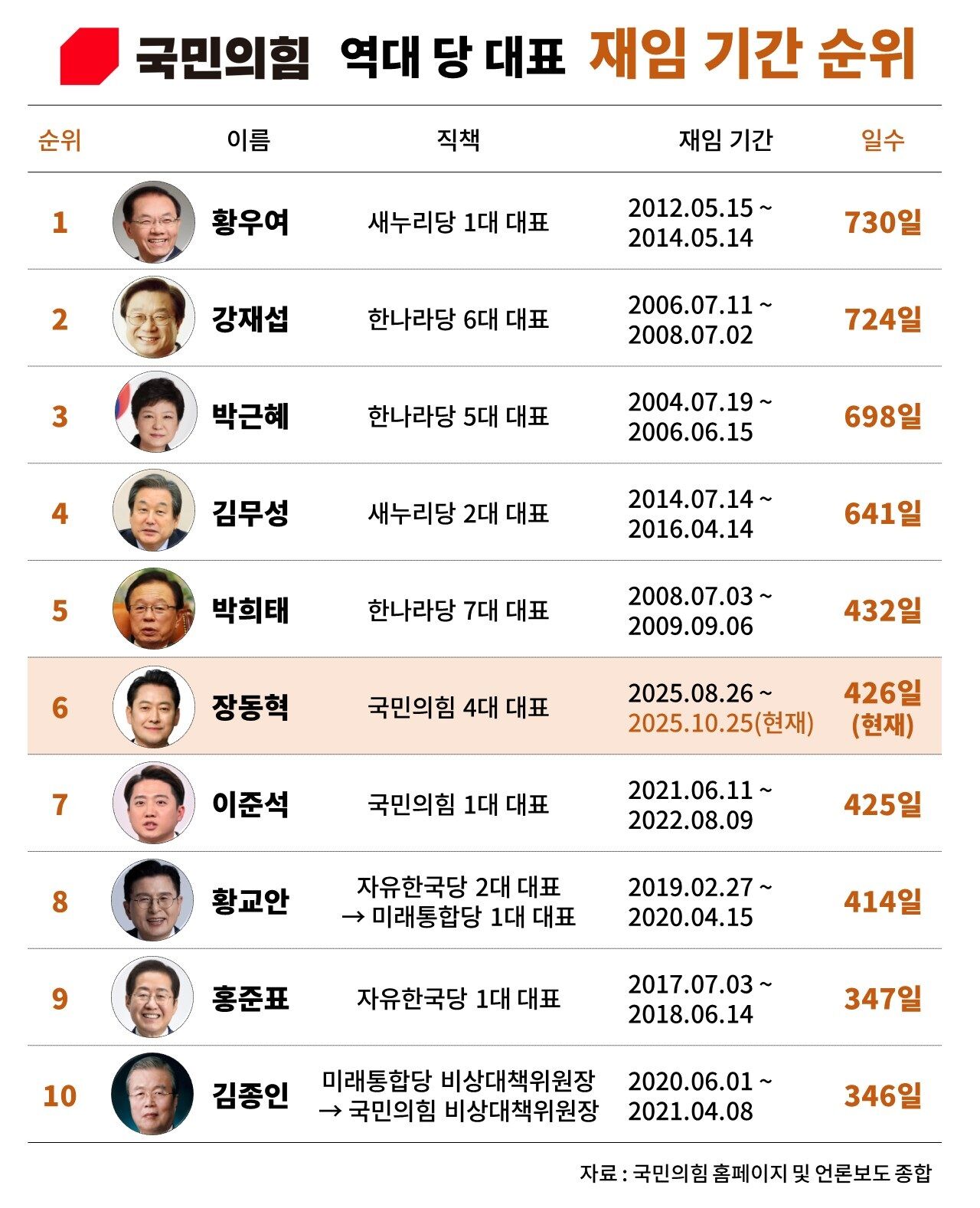
The top five includes Hwang Woo-yea, Kang Jae-sup, and Park Geun-hye, all of whom completed their two-year terms, along with former Saenuri Party leader Kim Moo-sung and former Grand National Party leader Park Hee-tae.
Jang Dong-hyeok, who has now become the longest-serving leader in the PPP's history, ranked sixth overall. In one week, on November 1, Jang will surpass former Grand National Party leader Park Hee-tae's record of 432 days to take fifth place all-time.
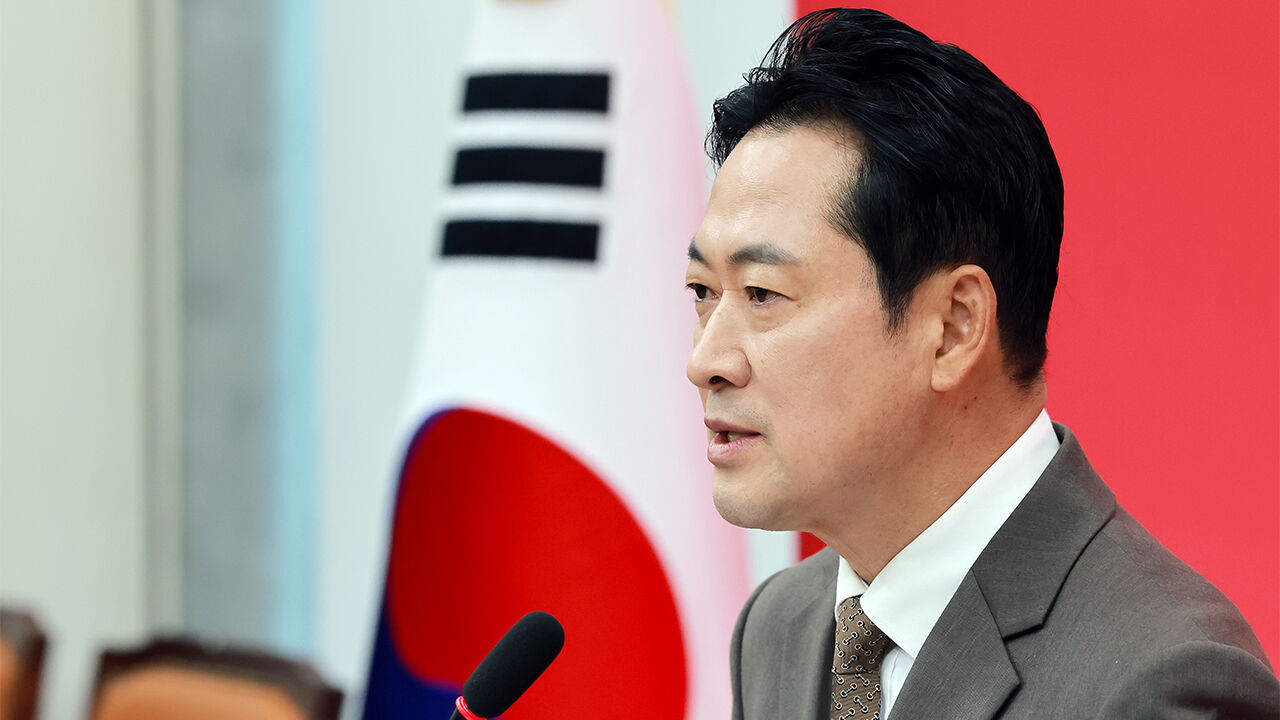
What common traits did these long-serving party leaders share?
First, extended tenures emerged notably during periods when internal unity and stability were paramount ahead of presidential elections. Former Grand National Party leader Kang Jae-sup led the party for 724 days, and former Saenuri Party leader Hwang Woo-yea served for 730 days. Both shared the experience of managing major presidential election campaigns and securing victory.
Kang managed the fierce factional primary rivalry between Lee Myung-bak and Park Geun-hye during the 2007 presidential race. He played a key role in mediating internal party divisions and laying the groundwork for a transition of power. Hwang was credited with winning the 2012 presidential race and subsequently maintaining relatively stable relations between the ruling party and the Blue House following the launch of the Park Geun-hye administration.
While those leaders achieved long tenures fueled by presidential election victories, conversely, there were also cases where individuals chosen as new rallying points when the party faced severe crises ended up leading for extended periods.
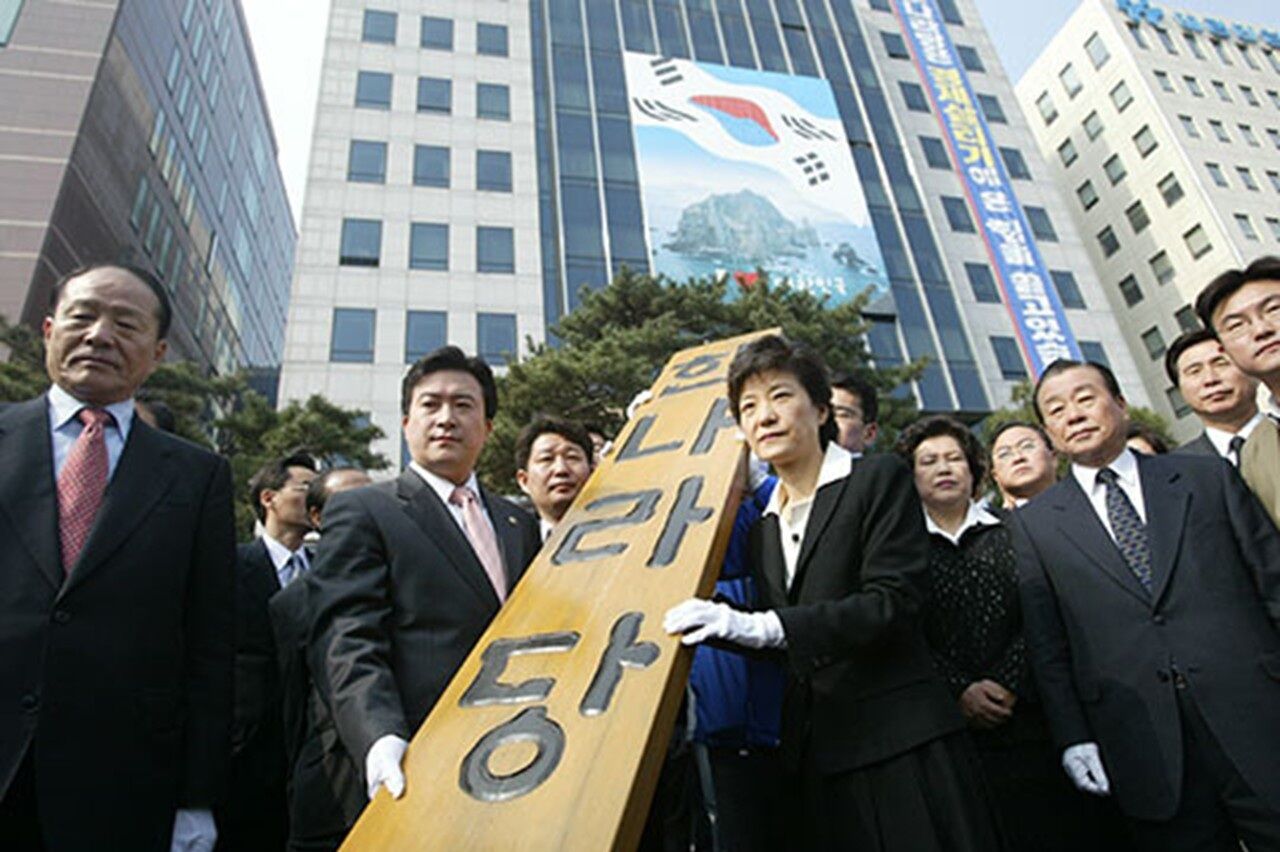
Former President Park Geun-hye personally carries the Grand National Party plaque to a makeshift tent headquarters in March 2004.
A prime example is former President Park Geun-hye, who served as leader of the Grand National Party for 698 days. In 2004, when the party faced an existential crisis due to an illegal presidential campaign fund scandal and the political backlash over the impeachment of former President Roh Moo-hyun, Park led party reform efforts from a makeshift tent headquarters. She then won successive elections, helping rebuild the party's collapsed support base. It was during this period that she earned the moniker "Queen of Elections." Her political centripetal force in steering the party through a crisis laid the foundation for her prolonged leadership.
Former leader Lee Jun-seok's tenure followed a similar trajectory. Leading the party for 425 days, Lee was the first party leader in South Korean constitutional history in his 30s. A sense of crisis within the conservative party, which desperately needed youth support to regain power, led to the election of a figure symbolizing generational change.
Lee delivered results as a campaign strategist, steering the party to victories in both the presidential and local elections. However, he was embroiled in persistent clashes with the party's mainstream faction throughout his tenure, ultimately seeing his term cut short following an unprecedented suspension of his party membership rights. Electoral triumphs and internal conflicts coexisted throughout his leadership.
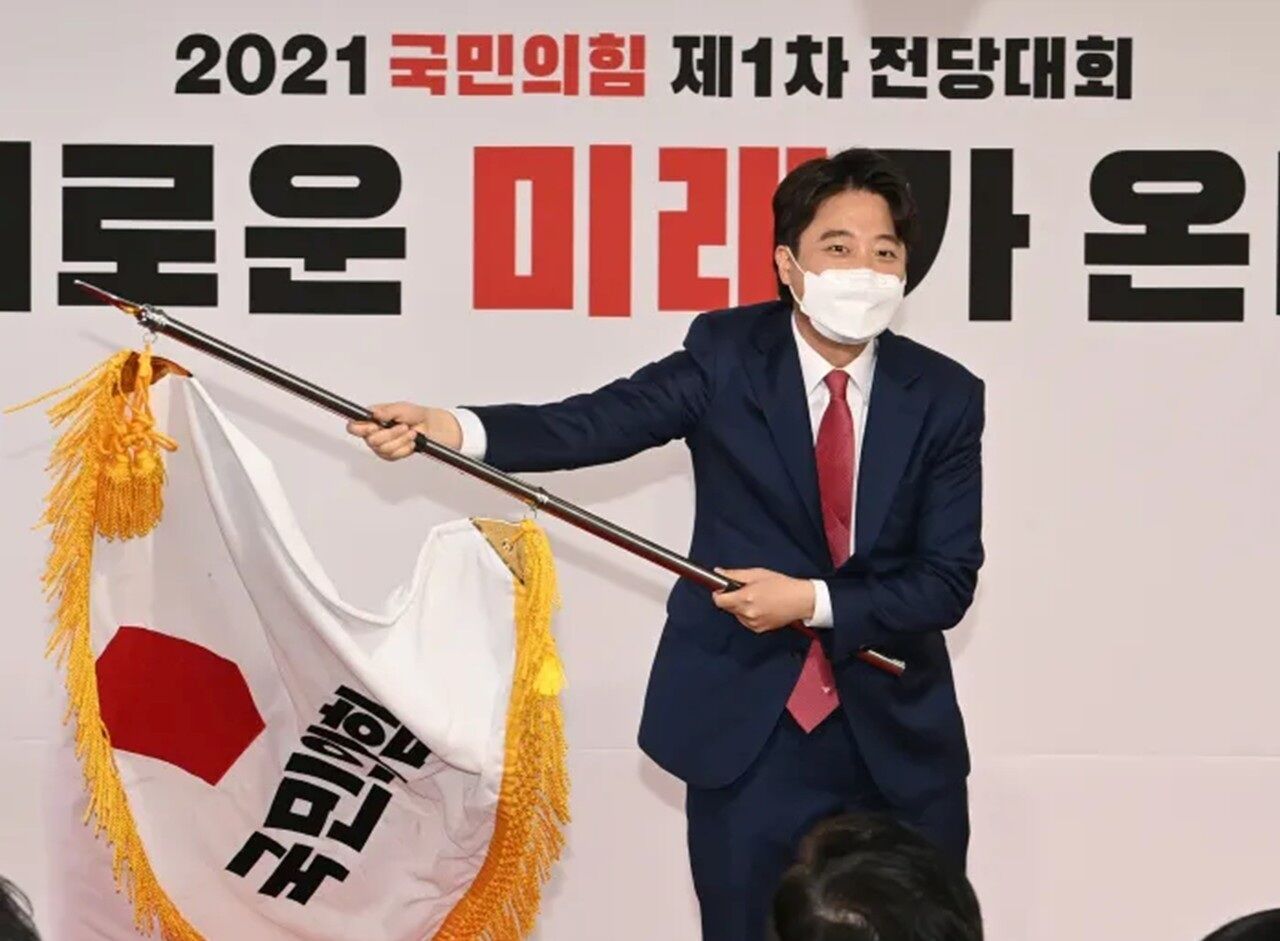
Former leader Lee Jun-seok waves the party flag at the national convention in June 2021 after being elected leader of the People Power Party.
Former Grand National Party leader Park Hee-tae also led the party for 432 days. His term came during a turbulent period early in the Lee Myung-bak administration marked by candlelight protests against U.S. beef imports, making party stability and steadying the ruling bloc critical priorities.
Relatively long tenures were also seen during the aftermath of former President Park Geun-hye's impeachment, when the conservative bloc suffered heavy blows. Former leader Hong Joon-pyo led the party for 347 days, and former leader Hwang Kyo-ahn led for 414 days.
Hong was tasked with rallying the traditional conservative base when the party's very survival was at stake. Hwang led the founding of the United Future Party amid fierce ideological polarization over the Cho Kuk scandal. However, neither could escape accountability for electoral defeats. Hong resigned following a crushing defeat in the 2018 local elections, while Hwang stepped down after a landslide loss in the 2020 general election.
Ultimately, a prolonged tenure does not necessarily signify political success. Historical records demonstrate that a leader's longevity in office resulted from an interplay between political necessity and crisis conditions.
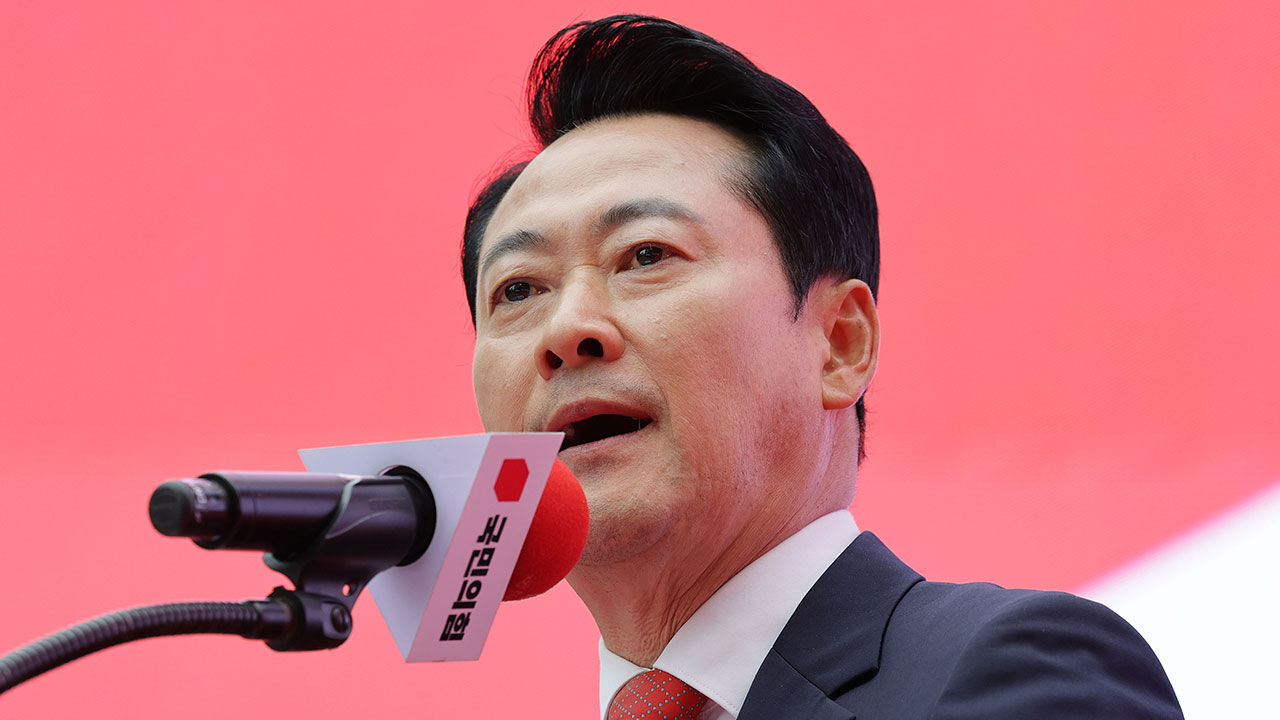
The tenure of Jang Dong-hyeok, now ranked sixth in history, can be understood in this context.
Jang took the party helm at a time when the conservative party was plunged into crisis following former President Yoon Suk Yeol's impeachment and defeat in the presidential election. He established his leadership by winning the party membership vote and weathered multiple crises, including controversies surrounding the expulsion of former leader Han Dong-hoon and calls for his resignation after local election defeats. In doing so, he set the record as the longest-serving leader since the PPP's founding.
Maintaining control over internal party power and continuing his tenure while the party's influence shrank is clearly an achievement for Jang. However, retaining power within the party is separate from expanding broader public support.
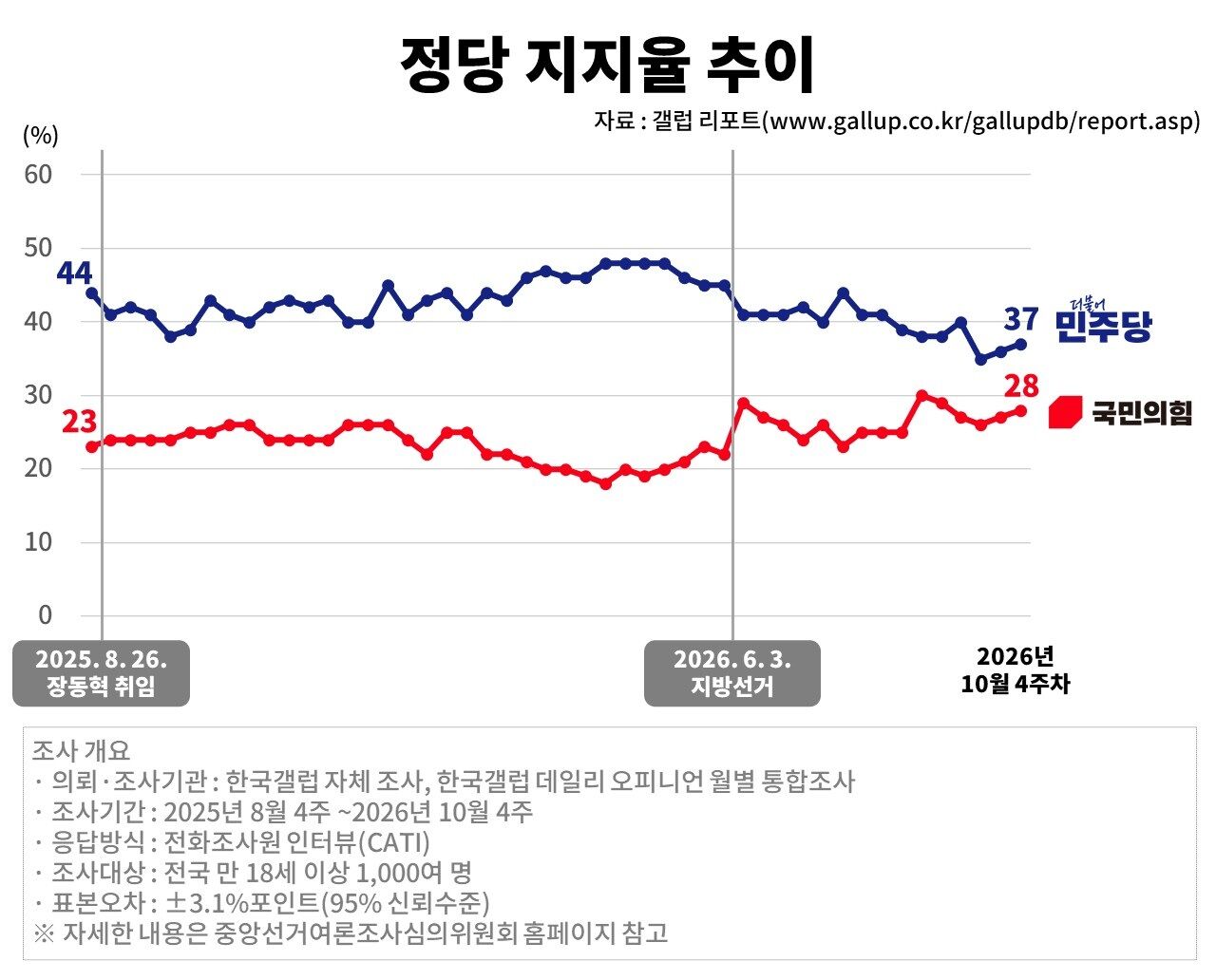
Approval ratings highlight this disparity. According to Gallup Korea surveys, the PPP's approval rating hovered in the low-to-mid 20% range after Jang took office without significant gains, before fluctuating in the high 20% range after the local elections. Notably, the PPP failed to benefit substantially from declines in the Democratic Party's approval ratings.
This can be interpreted to mean that rallying the party membership base did not translate into expanding support across the broader public. While Jang has succeeded in lengthening his tenure by maintaining his support base inside the party, it also indicates that many challenges remain in broadening the party's appeal and restoring voter trust.
Controversy has recently erupted over audio recordings containing profanities, and calls for leadership changes are surfacing almost daily. For his record as the longest-serving leader to serve as proof of political success, Jang must demonstrate political achievements that transcend the title of "longest-serving." A longer tenure does not automatically translate into greater political success.
(Writer: Kim Hyo-jin, Intern: Kim Jeong-won)
※ Please note: This article was translated by AI and may contain errors.



 Video News
 Video News
 Video News
 Video News