
 KOR
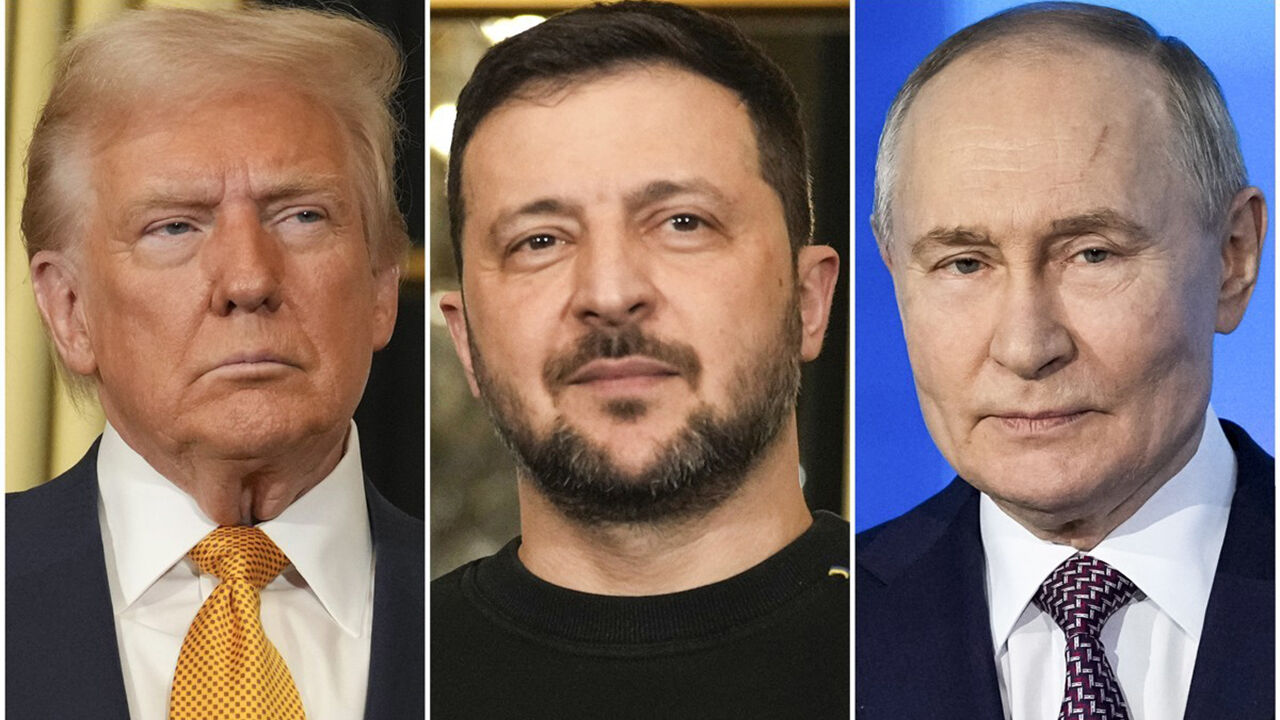
▲ (From left) U.S. President Donald Trump, Ukrainian President Volodymyr Zelenskyy, and Russian President Vladimir Putin.
Attention is focused on whether Russia and Ukraine's positive response to the White House's announcement of a ceasefire in Oleshky, located in Ukraine's southern Kherson Oblast, will serve as an opportunity to ease tensions.
According to Reuters, AP, and other news outlets on the 23rd (local time), Kremlin Spokesperson Dmitry Peskov welcomed the efforts of U.S. First Lady Melania Trump regarding the ceasefire in the Oleshky region and expressed willingness to agree to a ceasefire.
He added, "Residents of Oleshky can leave the city if they wish."
Russian military authorities stated, "For the humanitarian operation in Oleshky, a ceasefire will be implemented in Kherson Oblast starting at 4:00 AM Moscow time on the 27th."
David Arakhamia, a ruling party lawmaker and Ukrainian chief negotiator, also wrote on social media that day, "A ceasefire will soon be established in Oleshky," adding, "Permanent humanitarian corridors will be established for the evacuation of residents and the delivery of food."
Oleshky is a Russian-occupied region in Ukraine where residents are reportedly facing survival crises due to prolonged cutoffs in food and medical supplies.
The White House announced that day that, through the mediation of First Lady Melania Trump, Russian and Ukrainian forces have agreed to halt combat operations in Oleshky.
The resumption of U.S.-mediated trilateral peace talks between Russia and Ukraine was also officially confirmed that day.
Ukrainian President Volodymyr Zelenskyy announced that day, following a meeting with U.S. presidential special envoys, that working-level peace negotiations will be held in Abu Dhabi, United Arab Emirates (UAE), early next month.
Russian President Vladimir Putin met with U.S. Presidential Special Envoy Steve Witkoff on the 21st and accepted the proposal to resume trilateral peace talks.
With both sides agreeing to the Oleshky ceasefire and resuming peace talks, expectations are rising that the recent intensification of clashes between the two sides could be somewhat mitigated.
However, some observers note that it will be difficult to expect tangible progress in the peace negotiations, given that both sides remain deadlocked without concessions over Ukraine's Donbas region.
Previously, Kremlin foreign policy aide Yuri Ushakov practically rejected the U.S. side's new peace proposal, stating that it "lacks substantive content" and that "the changes in attitude by Europe and the North Atlantic Treaty Organization (NATO) detected by the U.S. do not completely satisfy us."
Concerns also follow that the Oleshky ceasefire may have limited impact, given that it is a localized cessation of hostilities for humanitarian purposes.
Despite repeated dialogue proposals from Ukraine, Russia has maintained its stance that it needs "peace, not a ceasefire."
(Photo: AP, Yonhap News)
※ Please note: This article was translated by AI and may contain errors.



 Video News
 Video News
 Video News
 Video News