
 KOR
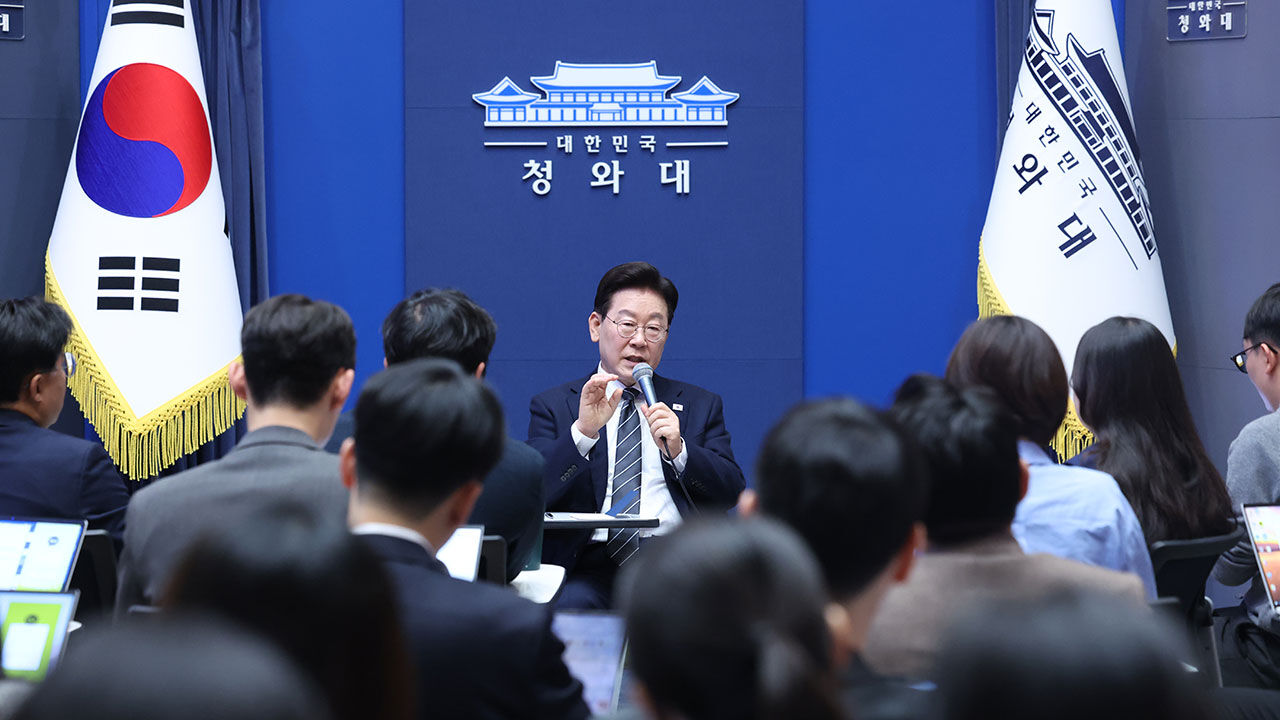
▲ President Lee Jae-myung speaks with reporters in the lobby of Chunchugwan, the press center at Cheong Wa Dae, on October 19.
Regarding the issue of wartime operational control (OPCON), President Lee Jae-myung stated, "It must be retrieved promptly without fail," adding, "Consultations between South Korea and the United States are also basically progressing toward returning it."
Marking the 500th day since his administration took office, President Lee visited Chunchugwan for a luncheon and meeting with reporters, where he made the remarks in response to a question asking, "Gen. Xavier Brunson, commander of US Forces Korea, recently mentioned changes to the conditions for the OPCON transition. What are your thoughts on this?"
While some view Commander Brunson's remarks as effectively putting the brakes on transferring OPCON to South Korea, President Lee made clear his intention to regain OPCON early, as originally planned.
President Lee noted, "People use the term 'transition' of OPCON, but in fact, it should be expressed as 'retrieval' or 'reversion.'
We are a sovereign, independent state, and we must regain OPCON to fulfill the minimum requirements of a nation," emphasizing that "in terms of national standing as well as economically, culturally, and militarily, we are not in a situation to leave OPCON entrusted (to the US) and neglected."
He continued, "It has been more than 70 years since OPCON was entrusted, so the process will not be easy," but added, "We must take charge of our own defense, and we are fully capable of handling it.
South Korea's defense spending alone is about 1.5 times North Korea's annual gross national product."
He also stated, "Excluding nuclear capabilities, South Korea ranks fifth in the world in conventional military strength," adding, "Of course, some say, 'Doesn't the other side (North Korea) have nuclear weapons?' but that is not the reality.
Can an actual war be fought with nuclear weapons?
That corresponds to a weapon of last resort for defense," he elaborated.
President Lee said, "On the other hand, (the US's) goodwill is also something to be grateful for.
It means, 'We will verify whether you can sufficiently defend yourselves and conduct operations on your own before handing it over,'" adding, "While we appreciate it, I believe this is something we must do on our own.
It will turn out well."
Regarding dialogue between North Korea and the US for denuclearization, he briefly commented, "I have no information on that."
Discussions also touched upon trade issues, including investment in the United States.
Regarding tensions between South Korea and the United States surrounding investment in the US, President Lee said, "It is not normal for there to be zero issues and complete calm between nations.
I cannot understand treating differences of opinion themselves as a problem," adding, "If there are elements of conflict, one should stand by their own government, yet this is the first time I have seen domestic attacks simply because political stances differ."
This is interpreted as a rebuttal to the offensive mounted by opposition parties surrounding the matter.
He continued, "How could there be no differences between South Korea and the US, South Korea and Japan, or South Korea and Russia?
There can always be disagreements between independent, sovereign nations," emphasizing that "South Korea, whether in industry or foreign affairs and security, is no longer the South Korea of the past."
Regarding concerns over "discord" between South Korean and US intelligence authorities, he said, "We cannot say that the relationship between the National Intelligence Service and US intelligence agencies is 100 percent completely problem-free like parents and siblings or a happily married couple," adding, "It is only natural that differences exist.
It is not because anyone did anything wrong, but merely small differences that arise in the process of each protecting their own national interests, and they are fully manageable."
Regarding the government's recent decision to reconsider joining the Comprehensive and Progressive Agreement for Trans-Pacific Partnership (CPTPP) from scratch, he assessed, "While we need to expand our economic territory in the long run, there seems to have been an oppressive approach toward the agriculture, livestock, and fisheries sectors in the past."
He added, "We must now overcome that distrust and restore confidence," noting, "I will soon meet with farmers' organizations to sort out the key issues."
Regarding the recent return of the Panstar Acro after completing a trial voyage along the Arctic route, he remarked, "They completed the voyage under difficult conditions," adding, "Cooperation with Russia is necessary if an emergency occurs, and that part must be resolved."
(Photo: Joint Press Corps, Yonhap News)
※ Please note: This article was translated by AI and may contain errors.


 Video News
 Video News
 Video News
 Video News
 Video News