
 KOR
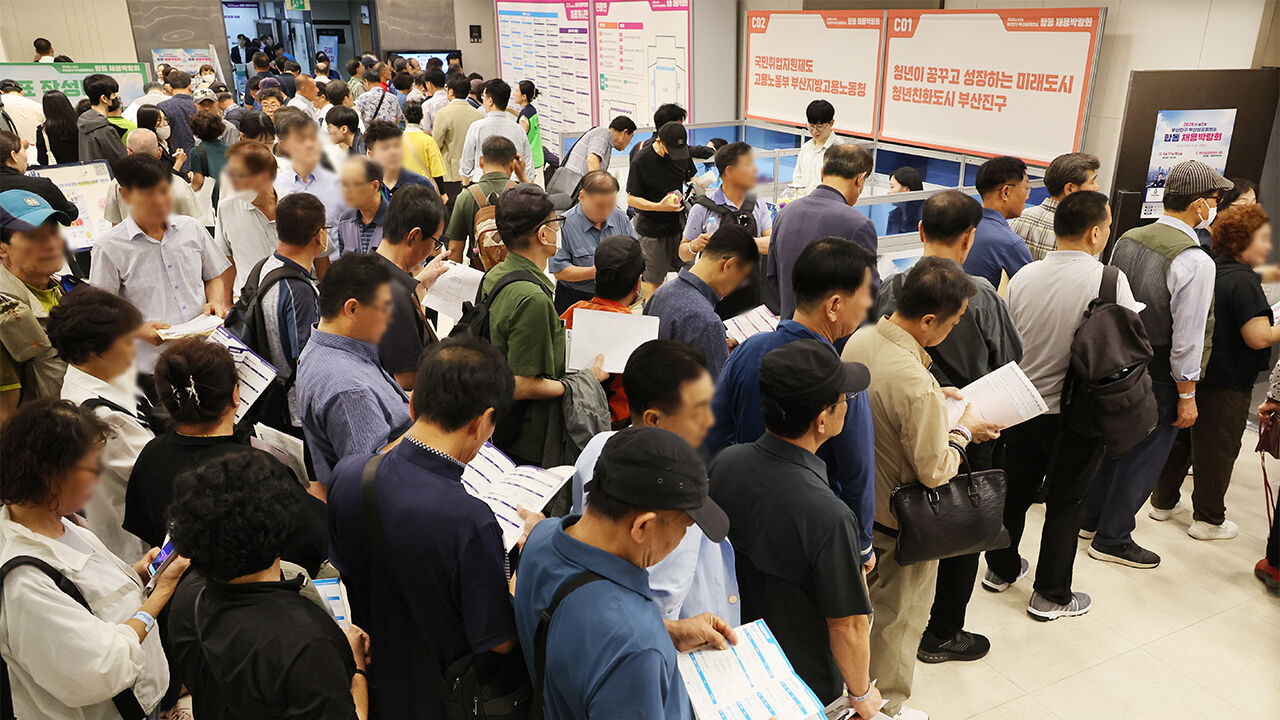
▲ Job seekers wait in line to enter a joint job fair held at the Busan Chamber of Commerce and Industry in Busanjin-gu, Busan, on September 17.
Seven out of ten young job seekers feel burdened by the costs of preparing for employment, spending an average of 580,000 won per month, data showed.
For those whose job preparation period lasted three years or longer, average monthly expenditures reached 800,000 won.
The Korea Economic Concentrations (FKI) announced the results of its "Survey on Job Preparation Costs for Young Job Seekers" on October 19, which was conducted by polling agency Mono Research targeting 1,000 job-seeking youths aged 19 to 34 nationwide.
According to the survey, the average monthly cost spent on job preparation over the past three months was tallied at 580,000 won.
Expenditures generally increased as the job preparation period lengthened, recording an average of 560,000 won per month for those preparing for less than six months, 670,000 won for those between one and a half years to less than two years, and 800,000 won for three years or more.
By age group, those aged 30 to 34 spent the most at 600,000 won, followed by 580,000 won for those aged 25 to 29, and 560,000 won for those aged 19 to 24.
By major, education, medicine, and health majors recorded the highest at 740,000 won, followed by arts and physical education majors (690,000 won), natural science and engineering majors (550,000 won), and humanities and social science majors (520,000 won).
By desired employer, monthly job prep costs for those hoping to work at conglomerates averaged 700,000 won, higher than those aiming for mid-sized companies (630,000 won) and small and medium-sized enterprises (590,000 won).
Respondents who said job preparation costs were burdensome reached 69.3%.
Conversely, only 7.3% answered that they were not burdensome.
Examination and language test application fees accounted for the largest share of expenditures at 30.7%.
This was followed by education expenses (22.6%), textbook and learning material purchase costs (16.1%), transportation expenses (12.4%), and space usage fees for cafes and study cafes (7.3%).
The survey showed that 70.8% of young job seekers live with their parents.
This figure is 16.4 percentage points higher than the parental co-residence rate of 54.4% for all youths recorded in the Office for Government Policy Coordination's 2024 Youth Life Status Survey.
The primary method for securing job preparation funds was also support from parents and family, accounting for 32.8%.
This was followed by income from part-time jobs and other sources (29.5%), personal savings (27.3%), and government or local autonomous government subsidies (7.9%).
As for necessary support policies, financial assistance for certification and language test application fees was most frequently cited at 25.9%.
Housing cost support including monthly rent (16.7%), the provision of job preparation vouchers (16.1%), and transportation cost support (11.4%) followed.
Lee Sang-ho, head of the FKI's Economic Research Division, said, "Amid the prolonged employment difficulties for young people, a significant number of job-seeking youths feel financial pressure during their job preparation process," adding, "In particular, it is necessary to strengthen support for test application fees and education tuition to ease the burden on low-income youths."
(Photo: Yonhap News)
※ Please note: This article was translated by AI and may contain errors.


 Video News
 Video News
 Video News
 Video News
 Video News