
 KOR
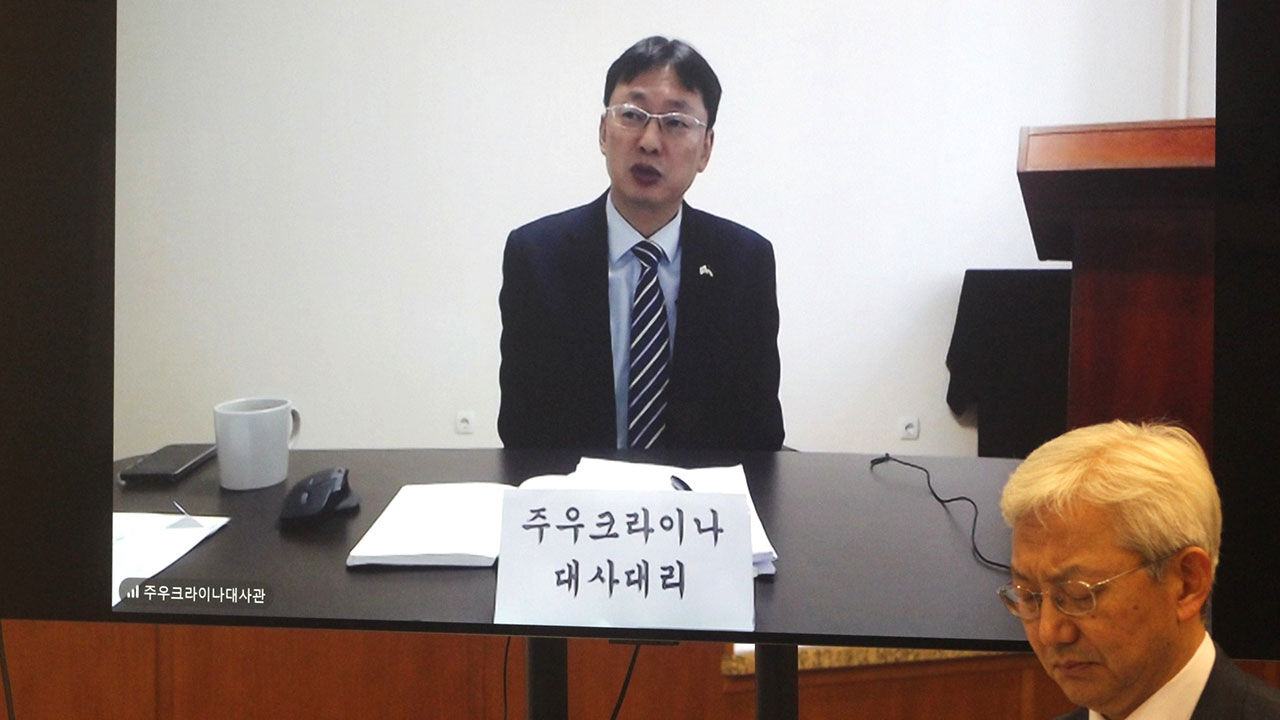
▲ Yoon Ji-wan, Minister-Counselor and Chargé d'Affaires ad interim at the South Korean Embassy in Ukraine, answers questions via video link during a parliamentary audit by the National Assembly's Foreign Affairs and Unification Committee on the 18th (local time). Bottom right is Tae Jun-yeol, South Korean Ambassador to Poland.
The South Korean Embassy in Ukraine stated on the 18th (local time) that there was a mutual understanding between the South Korean and Ukrainian governments to keep the repatriation of North Korean prisoners of war confidential for as long as possible during their consultations.
Yoon Ji-wan, Chargé d'Affaires ad interim at the South Korean Embassy in Ukraine (Minister-Counselor), said during the parliamentary audit held by the National Assembly's Foreign Affairs and Unification Committee at the South Korean Embassy in Poland that "there was no discussion whatsoever on when to disclose the matter, and many opinions favored keeping it confidential for as long as possible."
Yoon noted that the embassy had no prior knowledge that Ukrainian President Volodymyr Zelenskyy would publicly announce the repatriation of North Korean POWs to South Korea during his UN General Assembly speech on September 23, and added that the Ukrainian side has yet to provide a detailed explanation for the disclosure.
Regarding President Zelenskyy's public announcement of the POW repatriation, he stated, "There is a lot of criticism within Ukraine as well, such as criticism that there was no internal consultation and that the confidentiality agreement was broken impulsively," adding, "There are no further rebuttals from the Ukrainian side. I understand this to mean they cannot deny the fact that a confidentiality agreement existed."
Evaluating the Ukrainian authorities' actions, Yoon remarked, "It seems to take a considerable amount of time to coordinate and respond to the president's remarks."
Three days after the repatriation was made public, Dmytro Litvin, an adviser to President Zelenskyy, denied the existence of any such confidential agreement, stating, "There was no such agreement. It is not true."
On the 12th, Ukrainian Foreign Minister Andrii Sybiha effectively rejected the South Korean government's demand for an apology, saying, "I consider the matter closed."
In response to criticism that the diplomatic friction arose because the confidential agreement was not firmly secured in writing, Yoon answered, "Formalizing a diplomatic agreement in a document is effectively a treaty," making it difficult to disclose concrete evidence of the agreement.
Regarding the diplomatic friction between the two countries, he said, "Both sides consider the repatriation of POWs to be an immensely significant achievement," adding, "There is a shared consensus that bilateral relations must be maintained on a stable and trust-based foundation, and this issue must be resolved wisely."
Following the public disclosure of the POW repatriation, the South Korean government recalled Park Ki-chang, South Korean Ambassador to Ukraine, and demanded an apology after the Ukrainian side denied the confidentiality agreement itself.
Yoon, the deputy head of the embassy in Ukraine, attended the parliamentary audit—which covered the embassies in Poland, Ukraine, Russia, and Belarus—via video link in his capacity as Chargé d'Affaires ad interim.
Ambassador to Russia Lee Seok-bae also underwent the audit via video link as Moscow airports were closed due to a drone attack by Ukrainian forces.
(Photo: Yonhap News)
※ Please note: This article was translated by AI and may contain errors.


 Video News
 Video News
 Video News
 Video News
 Video News