
 KOR
KOR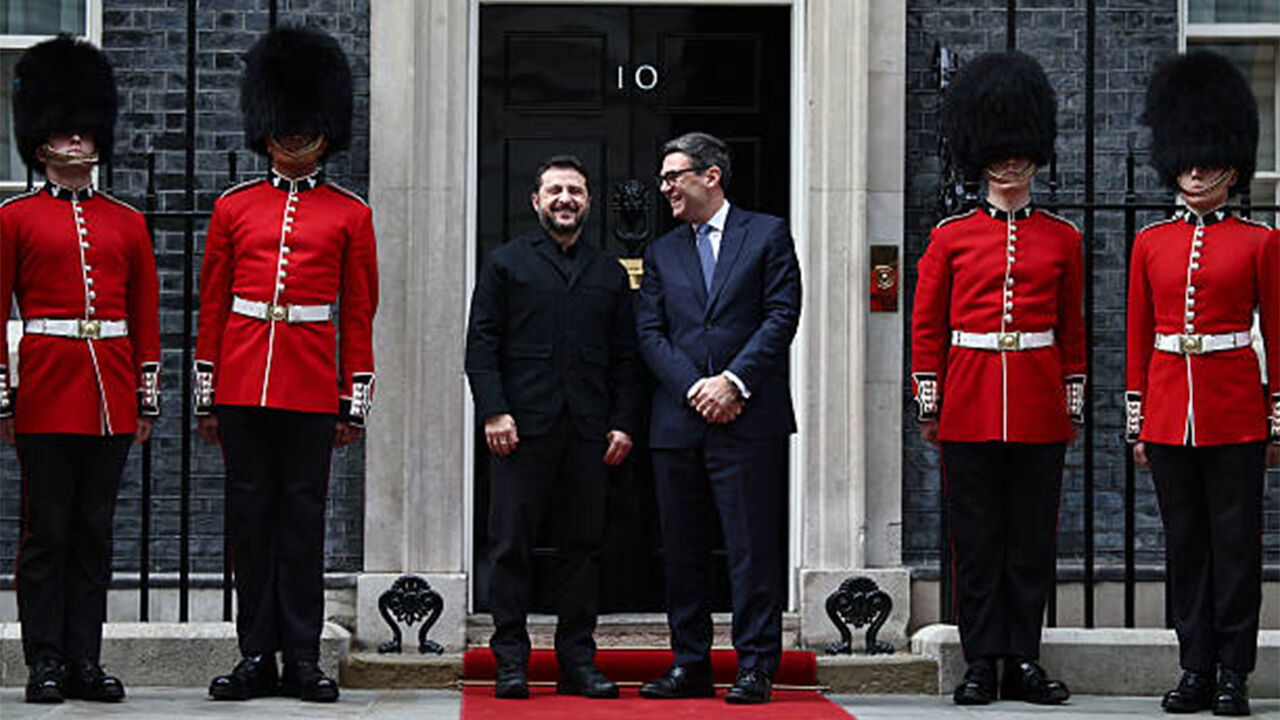
▲ Ukrainian President Volodymyr Zelenskyy visits the British Prime Minister's residence
European nations have stepped up to pledge stronger support for Ukraine as it continues its war against Russia.
The move comes as the Donald Trump administration in the United States pressures Ukraine to accept an energy truce with Russia, threatening to cut off intelligence sharing and other forms of assistance.
The New York Times reported on October 14 (local time) that British Prime Minister Andy Burnham held a meeting with Ukrainian President Volodymyr Zelenskyy and promised to bolster military and economic support.
Prime Minister Burnham promised to supply Ukraine with new, effective air defense missiles against Russia, stating, "We will deploy them as quickly as possible."
King Charles III also received President Zelenskyy at Buckingham Palace for 25 minutes, lending weight to the support for Ukraine.
Britain also had the Irish Guards, a unit of the British Army, greet President Zelenskyy upon his arrival at the Prime Minister's residence.
Foreign media outlets, including Politico, interpreted the deployment of an honor guard for a visiting foreign leader as an unusual gesture that symbolically demonstrates Britain's support for Ukraine.
Mark Rutte, Secretary General of the North Atlantic Treaty Organization (NATO), urged continued support to strengthen Ukraine's air defense capabilities during a joint press conference with Estonian Prime Minister Kristen Michal.
Secretary General Rutte emphasized the need for stronger alliance support, stating, "Putin is trying to wear down our resolve and cut off support for Ukraine, but Russia is losing on the battlefield and we will not yield."
Estonia stepped forward to provide 10 million euros (approximately 15.09 billion won) to Ukraine through the Prioritized Ukraine Requirements List (PURL), a U.S. weapons procurement system.
PURL is a system through which Ukraine's allies shoulder the costs to purchase U.S.-made weapons and supply them to Ukraine.
Europe has rushed to pledge such support because of growing concerns that security cooperation between Ukraine and the U.S. could be severed over the recent energy truce issue.
These concerns have intensified after U.S. President Trump and President Zelenskyy clashed over a transit deal between the U.S. and Russia, following which early warning data on Russian ballistic missiles previously provided by the U.S. was abruptly cut off, and unexpected speed restrictions were placed on Starlink services.
At the same time, observers point out that no matter how much Europe steps up as a backer, it cannot fully replace U.S. support.
Given that U.S. security assistance capabilities far outweigh those of other nations, losing them would inevitably deal a major blow to Ukraine.
Thomas Withington, a researcher at the Royal United Services Institute (RUSI) in Britain, noted that while European intelligence agencies have "considerably strong" capabilities, information shared among individual nations can become fragmented or duplicated, which may slow down intelligence-sharing speeds.
He explained, "While it is not impossible for Europe to replicate U.S. intelligence sharing, if the U.S. provides additional capabilities, the weight of the intelligence becomes greater, which is why U.S. support is so crucial."
(Photo: Getty Images)
※ Please note: This article was translated by AI and may contain errors.


 Video News

 Video News
 Video News
 Video News