
 KOR
KOR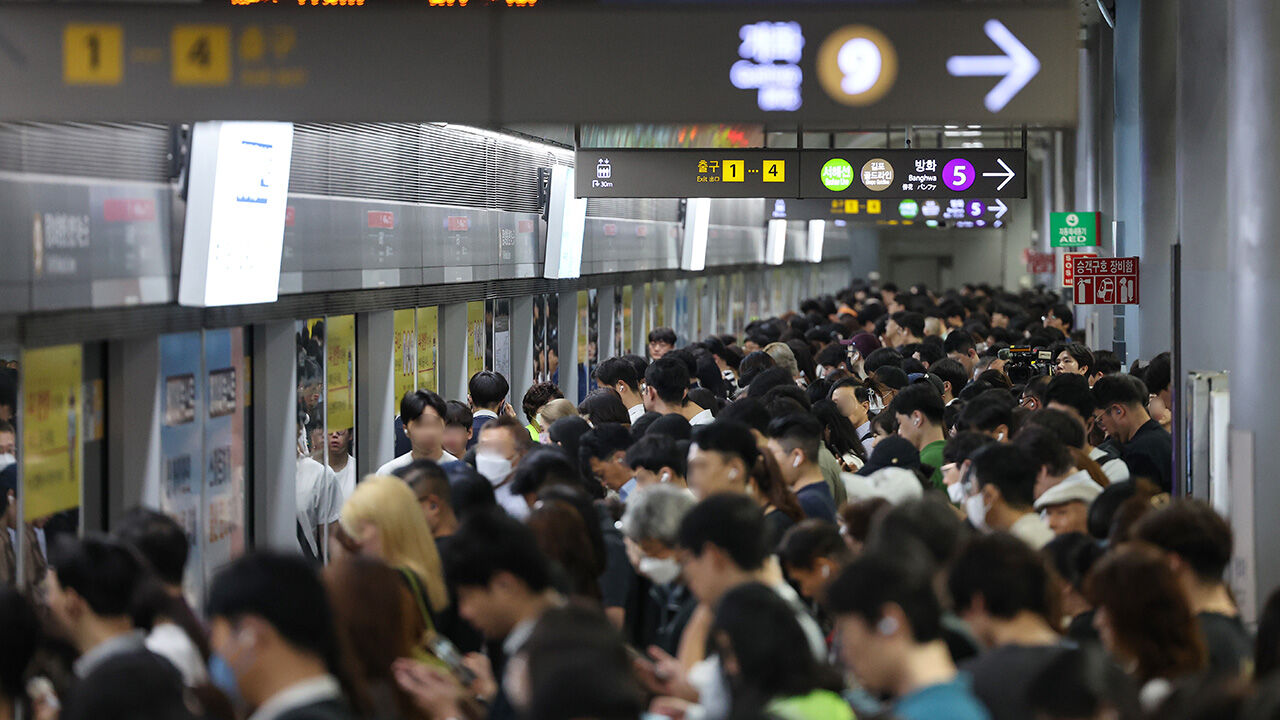
▲ Passengers wait for a train at Gimpo Int'l Airport Station on Seoul Subway Line 9. (Photo: Yonhap News)
Seoul Subway Line 9, notorious for its heavy congestion and often called the "Hell Train," is expected to see its rush-hour train operations increased by eight runs, which is projected to lower congestion levels by more than 20 percentage points.
Additionally, express buses that stop only at key stations will be introduced on a trial basis to connect outer districts of Seoul—such as Dobong, Gangdong, Sangam, and Gangseo—to the downtown area.
Yeo Jang-kwon, head of the Seoul Metropolitan Government's Transportation Office, announced these measures during a briefing at Seoul City Hall today (October 14), stating that they will take effect starting November 16.
"While transportation options such as metropolitan buses and Great Train Express (GTX) lines entering downtown Seoul from the capital region are increasing, there is a lack of consideration for transportation means heading to the downtown area from the outer areas of Seoul," Yeo said. "We have prepared these measures to supplement this gap."
Under this new plan, Line 9 will adjust its ratio of express and regular trains based on demand by time slot for the first time since its opening.
Between 5:40 AM and 7:00 AM, the sequence of trains heading from Gaehwa Station toward Jugang Bohun Hospital Station will be expanded from the existing "1 express and 1 regular" rotation to a "2 express and 1 regular" rotation.

The start of intensive rush-hour operations will be moved up by 50 minutes, from 6:30 AM to 5:40 AM.
Under the new timetable, once the first express train finishes its run and returns, there will be enough capacity to deploy one additional train during peak morning commuting hours.
As a result, total train operations during the morning hours will increase by eight runs.
Yeo explained that this is equivalent to adding four trainsets (24 cars) per day, an effect that would normally require an investment of about 66 billion won.
Based on Dongjak Station, between 7:00 AM and 8:30 AM, the express train dispatch interval in the direction of Gaehwa to Jugang Bohun Hospital will be shortened from 6 minutes and 20 seconds to 6 minutes, while the opposite direction will be shortened from a maximum of 13 minutes down to between 6 minutes and 20 seconds and 8 minutes.
The city expects the peak morning congestion rate to drop from 182.3% to 174.2% for the express section from Noryangjin to Dongjak toward Jugang Bohun Hospital, and from 192.5% to 172.1% for the opposite section from Dongjak to Noryangjin.
Initially, the Seoul Metropolitan Government had placed an additional order for Line 9 trains to ease congestion. However, after railway vehicle manufacturer Dawonsys failed to deliver the trains on time, causing setbacks in the expansion plans, the city canceled the order this April and has since been working on alternative congestion-relief measures.

In the bus sector, four "median lane express bus" routes that stop only at major stations will be operated on a pilot basis.
While running along the same paths as existing routes, these buses will pick up passengers at major stops in outer areas—similar to metropolitan buses in the capital region—bypass intermediate stops, and drop passengers off at major downtown hubs such as City Hall and Yeongdeungpo.
The target routes are ▲ Express No. 150 from Dobong Depot to City Hall Station, ▲ Express No. 370 from Gangdong Depot to Chungjeongno Station, ▲ Express No. 470 from Sangam Depot to City Hall Station, and ▲ Express No. 605 from Gangseo Depot to Yeongdeungpo Station.
Each route will operate three times a day—once at dawn and twice during the morning rush hour—and will revert to regular routes after the commuting period ends.
The city estimates that these express buses will have 45.8% fewer stops than regular routes, reducing travel time by about 10%.
Following the pilot operation, the city plans to analyze user demand and effectiveness to review whether to expand the routes.
"Recruitment and training of train drivers for the Line 9 expansion and consultations with related organizations have become tangible, bringing the full-scale implementation on November 16 within reach," Yeo said. "We will continue our efforts to intensively supply necessary transportation services during commute hours so that citizens can make productive use of the time saved."
(Photo: Yonhap News)
※ Please note: This article was translated by AI and may contain errors.




 Video News
 Video News
 Video News