
 KOR
KOR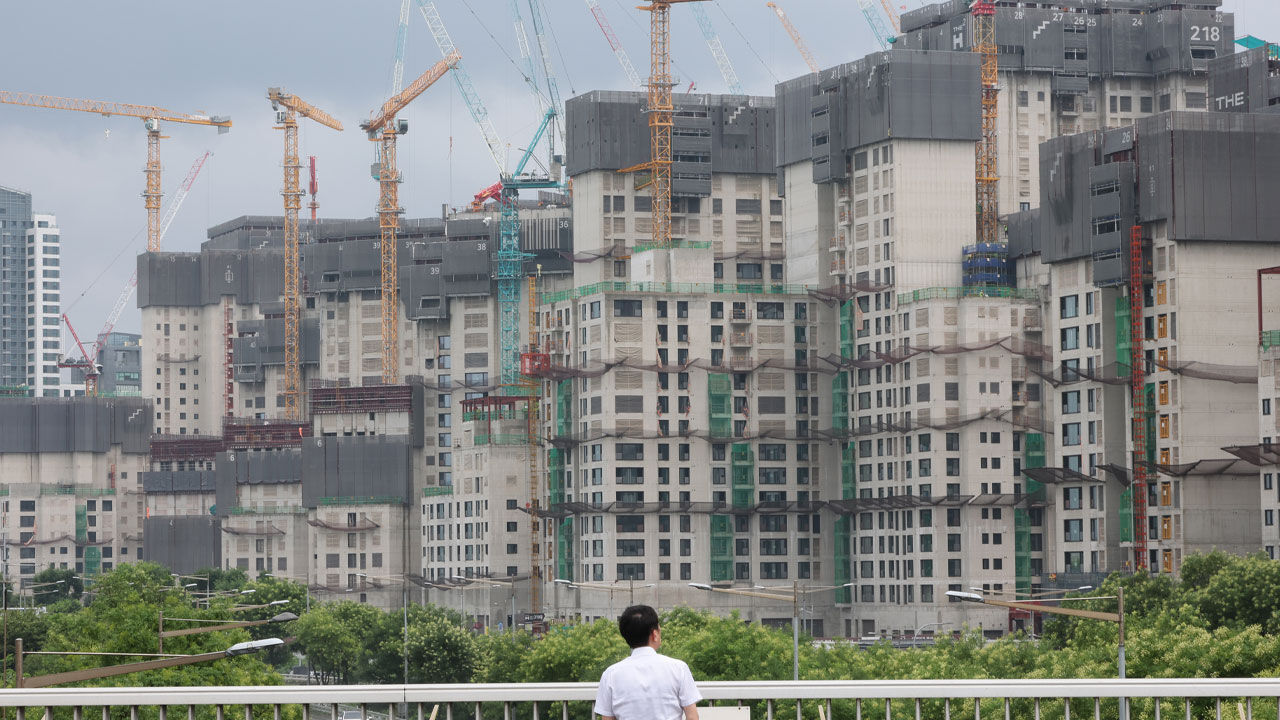
▲ An apartment reconstruction site in Seocho-gu, Seoul, on July 23. (Photo: Yonhap News)
Domestic construction orders in August fell for the third consecutive month as continued sluggishness in the private sector offset a rebound in the public sector, data showed.
The downturn in the construction industry appears to be prolonging, with the number of construction employees declining for the 28th straight month.
According to the Monthly Construction Market Trends (October 2026 issue) released today by the Construction & Economy Research Institute of Korea, construction orders in August totaled 15.7 trillion won, down 8.1 percent from the same month last year.
Compared to the previous month, orders also decreased by 10.3 percent, extending a three-month downward trend.
However, the figure was 2.6 trillion won higher than the August average over the past three years.
By ordering sector, public construction orders rose 5.9 percent year-on-year to 4.7 trillion won, driven by large-scale road construction projects such as the Second Gyeongchun National Highway.
Conversely, private orders fell 13.0 percent to 11 trillion won. Despite securing large-scale redevelopment projects such as District 4 of the Apgujeong Apartment Special Planning Zone in Seoul, the sector was dragged down by slumps in civil engineering (-21.2 percent) and non-residential building (-32.2 percent).
Construction work-done, which reflects actual execution performance, stood at 11.6 trillion won, marking a 7.4 percent increase from the same month last year.
However, it fell short of previous August levels (14.1 trillion won in August 2023 and 13 trillion won in August 2024).
Public and private work-done increased by 8.7 percent and 7.1 percent, respectively, while civil engineering (13.4 percent) and non-residential building (19.2 percent) also grew.
Yet, residential building work-done declined by 2.7 percent, continuing the slump in the housing sector.
Employment conditions in the construction industry showed no signs of improvement.
Construction workers totaled 1.878 million in August, up 0.7 percent from the previous month, but down 1.7 percent from the same month last year, marking a 28-month consecutive decline.
This contrasts with a 0.6 percent increase in total employment across all industries over the same period.
Cost burdens stemming from rising construction costs also persisted.
The construction cost index in August reached 138.74, up 6.0 percent from a year earlier.
This is approximately double the consumer inflation rate (3.1 percent) for the same period.
In particular, the producer price index for general reinforcing bars rose 11.5 percent and the market price index climbed 18.3 percent, adding to material cost pressures.
Business sentiment among construction firms remained sluggish as well.
The Construction Business Survey Index (CBSI) for September stood at 73.2, edging up just 0.5 points from the previous month.
A CBSI reading below 100 means that companies with a negative outlook on the construction business outnumber those with a positive outlook.
While the work-done index and the order-receivables collection index rose by 1.6 points and 8.8 points, respectively, the new orders index fell by 0.8 points.
By company size, the large enterprise index rose 8.4 points from the previous month to 91.7, hitting a yearly high.
In contrast, mid-sized builders (68.0) and small builders (60.0) fell 5.1 points and 1.8 points, respectively, widening the gap between large and small companies to 31.7 points.
The comprehensive construction business outlook index for October came in at 77.5, up 4.3 points from September's performance, but still below the baseline.
※ Please note: This article was translated by AI and may contain errors.



 Video News
 Video News
 Video News
 Video News