
 KOR
KOR
The amendment includes the establishment of the "right to fair compensation," which allows creators to demand fair compensation for profits generated from the exploitation of their works, even after transferring the rights necessary for using those works.
Lawmaker Im explained the legislative intent behind proposing the Copyright Act amendment to establish a legal basis, stating, "Even when works like 'Squid Game' achieve global success, creators who fail to sign special clauses receive nothing, and the structure itself makes it difficult to even negotiate such clauses."
The "Creators' Alliance for Fair Compensation of K-Content" (abbreviated as the "Creators' Alliance"), a coalition consisting of six organizations including the Korea TV and Radio Writers Association and the Directors Guild of Korea, participated in the press conference that day to state that writers, directors, producers, and performers are being excluded from shares of a work's success due to buyout contract practices regarding copyrights by global OTT services like Netflix.
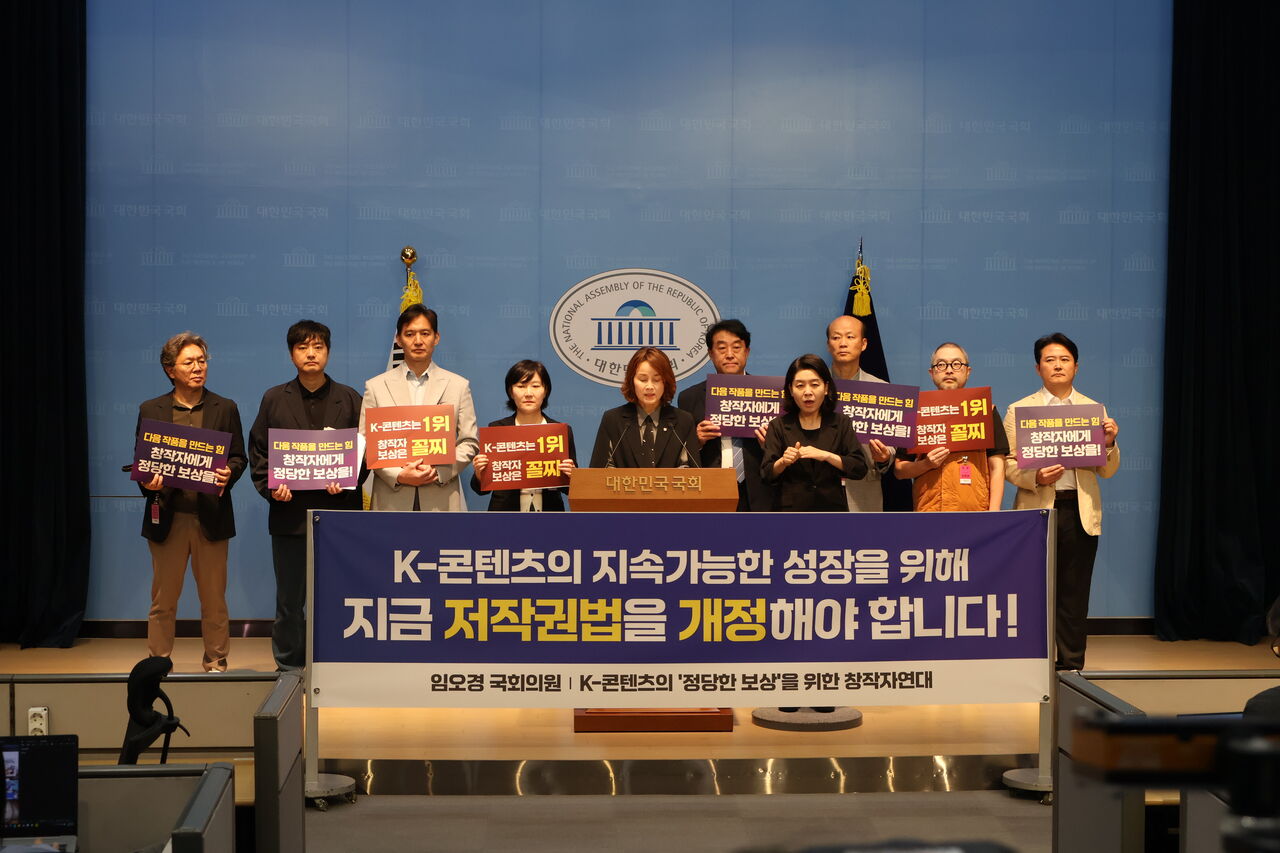
Park Hae-young, the writer who penned dramas such as 'My Mister' and 'My Liberation Notes', stated that global OTT services such as Netflix and Disney Plus demand contracts that surrender all copyrights, conveying the reality that creators' copyrights are being unfairly stripped away.
Song Young-woong, chairman of the Korea Broadcasting Performers' Rights Association, pointed out the absence of a legal basis to compel negotiations with global OTTs, noting that he had requested negotiations with Netflix but received no response. In connection with this, Moon Hyun-sung, copyright committee chairman of the Directors Guild of Korea, explained that the United States, Europe, and South America guarantee fair compensation for the exploitation of works through laws or collective agreements, stating, "Fair compensation is an international standard."
Kang Ho-jun, chairman of the Korea Independent Producer Association, pointed out the imbalance in compensation systems between music and video, noting that when music is streamed, copyright royalties go to composers and lyricists, whereas video creators do not receive compensation for the exploitation of their works.
Actor Im Ho shed light on the difficult livelihood realities of creators, stating that the average annual appearance fee for broadcasting actors is 7.58 million won. Baek Jae-ho, chairman of the Association of Korean Independent Film & Video, emphasized that fair compensation is necessary for creators to continuously produce good works, describing this Copyright Act amendment as a livelihood-focused bill that supports the survival of creators.
Lawmaker Im expressed her legislative commitment, stating, "I will stand together until the day a legal basis is established to guarantee the rights of K-content creators, which is a core element of a sustainable K-culture ecosystem." The Creators' Alliance urged the National Assembly to promptly pass the amendment and demanded that the government lend its support so that creators can receive fair compensation and foster the K-video industry.
(Photo: Yonhap News, reported by Kim Ji-hye for SBS E&S)
※ Please note: This article was translated by AI and may contain errors.




