
 KOR
KOR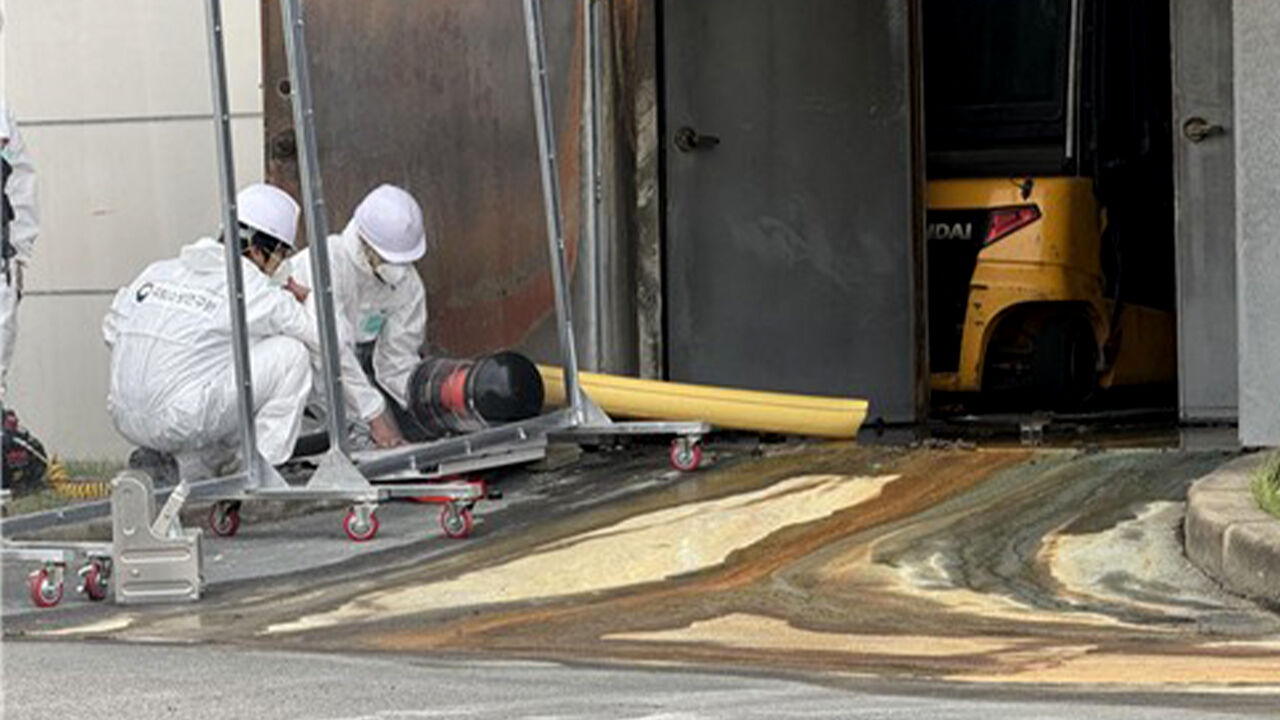
▲ The Vine Robot being deployed on the ground
A "vine robot," capable of moving flexibly like plant vines, was deployed to a battery manufacturing plant fire site fraught with the risks of serial explosions and collapses, successfully carrying out a reconnaissance mission to closely assess internal safety conditions.
The National Fire Research Institute of the National Fire Agency announced yesterday (October 11) that, in cooperation with the Korea Advanced Institute of Science and Technology (KAIST), it deployed the vine robot in August of this year to a finished product warehouse fire at a primary battery manufacturing plant in South Chungcheong Province, successfully completing reconnaissance tasks such as checking internal safety conditions.
According to the institute, although the fire at the time was extinguished early on, a significant portion of the approximately 210,000 military primary battery packs stored inside remained unburned but exposed to high heat.
Deeming that there was a high risk of triggering secondary thermal runaway and serial explosions, the fire authorities completely restricted internal access for two weeks after extinguishing the fire while conducting monitoring from the outside.
The authorities considered deploying tracked equipment or quadrupedal walking robots for internal reconnaissance, but concluded that their own weight could apply pressure to the batteries on the floor and potentially cause secondary thermal runaway.
Instead, cooperating with the research team led by Professor Yoo Ji-hwan of KAIST—which has been evaluated as possessing world-class technological prowess in the field of soft robotics—they deployed an ultralight, pneumatic expansion-driven vine robot into the warehouse.
The vine robot deploys by growing flexibly like a plant vine when compressed air is injected, minimizing ground load and allowing it to safely pass through narrow spaces without physically stimulating the batteries.
To ensure the safety of the personnel remotely controlling the vine robot from outside the building, a protective barrier was installed, and the team members carried out the robot reconnaissance mission while wearing specialized protective gear within a safe zone.
Kim Yeon-sang, head of the National Fire Research Institute, stated, "We will take the lead in advancing field-centric robot technologies that secure the safety of personnel and support mission completion by directly reflecting the conditions and overcoming challenges required at fire scenes."
(Photo provided by the National Fire Research Institute, Yonhap News)
※ Please note: This article was translated by AI and may contain errors.


 Video News
 Video News
 Video News

 Video News