
 KOR
KOR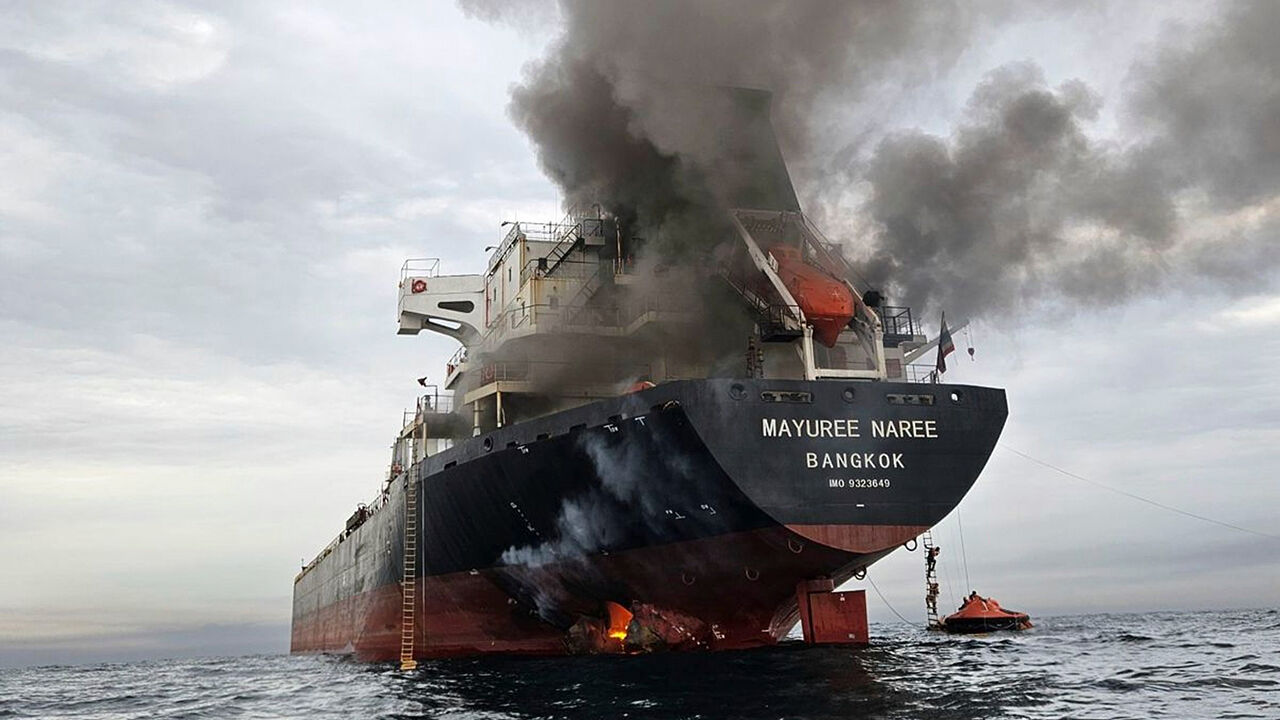
▲ A Thai-flagged cargo ship hit by an Iranian missile attack in the Strait of Hormuz
Amid desperate efforts to transport crude oil out of the Strait of Hormuz despite relentless attacks by Iran, the compensation for oil tanker crews, including hazard pay, is soaring, the British daily Financial Times reported.
According to industry insiders, tanker owners are offering massive amounts of hazard pay to keep crew members working in the dangerous waters.
Amid intensified Iranian attacks, tanker captains receive a monthly salary of 100,000 dollars (approx. 130 million won) for traversing the Strait of Hormuz.
Separately, a bonus of 50,000 dollars (approx. 70 million won) is paid for each transit through the Strait of Hormuz.
A typical tanker captain's monthly salary is known to be about 15,000 dollars (approx. 20 million won).
Even excluding the bonus, the monthly salary alone is more than six times the usual level.
The monthly wages for regular crew members deployed to navigate the Strait of Hormuz have also increased significantly.
Regular crew salaries start at 1,500 dollars (approx. 2 million won).
However, when boarding oil tankers passing through the Strait of Hormuz, their monthly wages increase by at least four to six times.
Oil tankers carrying about 2 million barrels of oil accommodate up to 35 crew members.
Currently, the tankers passing through the Strait of Hormuz are so-called shuttle tankers that repeatedly ply a short, highly vulnerable route in the Strait exposed to Iranian attacks, transferring crude oil from inside the Persian Gulf to the outside.
Consequently, crew members working on these vessels can earn higher-than-normal wages over several months.
Crude oil that breaks through Iran's blockades and exits the Persian Gulf trades at high prices.
As a result, high operating costs for shuttle tankers, such as massive increases in crew pay and allowances, do not pose a major problem.
Furthermore, for Gulf oil-producing countries such as the United Arab Emirates (UAE) and Saudi Arabia, alternative means such as pipelines have limitations, leaving them with no choice but to continue crude oil exports—which are practically their economic lifelines—through the Strait of Hormuz.
As the shipping system before the outbreak of the war collapsed, oil-producing nations like the UAE and Saudi Arabia are urgently assembling and operating large fleets of directly managed shuttle tankers.
This method involves directly delivering shipments to customers through commando-style shuttle tankers across only the dangerous Strait of Hormuz section.
Conversely, Iran, which views securing control over the Strait of Hormuz as leverage in negotiations with the United States, is fiercely targeting these shuttle tankers.
Therefore, industry circles sometimes compare these crew members to mercenaries who have jumped into the middle of a war to make money.
An industry insider told the Financial Times that among crew members, those who venture into voyages across the Strait of Hormuz are viewed like mercenaries.
Recently, news reports have emerged consecutively showing that the crude oil export volumes of Persian Gulf oil producers have recovered close to pre-war levels.
In response, Iran has further intensified its attacks on shuttle tankers, out of concern that its leverage against the United States might weaken.
According to the International Maritime Organization (IMO), a total of 93 vessels have been attacked in the Strait of Hormuz region since the outbreak of the U.S.-Iran war on February 28.
Consequently, 24 crew members have lost their lives.
Data from shipping analytics firm Windward shows that about 2 percent of vessels passing through the Strait of Hormuz in the third quarter were attacked.
The reason many tanker crew members boarded ships sailing through the Strait of Hormuz despite these dangers is the high financial compensation.
Many of them hail from relatively impoverished regions such as the Philippines, India, Indonesia, Russia, and Ukraine.
In their home countries, it is difficult to earn as much money as can be made on tankers operating in the Strait of Hormuz.
However, it is reported that in some cases, crew members are coerced into participating in dangerous voyages through the Strait of Hormuz against their will.
Manoj Yadav, general secretary of the National Union of Seafarers of India, told the Financial Times, "In some cases, shipowners coerce reluctant crew members into sailing by stating that if they refuse, even repatriation costs will be deducted from their wages," adding, "Crew members can lose their jobs if they disagree, and their lives if they agree."
(Photo: AP, Yonhap News)
※ Please note: This article was translated by AI and may contain errors.



 Video News
 Video News

 Video News