
 KOR
KOR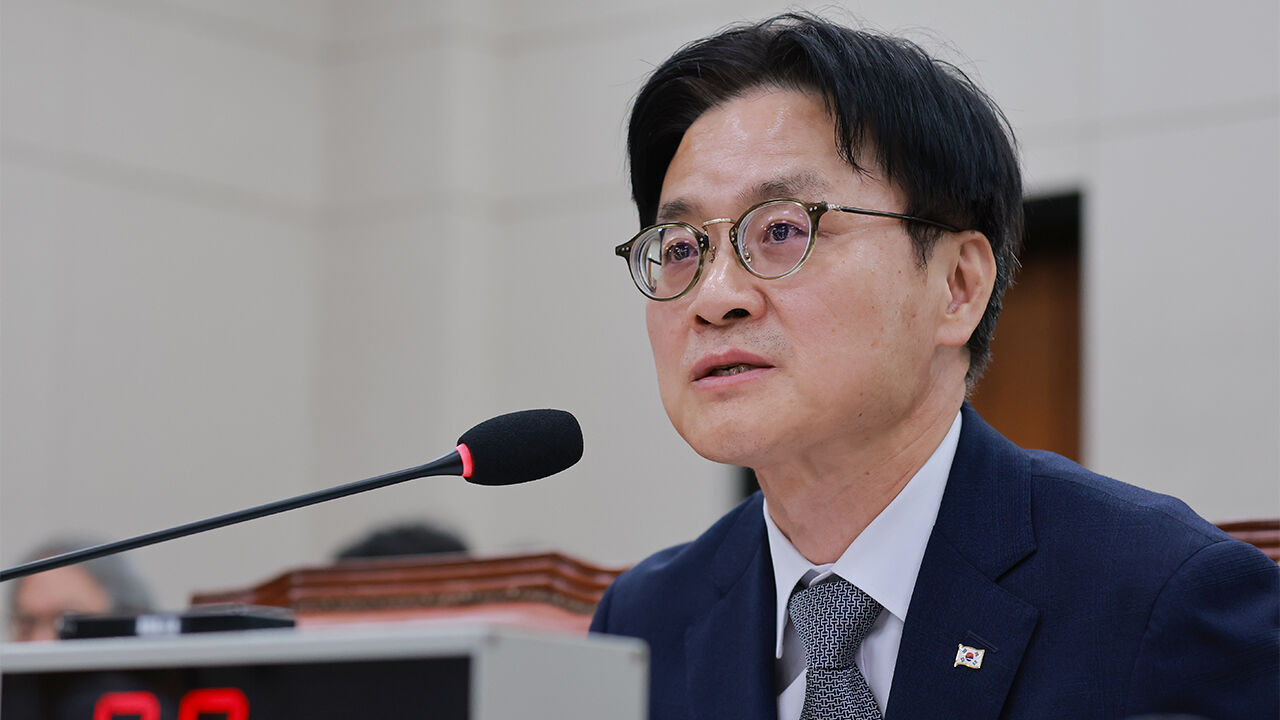
▲ Minister of Trade, Industry and Energy Kim Jung-kwan answers questions from lawmakers during a parliamentary audit held by the Trade, Industry, Energy, SMEs and Startups Committee at the National Assembly on the 6th.
The South Korean government has softened its tone just days after pushing back against U.S. President Donald Trump's assertion that South Korea's investment in the Alaska liquefied natural gas (LNG) development project is a fait accompli.
While refraining from directly commenting on President Trump's announcement, the government has kept the door open for participation in the Alaska LNG project, stating that "new strategic value has emerged."
During a parliamentary audit by the National Assembly's Trade, Industry, Energy, SMEs and Startups Committee on the 6th, Minister of Trade, Industry and Energy Kim Jung-kwan addressed a question from Democratic Party lawmaker Song Jae-bong regarding how the government plans to respond to President Trump's unilateral investment announcement. "It is not appropriate to individually comment on remarks made by a foreign head of state," Minister Kim responded, adding, "We are closely discussing related matters with the U.S. government."
Previously, President Trump unilaterally announced that "South Korea will invest $50 billion in the Alaska LNG project" and claimed that South Korea would pour $8.4 billion into an Enhanced Oil Recovery (EOR) project.
Minister Kim's remarks during the audit marked a notable shift in nuance compared to his initial response.
During a briefing at the Government Complex Sejong on the 1st, Minister Kim stated, "South Korea and the United States share the understanding that the Alaska project will not be pursued unless it makes commercial sense."
Minister Kim also noted that he had raised objections and expressed regret to U.S. Secretary of Commerce Howard Lutnick over President Trump's announcement of unagreed-upon investments.
However, as the U.S. maintains an asymmetric structure where it can pull out tariff hike cards at any time using Section 301 of the Trade Act, and with President Trump warning on the 2nd regarding the Alaska project that "(South Korea) will double it if they don't reach a deal soon," the government appears to have adjusted its response intensity.
"The biggest shock from the perspective of trade authorities recently was the import ban on Canada," Minister Kim said. "In an environment where sudden measures can occur at any time, managing the trade environment stably is more important than anything else."
"We are making efforts to ensure that our tariffs, such as the 15% on automobiles, are maintained," he added, asking for understanding of the situation given that the U.S. domestic schedule is complex and negotiations are underway.
During the audit, Minister Kim also mentioned positive aspects of the Alaska LNG project.
In response to a related question from People Power Party lawmaker Choi Su-jin, Minister Kim explained, "It is true that it hasn't been pursued previously because its economic viability was clearly low, but there are definitely parts where new strategic value has been created after going through the Middle East war."
Minister Kim conveyed that the war has caused difficulties in importing Middle Eastern LNG, and that shipments departing from the Persian Gulf are being diverted around the Cape of Good Hope due to disruptions in Panama Canal transit.
"If the Alaska LNG development project succeeds and we can bring in the LNG produced there, it certainly has strategic value," he said.
Furthermore, Minister Kim noted changes in the project environment compared to the past, pointing out that "the U.S., which previously pursued the Alaska LNG development project centered around the private sector, is now shifting to drive it under federal government leadership."
On the other hand, lawmaker Choi criticized that while the project had not been pursued for the past 40 years due to a lack of economic viability, the U.S. side specified an "agreement to initiate work" in its fact sheet, presenting large-scale investment as a fait accompli.
Lawmaker Choi pointed out that "at a time when even the verification of economic feasibility and validity has not finished, conflicting announcements between South Korea and the U.S. have dealt a blow to diplomatic trust and provided an excuse for tariff retaliation," while urging a Board of Audit and Inspection audit at the standing committee level regarding the overall negotiations.
In response, Minister Kim rebuked, "As I have repeatedly mentioned, the meaning of initiating a review is premised on commercial rationality. The fact sheet was a document jointly and identically released by both South Korea and the U.S., and nothing was hidden from the National Assembly."
The Alaska LNG development project is a project to transport natural gas produced on the North Slope of northern Alaska via a pipeline approximately 1,300 kilometers long to Nikiski, a port in southern Alaska, and then export it to Asia and elsewhere.
U.S. President Donald Trump announced on the 30th of last month, while announcing South Korea's areas of investment in the U.S., that South Korea had decided to invest in the Alaska LNG project, and Commerce Secretary Lutnick claimed that the investment scale is around $50 billion or more.
However, the South Korean government maintains its stance that the Alaska LNG project is at the review initiation stage and investments have not been finalized.
When lawmaker Choi stated that a full investigation of internal Ministry of Trade, Industry and Energy documents confirmed that external consulting services for investment feasibility analysis of South Korea-U.S. strategic investment projects Nos. 1 through 3 had been commissioned, and asked what the target projects were, Minister Kim replied, "Projects Nos. 2 and 3 have nothing to do with the Alaska project."
Minister Kim added that specific project details can be explained under the premise that external security is guaranteed.
(Photo: Yonhap News)
※ Please note: This article was translated by AI and may contain errors.


 Video News
 Video News
 Video News

