
 KOR
KOR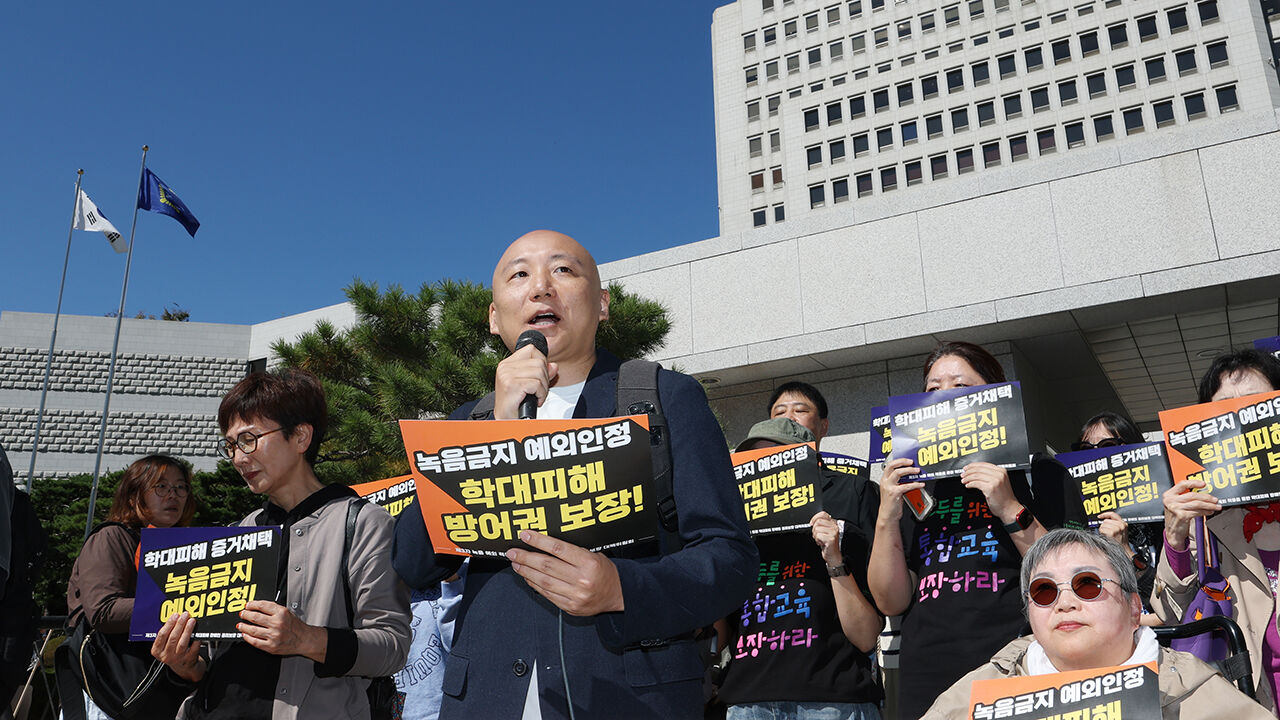
▲ Webtoon artist Joo Ho-min speaks during the second press conference urging exceptions to the ban on third-party recordings, hosted by the Committee for Guaranteeing the Rights of Abuse-Victored Persons with Disabilities through Exception Application to the Third-Party Recording Ban, in front of the Supreme Court in Seocho-dong, Seoul, on the 6th.
Webtoon artist Joo Ho-min urged the Supreme Court today (the 6th) to recognize "exceptions" to the law to allow third parties to covertly record situations when abuse of children with developmental disabilities is suspected.
Speaking at a press conference held in front of the Supreme Court in Seocho-gu by 10 organizations for people with disabilities, including the Solidarity for Act against Discrimination on Disability, Joo said, "Please establish standards so that the law can reach those who have difficulty speaking for themselves or leaving evidence."
Joo stated, "My son has an autism spectrum disorder. My son, who was 9 years old at the time of the incident, cannot explain what happened to him," adding, "The recording made by the child's mother served as evidence to reveal the fact of abuse in the first trial, but it was not recognized in the second trial on the grounds that it was made by a parent."
He continued, "Even though the exact same words were recorded, that voice was erased from the trial depending on who pressed the button," and argued, "I am not saying we should put recorders in every classroom. In places with no CCTV and no witnesses, where people cannot explain the harm or leave evidence, if we do not even allow recording, how can they protect themselves?"
Holding a placard that read "Recognize Exceptions to the Recording Ban, Guarantee the Right to Defense for Abuse Victims!" Joo chanted slogans with the participants and directly submitted petitions signed by about 24,000 people to the Supreme Court after the press conference.
He emphasized, "Even though you do not know our family well, you signed because you recognized that this is not just the problem of a single child or family, but of many people who have difficulty speaking for themselves," adding, "Our child is growing into a teenager and gradually learning to speak for himself. I hope he will tell his own story in his own voice, and until that day, I will speak for him."
In 2022, Joo used a recorder placed in his son's bag to capture statements such as, "Your behavior is very bad. Ah, I hate it. I hate it to death. I hate you. I hate you too. I really hate you," and filed a complaint against a special education teacher for child abuse.
The first-instance trial court recognized the admissibility of the recording as evidence and sentenced the teacher, surnamed A, to a suspended sentence with a fine of 2 million won.
However, the appellate court ruled that the covert recording fell under "private conversations between others not open to the public" pursuant to the Protection of Communications Secrets Act and thus lacked admissibility as evidence, thereby overturning the original judgment and rendering an acquittal.
This case is pending judgment by the Supreme Court following an appeal by the prosecution.
Attorney Cho In-young (from the Public Interest Law Foundation GongGam) stated, "School-sensed abuse against children with disabilities is extremely difficult to discover from the beginning. Schools are isolated spaces, and special education classes are even more isolated." She added, "Without recordings, the situation at the time is explained only as an educational context, and circumstances of abuse are concealed and minimized."
She further added, "If third-party recordings are not recognized as evidence, the case is highly likely to be closed at the investigation stage due to insufficient evidence, and even if it goes to trial, the court cannot even listen to recordings that lack evidentiary admissibility," calling this "a legislative loophole."
(Photo: Yonhap News)
※ Please note: This article was translated by AI and may contain errors.


 Video News
 Video News
 Video News
 Video News
 Video News