
 KOR
KOR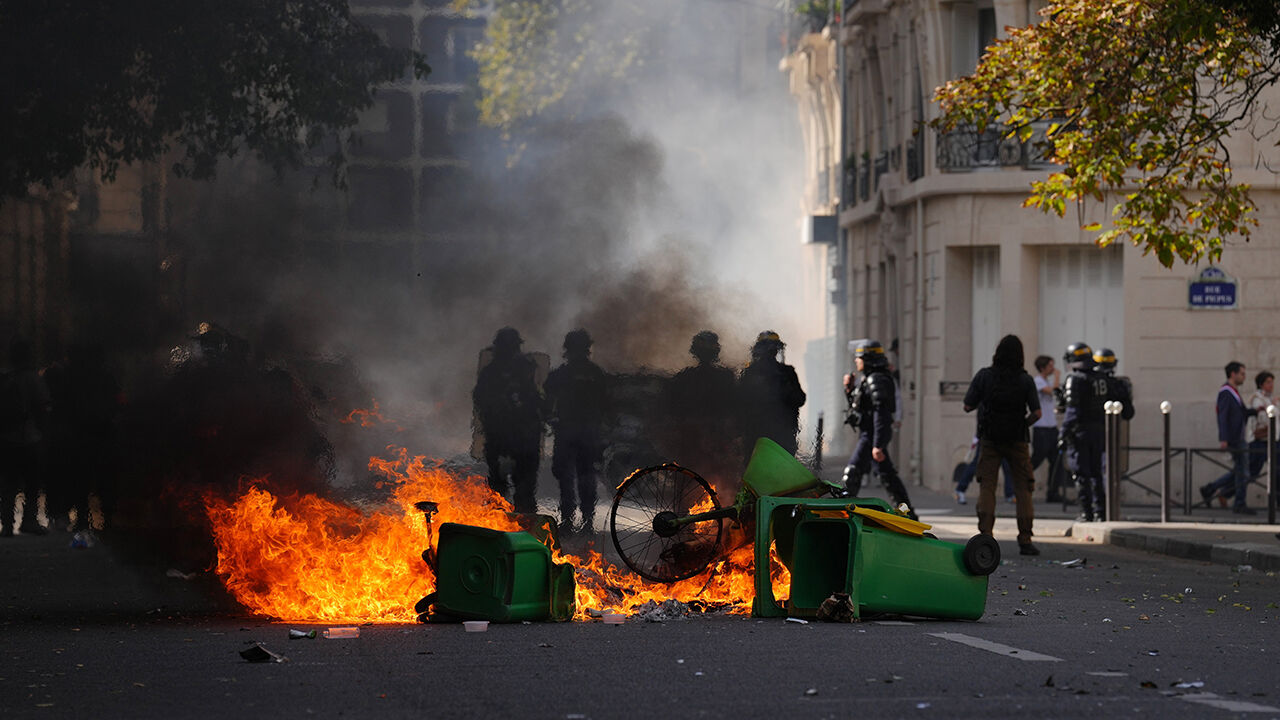
▲ Garbage cans and bicycles burn during a student protest in downtown Paris on October 2 (local time).
Protests by French high school students over poor educational conditions are intensifying day by day, compounding the difficulties faced by a French government struggling with a fiscal deficit.
Although the government attempted dialogue to calm students' anger, student organizations dismissed the government's response as unsatisfactory and announced large-scale rallies for next week.
French Education Minister Edouard Geffray stated on October 2 (local time) that out of 3,700 high schools nationwide, a total of 735 institutions were affected "in some form" by student protests as of that day.
Interior Minister Laurent Nunez announced that a total of 1,747 people had been arrested at the protest sites that day, stating, "Projectiles were thrown, and there were attacks targeting law enforcement agencies, teachers, journalists, and passersby."
The cumulative number of arrests since September 28 has exceeded 5,000.
Violence at the protest sites is becoming increasingly severe on both sides, involving protesters and police alike.
According to the daily Le Parisien, a police officer was knocked to the ground and beaten by a group of people in Belfort, eastern France, that day.
A video posted on social media captured a masked man spraying a homemade flamethrower into the face of a female passerby who attempted to block a group of protesters trying to vandalize a bus stop in Marseille the previous day.
The woman, who suffered burns to her face, filed a complaint with the police.
In Annecy, a female school supervisor was physically assaulted by a male student.
Police crackdowns have also crossed the line into excessive force.
According to the media outlet La Nouvelle Republique, 16-year-old Mael, who participated in a protest in Tours on September 30, lost sight in his right eye after being struck by a rubber bullet during a standoff with police.
Testimonies continue to surface on social media alleging that teachers who came out to protest sites to protect students were struck by police batons and shields.
Amnesty International's French branch also raised issues regarding the police's use of force on October 2, pointing out that police used tear gas, grenades, and batons while carrying out mass detentions of students.

The Ministry of the Interior estimated that more than 300 police officers and gendarmes were injured.
To pacify student grievances, Minister Geffray held meetings with student representatives, parents, and teachers on the afternoon of October 2.
Following the meetings, Geffray stated that work to improve how student voices are reflected within the educational system would begin immediately.
He also added that plans would be announced to accelerate the replacement of absent teachers next week and that a broad review of school timetables would be initiated.
However, student representatives stated that the meeting failed to yield the specific measures they demanded and announced plans to organize a massive nationwide protest on October 6.
Students are demanding improvements to poor educational environments, such as a chronic shortage of teachers, overcrowded classrooms, and aging school facilities, alongside an expansion of educational personnel and budgets.
Voices are also calling for the improvement or abolition of Parcoursup, France's university admission support platform, arguing that it exacerbates competition and inequality in the higher education admission process.
The demands of students flooding the streets place the French government, already plagued by a fiscal deficit, in an even more difficult position.
France's fiscal deficit ratio is projected to rise from 5.1% of Gross Domestic Product (GDP) last year to 5.4% this year.
In response, the government proposed a spending cut package worth 43 billion euros (approximately 65 trillion won) on October 1.
The Wall Street Journal (WSJ) analyzed that the government, which is pursuing fiscal soundness, faces a challenging task of appeasing protesters demanding more resources for schools while avoiding new large-scale spending commitments.
The protests have already forced the government into one policy retreat.
The government had included a plan in next year's budget bill to charge tuition fees for certain students preparing for universities and Grandes Ecoles after graduating high school, but withdrew it as student protests intensified.
This plan was among the policies that fueled backlash from protest participants.
(Photo: AP, Yonhap News)
※ Please note: This article was translated by AI and may contain errors.



 Video News
 Video News
 Video News