
 KOR
KOR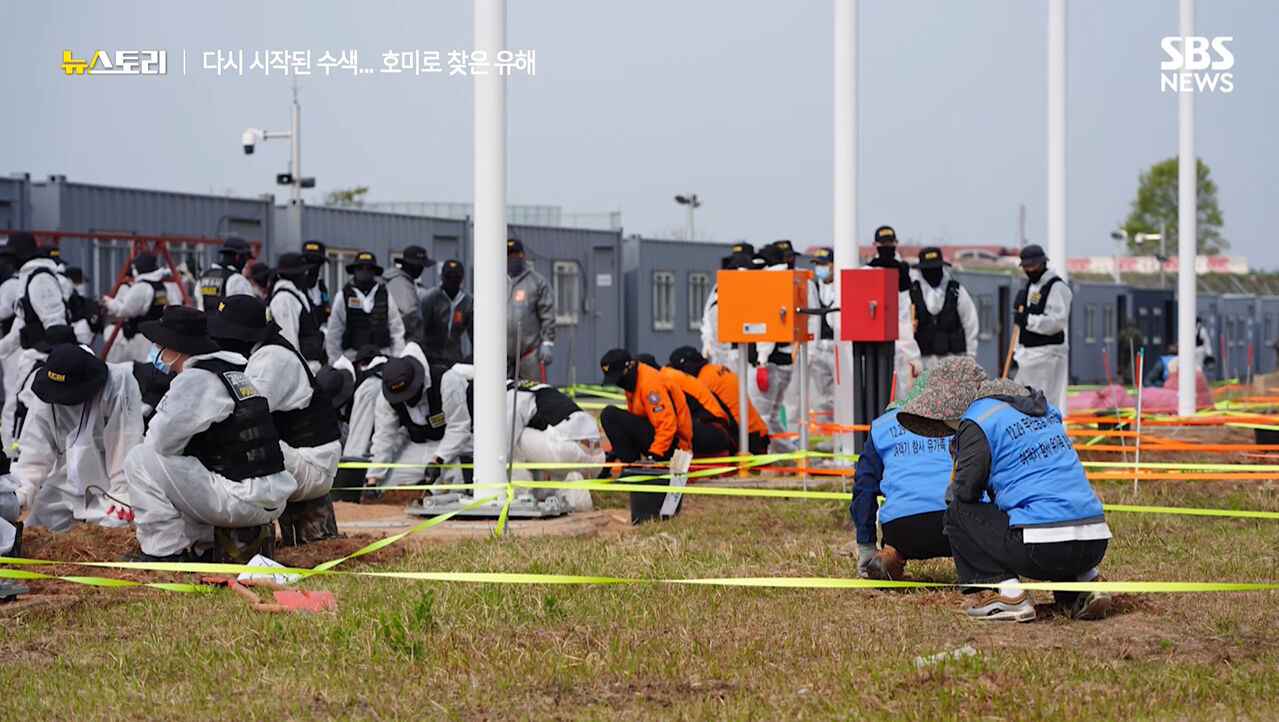
☞ [Reporter's Notebook ①] Search, Identification, Prevention: The State's Duties Shifted to Bereaved Families
☞ [Reporter's Notebook ②] Can One Mourn Without Knowing the Cause of Death?
Kim Seong-cheol lost his wife and daughter in the December 29 Muan Airport Jeju Air passenger plane disaster that claimed 179 lives. Until the first anniversary of the tragedy, he spent almost all his time at Muan International Airport handling affairs for the bereaved families' committee. He promised to return home after the one-year mark, but things did not go as planned. Struggling to adjust to daily life, he quit his job. Instead, by dedicating himself to the committee's work, he hoped to heal himself and be of help to other grieving families. One day, when his son asked why he had not come home despite his promise, he finally turned his attention to his son, who had been looking after the house alone. While he now spends more time at home, he still travels frequently to and from the airport, handling duties related to re-searching for remains and personal belongings.
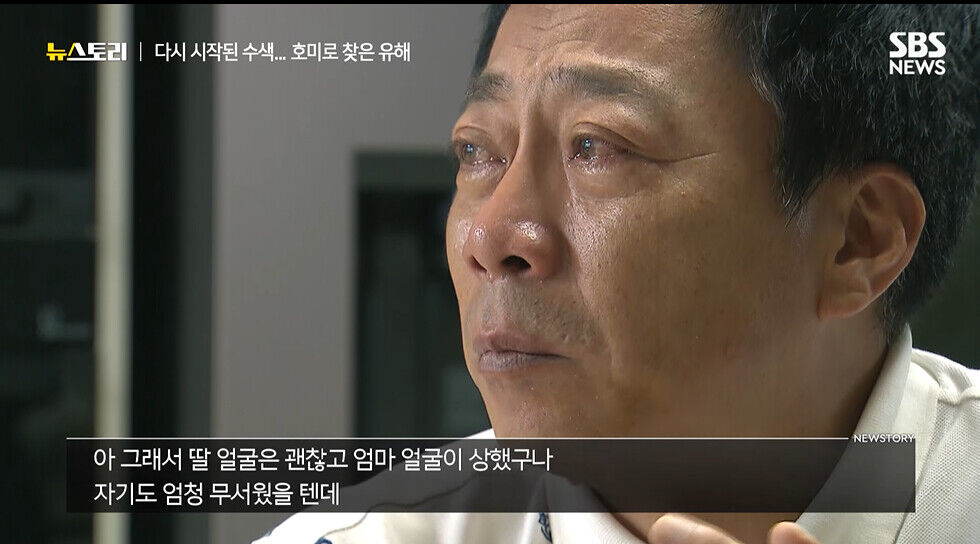
Kim's wife and daughter were social workers. In the summer of the year the accident occurred, the two had also flown from Muan Airport for a trip to Japan. Although they had previously used Incheon or Gimhae airports, Muan Airport was convenient because it was only a 30-to-40-minute drive from their home. Immediately after the crash, Kim identified his wife's body first. Officials advised him against viewing it directly, but he could not comply. Later, when he was notified that his daughter's identity had been confirmed through DNA testing, Kim told the rest of the family to stay outside and went in alone to see her. To his astonishment, his daughter's face looked just as it normally did. At that moment, Kim said, a vivid image formed in his mind of his wife holding their daughter tightly in her arms.
"Her face was so clean. I have a photo I took of my daughter sleeping when she was little. It looked truly 100 percent identical to that picture. But at that moment... how should I put it? An image formed in my mind. Her mother had held her tightly in her arms... Ah, that is why our daughter's face was spared while her mother's was badly injured. That picture became so clear... So I felt immensely grateful to my wife right then. She must have been terrified herself..."
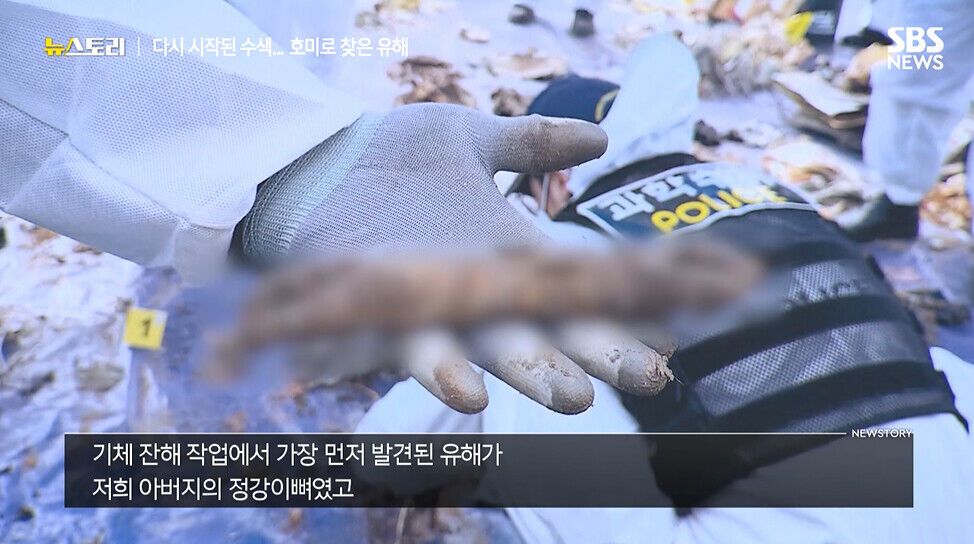
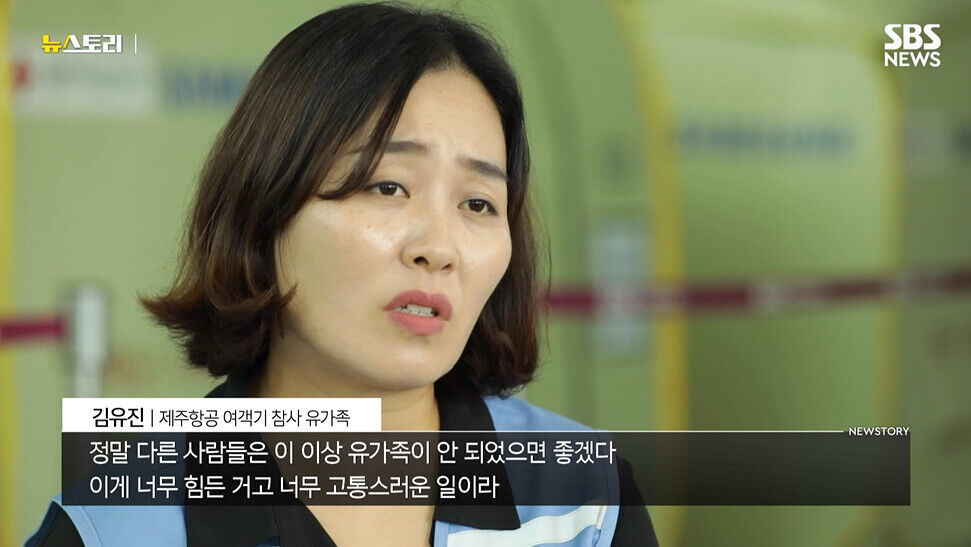
Kim Yu-jin, head of the bereaved families' committee, lost her parents and younger brother in the disaster. Her younger brother, Kang-heon, had been working in Cheonan and received vacation time as a long-service award from his employer. Although he could have traveled alone, he decided to take their parents, who lived in Gwangju, along with him. To save his parents from having to travel all the way to Incheon Airport and ensure they had as comfortable a journey as possible, they used Muan Airport. All three perished on their way back home from the trip. Having lost her parents and brother all at once, Kim said, "In effect, my entire family was wiped out." She added, "They were truly wonderful parents and a truly wonderful brother. Holding funerals for three people all at once was beyond devastating... I lived through days that felt impossible for a single human being to bear."
Yet that was not the end. More than a year after the crash, Kim received a bolt from the blue. An additional piece of her father's remains was discovered in the aircraft wreckage that had been kept in storage since the crash. It was a shinbone measuring over 25 centimeters. "When a reinvestigation of the fuselage wreckage began and large sack bags were opened, food waste, snack bags, personal effects, fuselage fragments, charred garbage, and wild rats came out. And among them were the remains of our family members... If it had been just one or two small fragments, I would have at least tried to understand that such oversights might happen. But the very first remain found there was my father's shinbone, and it measured more than 25 centimeters. It was a size that could hardly be missed by the naked eye—a remain that could never have been overlooked had meticulous work been done. To me, that was not just a bone, but my father himself, who had supported and held me up all my life... The guilt of realizing that while my father was left neglected outside the airport for over a year, I was sleeping comfortably, eating, and living my life..."
On April 13, a search of the crash site resumed at Muan International Airport. It had been one year and three months since the disaster. Personnel from the police, military, fire agency, and the Aviation and Railway Accident Investigation Board were deployed back to the site. Dividing the area where the aircraft traveled into sections, they removed layers of soil and sifted it through sieves to inspect it. The number of suspected remains and personal belongings recovered during the re-search continued to mount. According to an update on the re-search presented to the bereaved families by the Office for Government Policy Coordination on September 30, a total of 1,709 suspected remains and 906 personal effects were additionally recovered at the site. "Suspected remains" refers to items collected from the site on the suspicion that they might be human remains, meaning not all have been definitively confirmed as victims' remains. Among them, 1,265 pieces have been identified as belonging to 141 victims. These additional discoveries occurred in the area where relevant agencies had already terminated search operations twice before. Under what judgment and criteria, then, were those previous two searches concluded?
The initial search, from the day of the crash on December 29, 2024, to January 7 of the following year, was overseen by the Jeonnam Fire Service Headquarters. During a situational assessment meeting on January 7, fire authorities concluded that no additional remains were left to be found and ended the operation. However, the police discovered six more pieces of human remains at the site that very same day. The Joint Government Public Service Discipline Inspection Team under the Office for Government Policy Coordination judged that concluding the first search under such circumstances was a hasty decision.¹ Two days later, on January 9, the Jeonnam Provincial Police Agency launched another search. The second search ended on January 15 following an agreement with the bereaved families. But human remains were discovered at the site again on the following day, January 16. Despite knowing about the additional discovery, the police did not review the necessity of further searching. The inspection team concluded that in both instances, authorities brought the searches to an end without adequately considering the possibility of further discoveries or the conditions at the site.
At the time, the National Fire Agency's operational manual contained no specific guidelines regarding the scope or method for searching and recovering remains at an aircraft accident site. As a result, relevant agencies such as the fire service and police arbitrarily demarcated search sectors in the field without rational standards, and an investigation revealed that even when inexperienced personnel were deployed, relevant training or detailed search instructions were not properly provided. The searches were terminated twice amid an absence of concrete search criteria as well as inadequate on-site command and supervision.
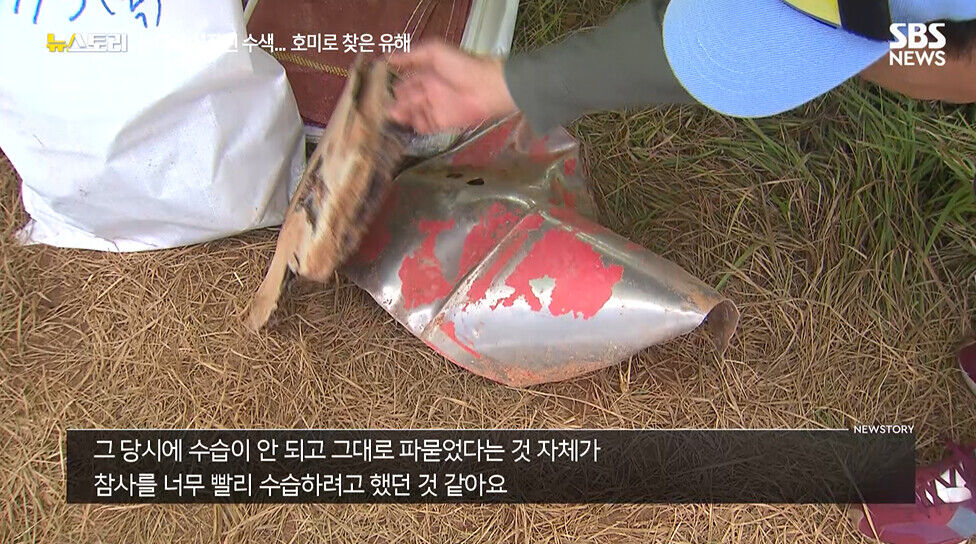
Problems persisted during the process of collecting and storing the aircraft wreckage after the searches concluded. Findings from the government inspection show that the Aviation and Railway Accident Investigation Board collected wreckage from the crash site over two days beginning January 16, 2025, and loaded it into large sacks. During this procedure, officials failed to properly verify whether human remains or personal belongings were mixed in with the wreckage. They also failed to draw up post-collection investigation plans or detailed inspection schedules. Instead of being transferred to a regulatory storage facility such as a hangar, the debris was left on an asphalt roadway at Muan Airport, packed in large sacks and cargo netting. Covered with tarpaulins and sunshades, it remained stored there for approximately 14 months. Although relevant regulations and manuals stipulated that debris must be stored and managed securely from external weather conditions such as rain and snow, this requirement was not observed.
The bereaved families had been demanding a reinspection of the aircraft wreckage since September of last year. Although this demand was forwarded to the accident investigation board through the Ministry of Land, Infrastructure and Transport's victim support team in September and October of that year, necessary measures, such as reviewing the release of the wreckage from storage, were not taken. On January 13 of this year, ahead of an on-site inspection by a special parliamentary committee for state investigation, officials from the accident investigation board discovered additional wreckage and personal effects during a preliminary survey. However, the inspection team revealed that even then, officials merely collected the discovered wreckage and did not consider conducting further searches. Although circumstances repeatedly indicated that remains or personal effects might still be left behind even after searches ended, it took more than a year for a full-scale re-search to begin.
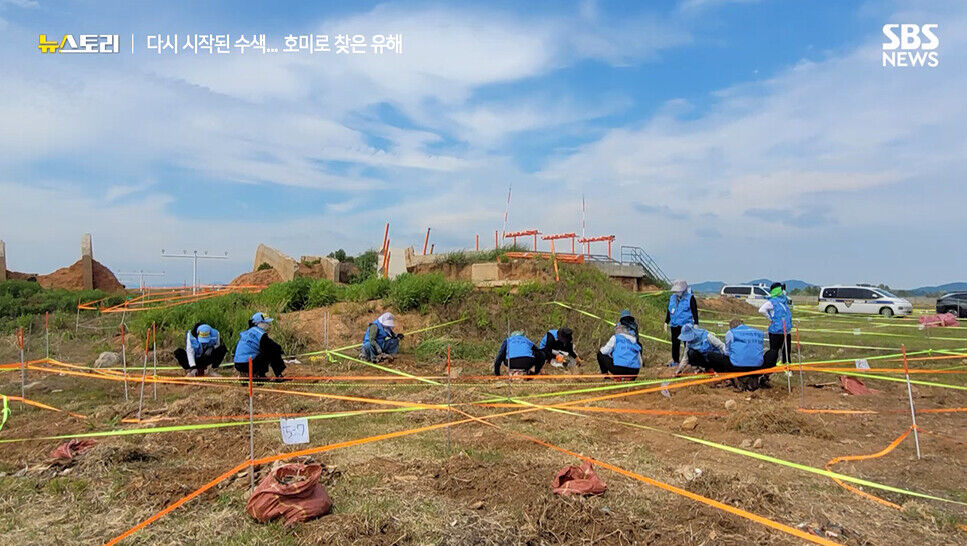
Before the comprehensive re-search began, the bereaved families took it upon themselves to comb the area around the crash site. Kim Seong-cheol said that when remains were found in the wreckage, the families suspected uncollected remains might still be left near the crash site. "We thought there was only wreckage and wondered if we might find even a single personal effect... But if remains had been left neglected like that in the wreckage, we thought there could be more at the site, so we went searching through the thickets outside the airport." The families took hand hoes and examined the airport surroundings themselves, and during this effort, suspected remains and personal belongings were once again discovered. Suspected remains were recovered not only through the families' direct searches, but also during the process in which relevant agencies re-examined crash debris. Before embarking on the comprehensive re-search, relevant agencies recovered an additional 115 suspected remains, 74 of which were confirmed through forensic examination to be the remains of 44 victims.
The comprehensive re-search conducted by the government across the crash site area was paused on the afternoon of its first day. This occurred because the bereaved families raised concerns that with multiple agencies deployed—including police, military, and fire authorities—it was unclear who was overseeing the overall operation. Each agency had also employed different search methods. After consulting with the families the following day, the relevant authorities reorganized the chain of command so that the Aviation and Railway Accident Investigation Board oversaw the site. The search sectors, initially split among agencies, were also adjusted. While workers had previously searched to a maximum depth of 30 centimeters, the reorganized plan called for digging up to 1 meter deep where necessary and checking the soil through sieves. Even after reorganizing the search areas and increasing the depth, suspected remains continued to be unearthed. When reporters visited in early September, soldiers were still carrying dirt in buckets and picking out items presumed to be personal belongings from worktables one by one.
Touring the site with reporters, Kim expressed deep sorrow as he watched military and police personnel toiling in the heat during the delayed search. "The hardship these people are going through right now is something that should never have had to happen. If things had been done properly, that is." An inspection of 995 deep-search target points was completed by September 14, and intensive searches of blind spots along with internal checks by search agencies continued through the end of September. However, during the progress briefing given to the families on September 30, the government stated that it could not definitively confirm that 100 percent of the remains had been recovered. The bereaved families continue to raise the possibility that unrecovered remains may still lie in and around the localizer berm and along the airport's outer perimeter. The families and relevant authorities plan to hold further consultations regarding the scope and methods for additional searches in these areas.
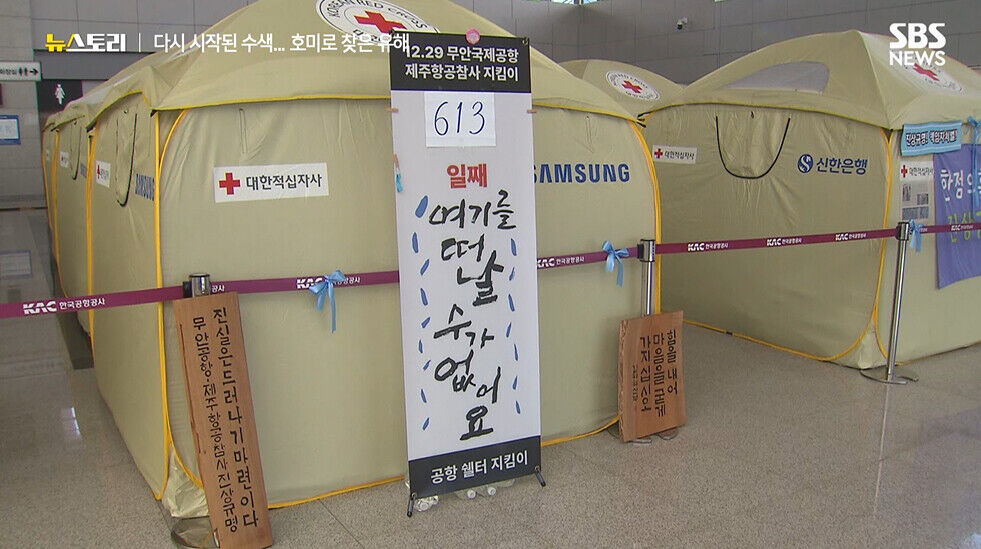
Bereaved families still reside in temporary shelters inside the airport. According to representative Kim Yu-jin, about 10 family members have essentially lived at the airport except for times they went home to hold funerals, while around 30 others take turns maintaining a vigil at the site. Even as the families kept watch at the airport, issues concerning investigations and funerals for the belatedly recovered remains dragged on. In August, the police booked 74 individuals on charges including occupational negligence resulting in death and injury to continue their investigation, but the bereaved families' committee pointed out on the 600th day since the disaster that not a single responsible person had been indicted by then. The families also stated that responsibilities remain unsettled between the Ministry of Land, Infrastructure and Transport and Jeju Air regarding who will handle the funeral procedures for remains recovered during the re-search. The Aviation and Railway Accident Investigation Board's final report has still not been released, one year and nine months after the tragedy. An investigation into how the concrete localizer berm influenced the scale of the damage is also continuing.
On September 14, the bereaved families filed a petition for a public interest audit with the Board of Audit and Inspection, requesting a review of eight matters, including the flawed initial recovery, the neglect of remains and personal items, whether the independence of the Aviation and Railway Accident Investigation Board was compromised, and suspicions surrounding the localizer. With the second anniversary of the disaster approaching, neither the determination of the accident's cause and accountability nor the procedures to lay to rest the belatedly found family members have been concluded. In this way, the families' life at the airport continues to stretch on. (To be continued in Part 4)
¹ Joint Government Public Service Discipline Inspection Team, Office for Government Policy Coordination, "Inspection Results on the Flawed Recovery of Victims' Remains in the Dec. 29 Passenger Plane Disaster"
Watch Broadcast (Aired Sept. 26, 2026)
☞ [News Story Episode 580] Those for Whom Holidays Hurt More: After Disasters and Tragedies (Video by Kim Tae-hoon)
※ Please note: This article was translated by AI and may contain errors.



 Video News
 Video News
 Video News