
 KOR
KOR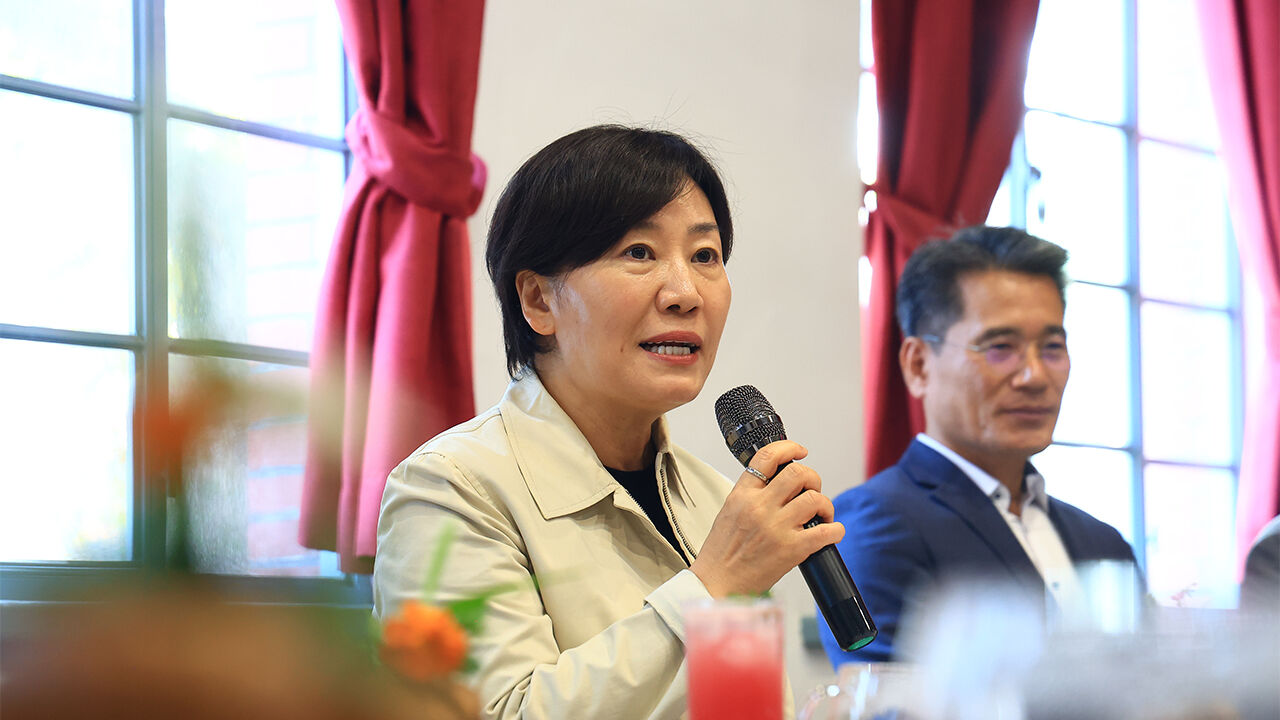
▲ Minister of Agriculture, Food and Rural Affairs Song Mi-ryung speaks during a field meeting on the basic income for rural and fishing communities held at the Gurye Store in Gurye, South Jeolla Province, on the 30th.
Minister of Agriculture, Food and Rural Affairs Song Mi-ryung stated today (the 30th) that issues unaligned with rural realities, such as graves, landlocked parcels, and underutilized farmland uncovered during the comprehensive farmland survey, will be reflected in subsequent institutional improvements.
Minister Song reaffirmed her stance that conventional leasing or fallow land due to aging will not be targeted for disposal, and that opportunities for normalization will be provided through a special act. At the service of this, she reiterated that speculative farmland acquisitions and serious illegal conversions will be dealt with strictly.
Minister Song made the remarks during a field meeting on the comprehensive farmland survey with representatives of heads of towns, townships, and neighborhoods from 23 eup, myeon, and dong held at the Namwon City Hall in North Jeolla Province.
Lee Gi-yeol, chairman of the economy and agriculture committee of the Namwon City Council, requested countermeasures, noting that if landlocked parcels contain ancestral graves, they could be classified as illegal in the comprehensive survey.
In response, Minister Song explained that there are cases where graves exist on land registered as farmland, and that measures to sort them out afterward are under review.
She continued, "We will seek ways to reorganize landlocked or underutilized farmland into actual farmland, or explore alternative uses such as solar power if utilizing it as farmland is difficult."
Minister Song stated, "Revising the Farmland Act is not something that can be done in a snap, so we will discuss it next year to improve the system," adding, "For those currently in a state of violation, we will provide sufficient grace periods or take necessary measures through a special act."
◇ Practical Challenges Raised, Such as Clan Farmland..."Customary Violations Are Not Targets for Disposal" During the meeting, difficulties hard to resolve under the current system were successively raised, such as clan and village communal property registered under individual names leading to disputes between descendants and residents, or farmland whose ownership relations are difficult to verify.
Village heads suggested that concrete criteria for measures be provided to avoid confusion during the investigation and follow-up processes, and requested a sufficient grace period necessary for normalization.
Yoon Won-seob, director general for agricultural policy at the Ministry of Agriculture, Food and Rural Affairs (MAFRA), stated that in the case of clan farmland, there are instances where actual owners are difficult to determine due to name-trust arrangements, and that improvement plans will be reviewed during the Farmland Act revision process.
MAFRA plans to pursue a revision of the Farmland Act in the first half of next year based on the unreasonable systems revealed through this survey.
Minister Song repeatedly emphasized that customary leases in rural areas or fallow land due to aging will not be treated the same as violations for speculative purposes.
She stated, "I emphasize a hundred times that leases without written contracts, swapping farmland for cultivation, fallow land due to aging, and inherited or migrated-from farmland are by no means subject to punishment or enforcement."
MAFRA explained that even without a written contract, leases that fall under permitted leasing grounds pursuant to the Farmland Act are legitimate, and that verbal contracts for inherited farmland or farmland leased by elderly farmers who have directly cultivated it for a certain period or longer are not illegal.
On the other hand, the ministry plans to respond strictly to cases where farmland is acquired with false farming plans in land transaction permission zones followed by unauthorized fallowing or illegal leasing; where agricultural corporations engage in the real estate business after acquiring farmland; where only shares of farmland are acquired through auctions followed by unauthorized fallowing or illegal leasing; and serious illegal conversions within agricultural promotion zones.
◇ Farmland Bank Utilization and Budget Under Fire..."Additional Increases Needed in the National Assembly" Suggestions regarding Farmland Bank utilization procedures and business capacity were also raised.
To the criticism that elderly farmers find it difficult to visit the Farmland Bank in person, Minister Song stated that she would actively review plans for the Farmland Bank to provide a direct visiting service.
Regarding criticisms that the Farmland Bank's project budget is insufficient, she said, "The Farmland Bank budget has increased by 25% compared to this year, but I think this is still not enough," adding, "Further budget increases should be made at the National Assembly stage."
Emphasizing the necessity of securing additional budgets, she noted that related matters were also discussed during ruling party-government consultations.
In a basic survey announced by MAFRA at the end of July, about 2.84 million parcels, or approximately 27% of the 10.49 million parcels surveyed, were classified as suspected violations of the Farmland Act, such as illegal leasing or unauthorized fallowing.
Since then, concerns have spread across rural areas that even customary leases or fallowing due to aging might become targets for disposal.
On the 21st, the government announced complementary measures stating that customary violations occurring in rural realities will not be treated as uniform targets for disposal, but will be given sufficient opportunities for normalization and legalization through a special act.
Despite these complementary measures, concerns persist that farmland transactions could shrink further.
According to the Korea Rural Community Corporation, the number of national farmland transaction parcels decreased by 52.6% from 663,381 parcels in 2021 to 314,144 parcels last year, and the transaction area also shrank from 69,409 hectares to 35,731 hectares.
The national average actual transaction price of farmland dropped from 81,434 won per square meter in 2021 to 50,085 won from January to July of this year.
Minister Song stated, "This comprehensive survey is not intended to crack down on and dispose of farmers, but to accurately grasp the ownership and utilization status of farmland and utilize it for realistic farmland management and institutional improvements," adding that opinions raised in the field will be reflected in subsequent institutional improvements.
(Photo courtesy of the Ministry of Agriculture, Food and Rural Affairs, Yonhap News)
※ Please note: This article was translated by AI and may contain errors.


 Video News
 Video News
 Video News
 Video News
 Video News