
 KOR
KOR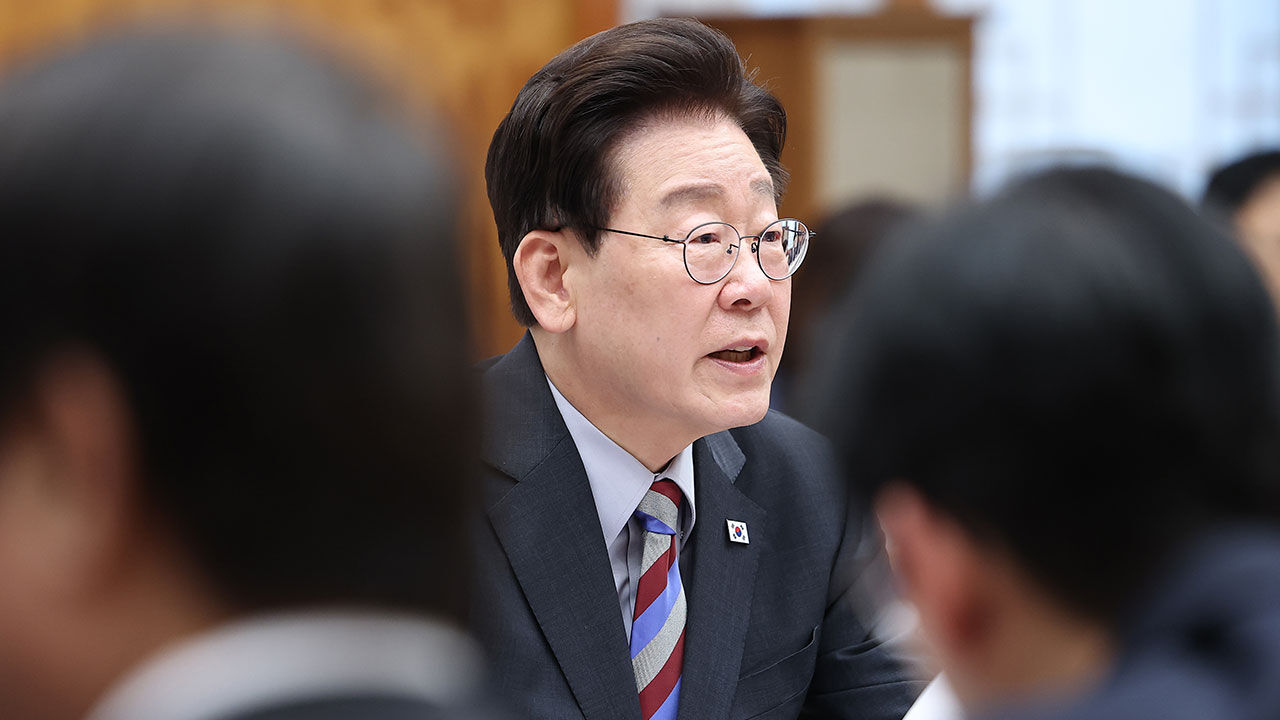
▲ President Lee Jae-myung speaks during the third public-private joint review meeting on mega projects held at Cheong Wa Dae on September 29.
President Lee Jae-myung has urged officials to advance the relocation schedule for the Gwangju military airport, a prerequisite for establishing a semiconductor cluster in the Honam region.
During the "3rd Public-Private Joint Review Meeting on Mega Projects" presided over at Cheong Wa Dae, President Lee received a report on the progress and plans for site preparation for an advanced semiconductor industrial complex in the southern region and inspected whether plans for water and power supplies were on track, Senior Presidential Spokesperson Kang Yu-jung said in a briefing.
During the meeting, upon receiving a report from the Ministry of National Defense on the plan for the temporary deployment of the Gwangju military airport, President Lee instructed, "Completing the temporary relocation in mid-2028 is too late," and ordered officials to "re-examine it so that it can be moved up as much as possible."
He was reported to have stressed, "Extraordinary times require extraordinary measures," adding, "If necessary, we must even consider revising laws or changing regulations and guidelines."
Regarding plans reported by the Ministry of Trade, Industry and Energy and the Ministry of Science and ICT to expand artificial intelligence (AI) robots and physical AI, as well as the status and plans for establishing AI data centers, President Lee said, "It is important to create an ecosystem by purchasing initial production volumes," and called for active public relations efforts through open briefings for the press.
Measures to improve living conditions, including housing, education, culture, and medical care, were also discussed at the meeting.
Regarding plans to build a domed stadium and an arena proposed as ways to improve cultural conditions, President Lee requested, "Demand surveys will likely be important," and added, "Please examine the aspects of effectiveness and efficiency closely."
He also emphasized, "If there are factors that attract people to the regions, such as education and medical care, we should push forward in a direction that actively permits them."
He also asked Samsung Electronics President Kim Yong-kwan, who attended the meeting, about measures that could provide practical help to corporate living conditions.
Upon hearing about difficulties related to hiring foreign personnel during this discussion, President Lee instructed officials to review expanding the scope of eligible universities under the 'K-Tech Pass' program, which provides top-tier visas and various settlement support to outstanding foreign talent in advanced industrial sectors.
President Lee concluded by urging, "Now is the time when concrete policy details are needed regarding where and how much budget is allocated," adding, "I ask each ministry to closely inspect project implementation plans and financing methods to put them into action with speed."
(Photo: Yonhap News)
※ Please note: This article was translated by AI and may contain errors.




 Video News
 Video News
 Video News