
 KOR
KOR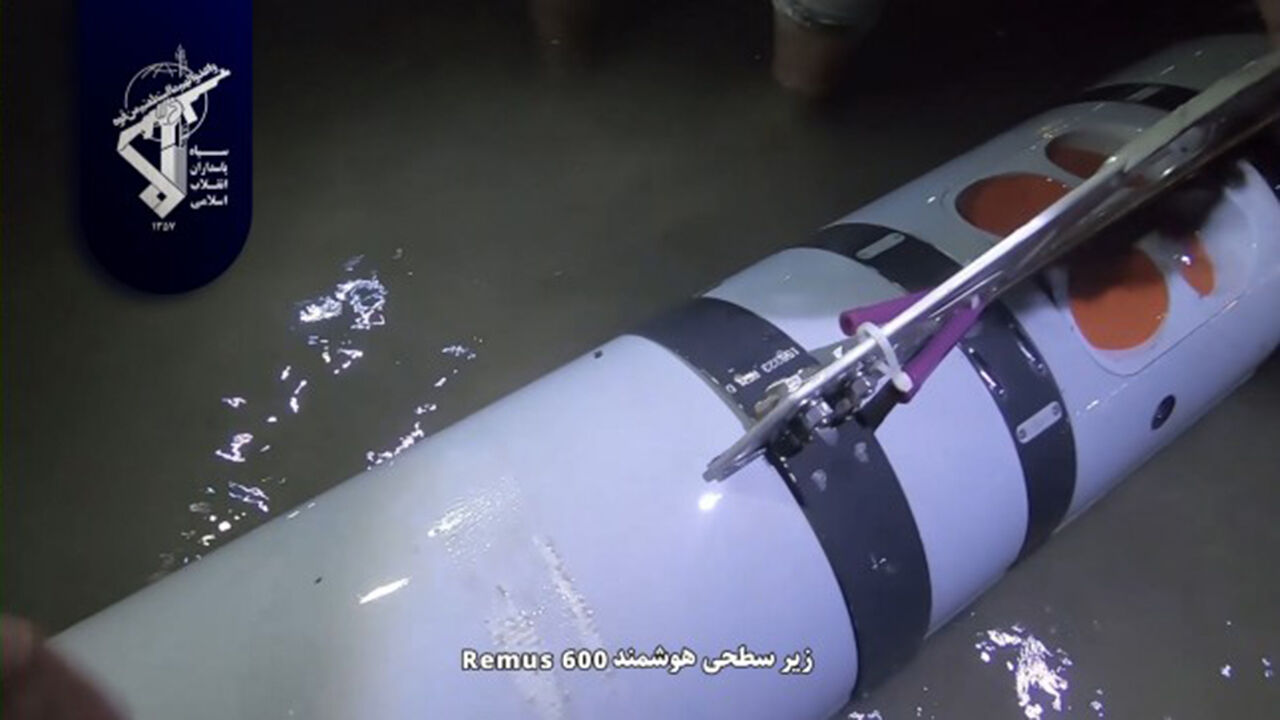
▲ A photo of a U.S. military unmanned underwater vehicle released by the Iranian Revolutionary Guard Corps Navy, claiming its seizure.
The Navy of Iran's Islamic Revolutionary Guard Corps (IRGC) announced on the 27th (local time) that it seized an advanced U.S. military unmanned underwater vehicle in the Strait of Hormuz.
In a statement, the IRGC Navy said, "Based on a complex and sophisticated joint operation utilizing information dominance and electronic warfare, we successfully seized an advanced U.S. military unmanned underwater vehicle conducting espionage activities in the Strait of Hormuz."
The seized underwater vehicle has been identified as a highly intelligent, advanced unmanned underwater vehicle model, the Remus 600.
The Revolutionary Guard explained that after impounding the submersible, experts were mobilized to extract and recover data from within the device.
The IRGC Navy issued a strong warning, stating, "We clearly declare that the Strait of Hormuz is closed," and adding, "We will respond decisively and relentlessly to any dangerous trends or unauthorized passage within the strait."
Previously, the Revolutionary Guard claimed it had also seized an advanced smart unmanned underwater vehicle, the Dive-LD, belonging to the U.S. military at the entrance of the Strait of Hormuz on the 8th.
The Remus 600, which the Iranian Revolutionary Guard claims to have seized, is a multipurpose, advanced autonomous underwater vehicle (AUV) primarily operated by the U.S. Navy.
It can submerge to a maximum depth of 600 meters and is deployed for missions such as mine detection, seabed topography surveys, and intelligence, surveillance, and reconnaissance (ISR) of enemy territory.
Shaped like a torpedo (approximately 3.25 meters in length) and utilizing a modular design, it can be equipped with various sensors such as sonars or cameras depending on the operational objective. A key feature is its ability to perform independent underwater operations without human control for up to 70 hours on a single charge.
(Photo: Capture from Sepah News Telegram Channel, Yonhap News)
※ Please note: This article was translated by AI and may contain errors.


 Video News
 Video News
 Video News
 Video News
 Video News