
 KOR
KOR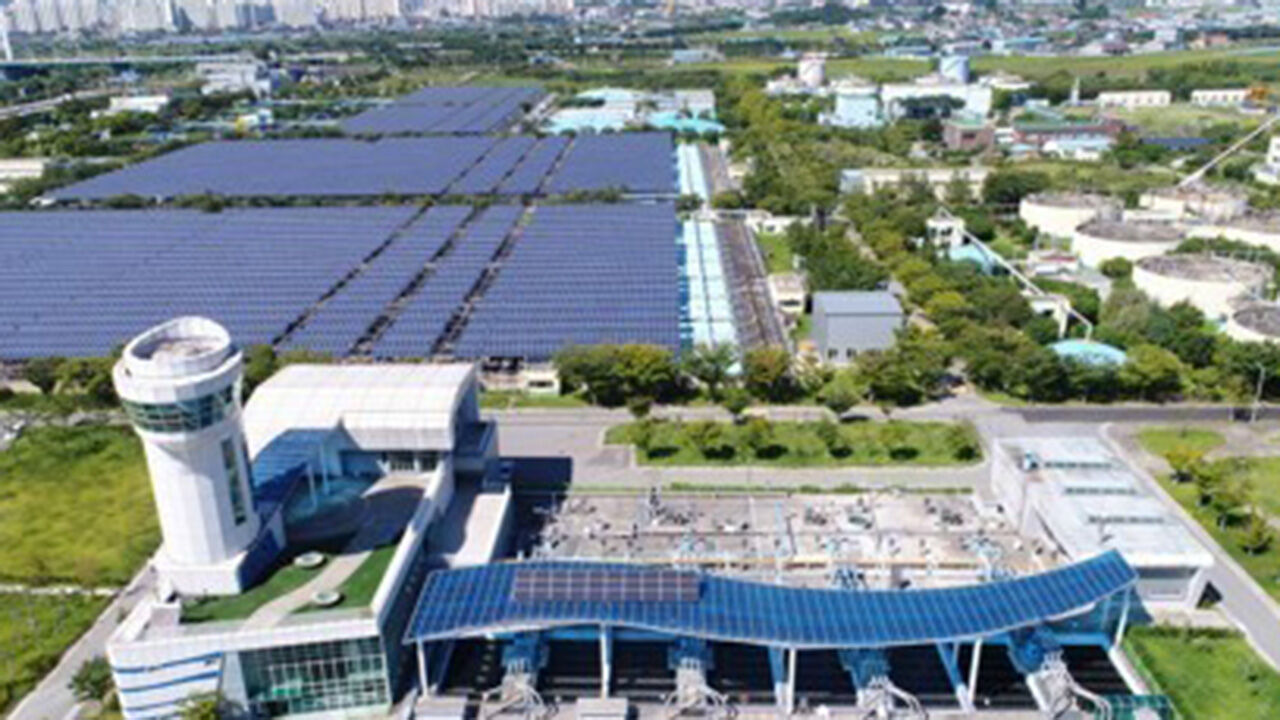
▲ Gwangju 1st Sewage Treatment Plant, which will supply treated wastewater to the Honam Semiconductor Industrial Complex
While water demand is projected to surge due to three major mega-projects and building additional water facilities like dams remains difficult, the government is focusing on reusing water.
The Ministry of Climate, Energy and Environment has decided to supply one-fifth of industrial water as recycled sewage by 2030 and revised the 2nd Basic Plan for Water Use to reflect this goal.
According to the plan, industrial water consumption across five major river basins—the Han, Geum, Nakdong, Yeongsan, and Seomjin rivers—is projected to reach 2.904 billion tons annually by 2030.
Of this total, the government aims to supply 664 million tons (22.9%) using purified wastewater for industrial use.
The initial target for the industrial water reuse rate was 15.0%, which has been raised by 7.9 percentage points.
A target has also been set to channel 20% of total treated wastewater outside of sewage treatment plants for use as industrial and agricultural water by 2030.
The annual volume of treated sewage in 2030 is projected at 7.998 billion tons, with a target of reusing 1.576 billion tons of it as water outside treatment facilities.
The government has also set a goal to supply 7.2% of total water use in 2030 (expected to be 39.4 billion tons annually), or 2.85 billion tons per year, through the reuse of treated wastewater, graywater, rainwater, and treated wastewater from industrial facilities.
Considering that recycled water in 2024 amounted to 1.48 billion tons—including 1.17 billion tons of treated wastewater, 260 million tons of graywater, 13 million tons of rainwater, and 39 million tons of wastewater from industrial facilities—this means nearly doubling the volume of reused water.
This revision of the basic plan for water use took place before the announcement of the mega-projects.
While water demand for the semiconductor cluster being built in Yongin, Gyeonggi Province, and 15 national high-tech industrial complexes was reflected, the Honam semiconductor complex was not included.
As 300,000 tons of treated wastewater per day are scheduled to be supplied to the Honam semiconductor complex as well, the proportion of treated wastewater in future industrial water supplies is expected to exceed current projections.
The government is putting momentum into water reuse because extreme droughts are becoming more frequent due to climate change, making a stable water supply critical as it fosters water-intensive industries such as semiconductors and artificial intelligence.
With the current water reuse rate lingering low at around 15%, there is significant room for expansion depending on government efforts.
To implement the revised basic plan, the government estimates that a total of 2.1968 trillion won will be needed over the five-year period from this year through 2030. It plans to invest 1.0107 trillion won from the national budget and 557.4 billion won from local government budgets, while raising 628.9 billion won from the private sector.
Institutionally, the government will pursue measures to mandate the use of recycled sewage in industrial complexes above a certain size and establish a foundation to increase the reuse of thermal discharge released after being used as cooling water in industrial facilities.
In particular, the government plans to take the lead in installing wide-area water reuse facilities and executing related projects.
Under the current Water Reuse Act, public sewage management authorities are authorized to supply recycled water, making local governments the main agents of water reuse projects. However, local governments often hesitate to undertake such projects when their financial conditions are poor or when multiple local governments are involved.
(Photo provided by Jeonnam-Gwangju Unified Special City, Yonhap News)
※ Please note: This article was translated by AI and may contain errors.



 Video News
 Video News
 Video News
 Video News