
 KOR
KOR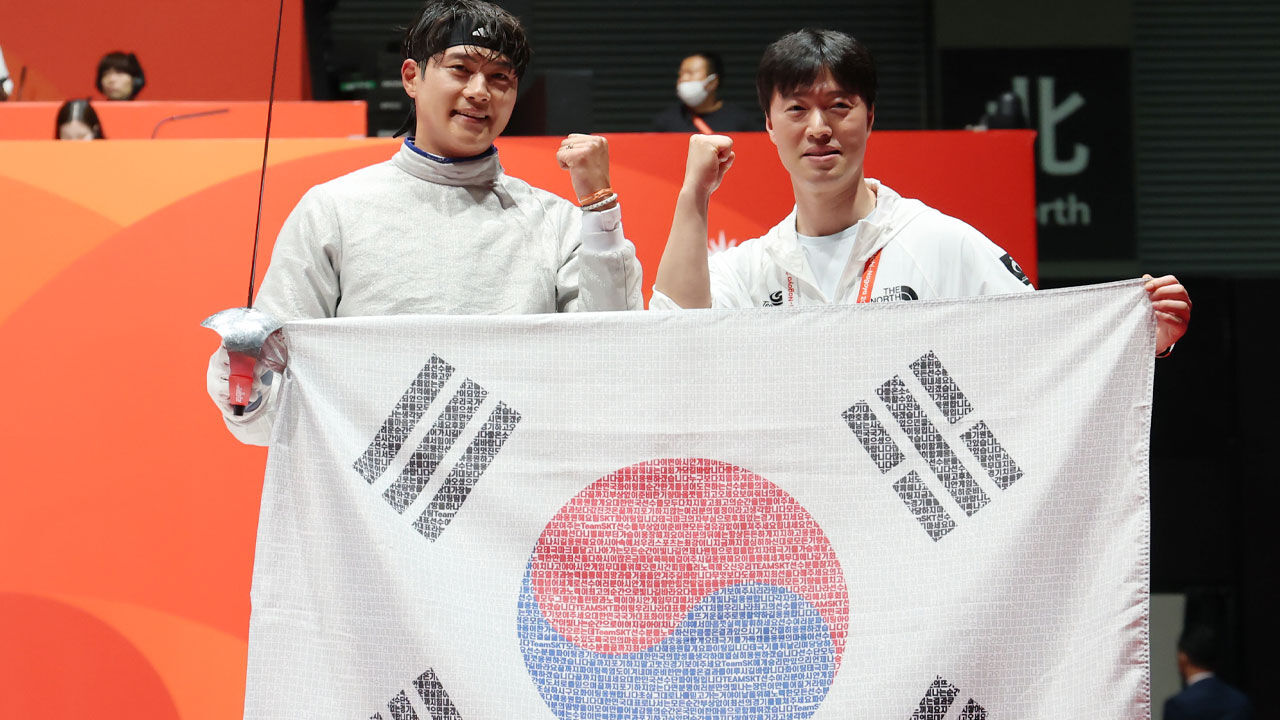
▲ South Korea's Oh Sang-uk celebrates with the national flag after defeating China's Shen Chenpeng in the final of the men's individual sabre event at the 2026 Aichi-Nagoya Asian Games at the Aichi Sky Expo in Tokoname, Japan, on the 23rd.
South Korean fencing star Oh Sang-uk (Daejeon Metropolitan City Hall) has overcome injuries to win his second consecutive Asian Games individual title, paving a smooth path toward the Los Angeles Olympics two years from now.
Oh claimed the gold medal by defeating China's Shen Chenpeng 15-13 in the final of the men's individual sabre event at the 2026 Aichi-Nagoya Asian Games held at the Aichi Sky Expo in Tokoname, Japan, on the 23rd, securing consecutive gold medals following the 2022 Hangzhou Games held in 2023.
Having swept both the individual and team events at the 2024 Paris Olympics to become South Korea's first-ever two-time Olympic fencing champion, Oh once again proved his world-class caliber by successfully defending his individual title at the Asian Games.
Oh becomes the second male sabre fencer to win two or more consecutive individual gold medals at the Asian Games, following Gu Bon-gil, who achieved a three-peat at the 2010 Guangzhou, 2014 Incheon, and 2018 Jakarta-Palembang Games.
Having had to settle for a silver medal in Jakarta after losing the final against national team senior Gu Bon-gil, Oh finally conquered Asia by winning their rematch in Hangzhou, and has now successfully defended his throne.
For Oh, who has already risen to become the world's best sabre fencer by winning gold medals whenever he competed in Hangzhou and the Paris Olympics, this tournament could have served as a major test.
After stepping down from the national team for one season following the Paris Olympics to recharge, he returned to the squad for the 2025-2026 season that began last autumn, but suffered from a herniated lumbar disc throughout the season while preparing for the Asian Games.
Choosing to forego surgery as it would have ruled him out of the Asian Games, Oh continued his tournament preparations while receiving treatment.
Standing tall at 192 centimeters, Oh frequently utilizes a lunge attack, extending one leg forward deeply.
Because back strength is essential for this movement, a bad back inevitably impacts his performance.
Despite these challenges, Oh showed his resilience by winning the International Fencing Federation (FIE) World Cup individual titles twice—in January in Salt Lake City, USA, and May in Cairo, Egypt—and recapturing the Asian Championships individual crown in June for the first time in two years.
At the World Championships in July, he led the team to a silver medal in the team event, but had to feel the lingering impact of his injuries after being eliminated in the round of 32 in the individual event.
After focusing on about a month of rest and recovery to improve his lower back condition, Oh arrived at the battleground with the resolve to "approach it with a challenger's spirit and grit rather than thinking about defending a title."
Known for his composure and strong mental fortitude with minimal emotional swings, Oh once again cast aside his pain, regained his coolness on the major stage, and re-solidified his image as the undisputed number one.
In the final against Shen Chenpeng on this day, there was a variable when he suffered an impact as their feet tangled during the very first scoring situation, but even this could not stop Oh.
Turning 30 years old on the 30th, Oh confirmed his enduring form through this victory, raising expectations that he will maintain his status as the world's premier sabre powerhouse all the way up to the 2028 LA Olympics.
(Photo: Yonhap News)
※ Please note: This article was translated by AI and may contain errors.



 Video News
 Video News
 Video News
