
 KOR
KOR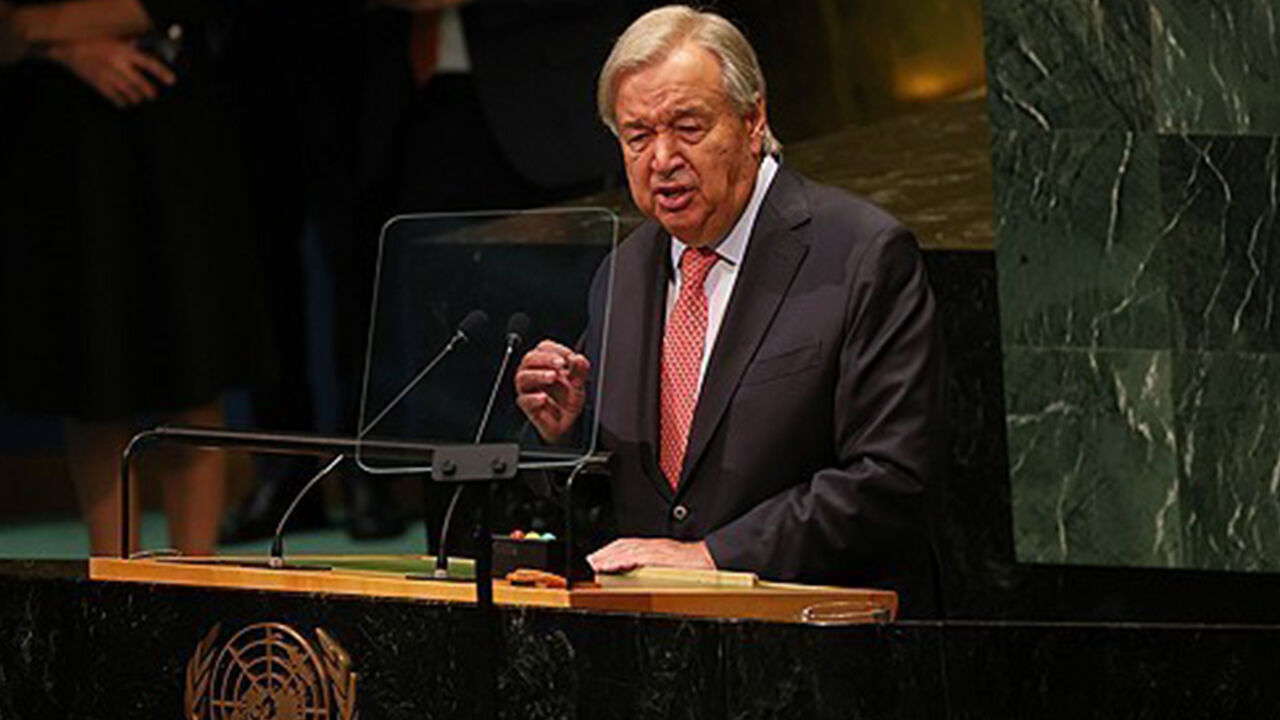
▲ UN Secretary-General Antonio Guterres
UN Secretary-General Antonio Guterres compared the risks posed by artificial intelligence to those of nuclear weapons during the Cold War on the 22nd (local time), urging leading AI nations to establish safety guards.
Speaking at the opening report of the UN General Assembly general debate at the UN headquarters in New York, Guterres selected technology, particularly AI, as one of the "four tests of power" currently facing the international community.
"For centuries, power came from territory, then from industry, and later from finance," he diagnosed, adding, "Today, power increasingly comes from data, computing power, and algorithms."
He warned, "This new power is highly concentrated and advancing at a breathtaking speed, racing ahead of our ability to understand all of its consequences."
"The danger does not lie in the technology itself," he stressed, adding, "The danger lies in technology without responsibility, capabilities without oversight, and decision-making without transparency."
Guterres compared the inter-state competition surrounding AI to nuclear weapons.
"During the Cold War, strategic competitors recognized the need to manage shared existential risks," he said, noting, "They built mechanisms to reduce misunderstandings, manage escalation, and prevent disaster—back then, that was for nuclear weapons."
"Today, artificial intelligence demands that same clear sense of purpose and urgency," he urged, stating, "Countries leading this technological revolution must share information on emerging security risks, cooperate on testing and evaluation, and work to establish joint safety guards to protect us all."
He particularly emphasized the responsibilities of major powers leading the AI sector, such as the United States and China.
Secretary-General Guterres stated that "Governments with the most powerful AI capabilities bear the greatest responsibility toward humanity," and called for the establishment of channels for dialogue, transparency, trust, and cooperation.
"They must do so not in spite of geopolitical competition, but precisely because of it," he added.
Emphasizing that global cooperation is essential as AI impacts the entire world, Secretary-General Guterres underscored that the UN, where all nations can make their voices heard in shaping a shared future, must play a central role in AI governance.
Secretary-General Guterres presented this argument for AI cooperation within the broader framework of a multipolar world order.
Stating that the world is "moving irreversibly toward a multipolar system," he stressed that instead of heading toward division, transactionalism, and zero-sum competition, the world must build a "networked multipolar system based on interdependence."
He added, "Competition will remain a permanent feature of international relations, but competition does not have to mean confrontation."
(Photo: AP, Yonhap News)
※ Please note: This article was translated by AI and may contain errors.


 Video News

 Video News
![An Se-young Shares Her Thoughts with a Smile After Mistake: "I Need to Exercise Restraint" [Sports Mug]](http://img.sbs.co.kr/newimg/news/20260923/202225276_300.jpg) Video News
Video News
 Video News