
 KOR
KOR⚡ Key Takeaways
Timeline for AI Adoption in Practical Work and Impact by Company Size: Securing trust and deep integration of AI in practical workflows is expected to take up to two to three years. While large corporations may face major disruptions such as organizational stagnation and layoffs, smaller companies could seize growth opportunities by boosting per-person productivity.
Divergence in AI Model Usage Across Roles: Tech companies heavily focused on coding and software engineering show an overwhelming preference for Anthropic's Claude, whereas public and financial institutions as well as general roles continue to favor ChatGPT, revealing a clear divide.
Fatigue from 'AI Slop' and Discontent with In-House AI: While expectations have soared with AI adoption, the burden of reviewing and correcting low-quality work (slop) is mounting. Furthermore, employees' dissatisfaction is growing as in-house AI models introduced by major conglomerates for security reasons fall short of the latest external models.
"Two to Three Years Left at Most"
Q. There are projections that AI could drastically change how office workers work and reshape jobs themselves. You observe this from the front lines in Silicon Valley. Once a few years pass, much of the uncertainty will likely be resolved. How long do you think that period will be?
To be honest, "we cannot know" is the real answer. I haven't used the newly released AGI (artificial general intelligence) services right now, so I will probably try them when I return to the U.S. Even if it is a truly astounding level of AGI, what matters is how much we can trust it. The question is how much I can trust this AI and how much of my work I can entrust to it, and another question is how long it will take to reach that level of trust. I think it will take two to three years at the latest until it is used deeply in practical workflows.
So it will vary by company. Larger companies might take a bigger hit. On the other hand, for smaller companies, rather than downsizing headcount, this can be an opportunity to magnify each person's capabilities. As they equip themselves to handle massive volumes of work at once that they couldn't do in the past, it could serve as a springboard for the company to grow further.
Claude for Naver, ChatGPT for the Police

It's the same in Korea and a similar trend in the U.S. Up until last year, OpenAI's ChatGPT held an overwhelmingly dominant market position. More than 70% of South Korean office workers reported using ChatGPT, and ChatGPT was also overwhelmingly dominant in the U.S. However, that pattern shifted—starting in January this year in the U.S., and around mid-year in Korea.
In almost all companies that do even a bit of coding or software engineering, Anthropic's Claude has taken over an overwhelmingly dominant usage share. While ChatGPT usage is maintained across other roles, its overall usage has declined significantly. In other words, when it comes to software engineering, AI is being utilized aggressively and heavily in practical tasks.
In tech companies where engineering plays a crucial role—such as Hyundai Motor, Naver, Viva Republica, NCSOFT, and LG Electronics—Claude usage was naturally far more prevalent. On the other hand, among civil servants, the Korean National Police Agency, Industrial Bank of Korea (IBK), Korea Railroad Corporation (Korail), and Korea Hydro & Nuclear Power (KHNP), ChatGPT usage remained relatively dominant.
"They Gave Us a High-Maintenance 'Rookie' and Raised Company Expectations Too High"
Q. Since the advent of AI, do you hear many positive comments saying it helps with work or that the company atmosphere is becoming more efficient? Or does the sense of crisis or negativity feel greater?
While there is anxiety about the future, that hasn't manifested as a full-blown crisis in reality. Rather, while it's true that people can do more work faster through AI, companies' expectations have risen just as much, causing a lot of stress.
In English, it is often called "slop"; when outputs are generated with AI, they frequently churn out low-quality results that require heavy review. As people witness a situation where work piles up and the burden of reviewing and correcting errors grows, they are feeling stressed.
Slop: A critical term referring to meaningless, low-quality content or work produced in mass quantities following the advent of generative AI.
Q. Are these complaints coming mostly from middle managers or team leaders and above?
Right. But that's not necessarily the case, as Microsoft even issued guidelines telling all employees to work like managers going forward. They say things like, even if you weren't a manager before, you will have six AI agents under you and need to work like a manager yourself. Ultimately, it is no longer about whether you were a manager or not; whatever the position, you must utilize AI to work, and whoever you are, you end up tasked with reviewing and organizing AI slop outputs. It does not seem to be something occurring only at a particular level.
Q. There are also companies that restrict the use of ChatGPT or Claude due to security concerns. Larger corporations in particular are developing their own in-house AI. What is the reaction from employees who actually use these?
It seems that most major corporations in Korea have yet to establish clear guidelines on how to apply AI to actual work. While they need to drive efficiency through AI, security is also important, leading to vague directives like "use it, but use it with restrictions"—which sparks widespread frustration over what they are actually supposed to do. In many cases, companies require the use of internally developed AI due to security risks, but because the quality of company-developed AI is functionally inferior and less practical than that of OpenAI or Anthropic, employee dissatisfaction appears to be substantial.
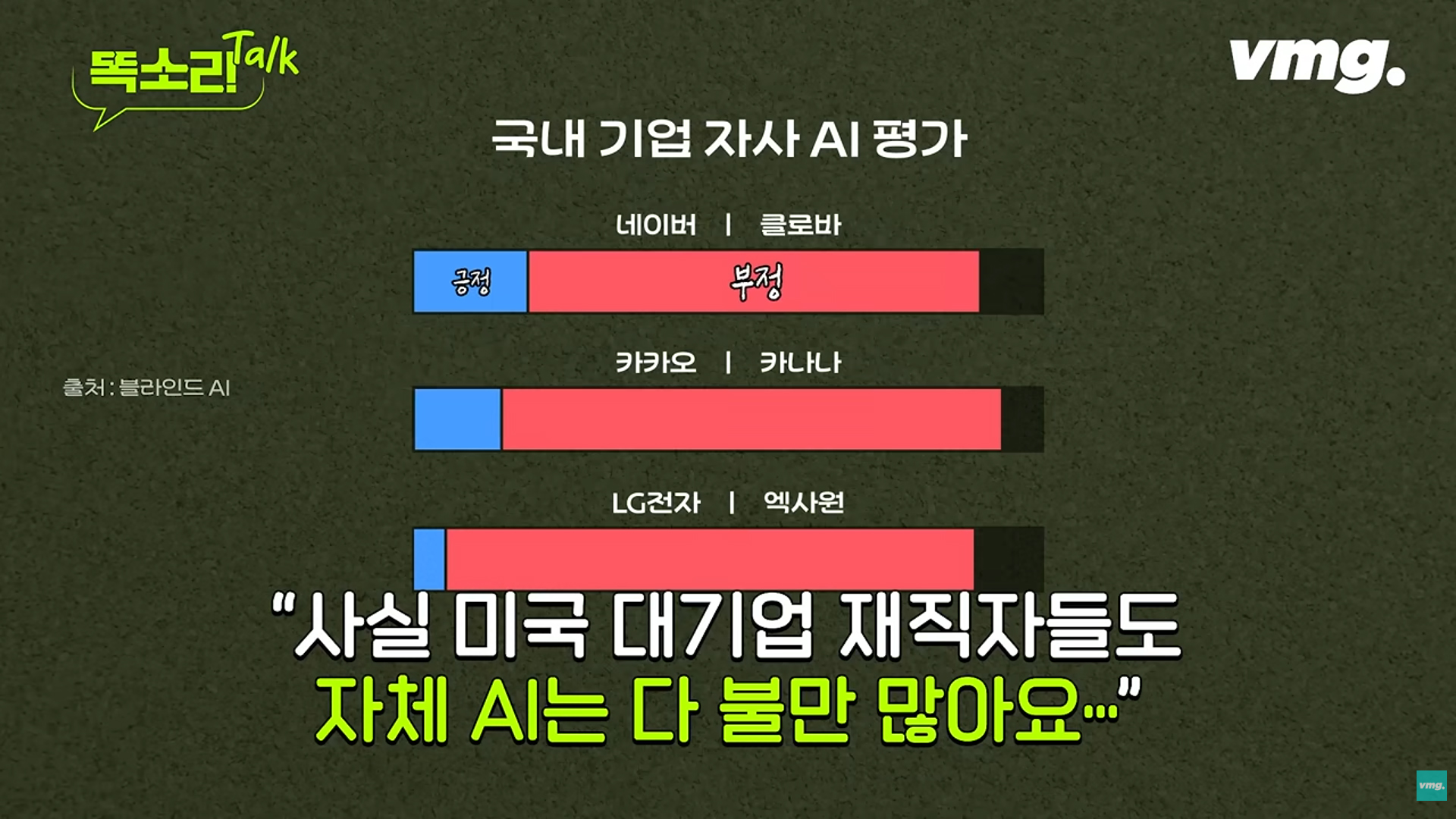
Many companies are using in-house AI, such as SK Group and LG Group. This is not a phenomenon unique to Korea. Even among some top U.S. tech companies that build foundation models, many use Anthropic or ChatGPT far more than their own AI. There may be cases where internally developed AI is not used because of poor quality, but even if the quality is reasonably good, the performance of Anthropic or OpenAI models is so outstanding that employees inevitably prefer them.
Q. Meta continues trying to build something akin to its own foundation model, doesn't it?
Not only Meta, but according to our survey earlier this year, Amazon and Microsoft also use the Claude model provided by Anthropic far more. While Gemini boasts overwhelmingly superior performance compared to other AIs within Google's ecosystem—such as Gmail and Google Drive—when it comes down to the software engineering level, it is evaluated as falling behind other models.
※ Please note: This article was translated by AI and may contain errors.




 Video News

