
 KOR
KOR
▲ Citizens shopping at a large discount store in Seoul
Consumer sentiment rebounded in September, just a month after declining.
The upturn is attributed to heightened expectations for improving income conditions, driven by solid real economic trends amid a reduced volatility range in the domestic stock market.
According to the results of the Consumer Survey released by the Bank of Korea (BOK) today (September 23), the Composite Consumer Sentiment Index (CCSI) for September stood at 106.6, up 2.1 points from the previous month (104.5).
The index had risen for three consecutive months starting in May on the back of robust semiconductor exports, before shifting direction with a 2.3-point drop in August, and then rebounding this month.
The margin of increase was the largest since May (6.9 points), and the index level matches that of June.
The CCSI has remained above 100 for five consecutive months since April (99.2).
The CCSI is an indicator calculated using six sub-indices: current living standards, outlook on living standards, outlook on household income, outlook on consumer spending, current economic judgment, and future economic outlook.
A reading above 100 means that consumer sentiment is optimistic compared to the long-term average (2003–2024), while a reading below 100 indicates pessimism.
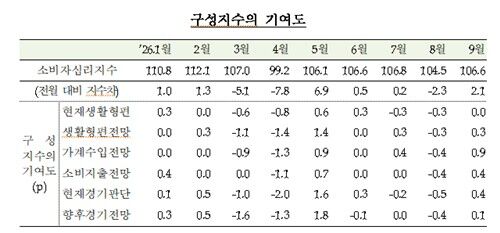
Among the six sub-indices making up the CCSI, the current economic judgment index saw the largest increase, rising 4 points to 83.
This is the highest level in two months since July (84).
The index rose as solid real economic trends, such as exports and consumption, continued alongside a reduction in stock market volatility.
The outlook on household income index rose 2 points to 102, marking the highest level in seven months since February (103).
It increased compared to the previous month due to expectations of improving income conditions following expanded growth.
The outlook on living standards (98, +1 point), outlook on consumer spending (110, +1 point), and future economic outlook (90, +1 point) all rose compared to the previous month.
The current living standards index remained unchanged from the previous month at 92.
The housing price outlook index (125) remained unchanged from the previous month.
The BOK explained that upward factors, such as the high upward trend in metropolitan area apartment prices, and downward factors, such as real estate countermeasures and benchmark interest rate hikes, offset each other, keeping the index at the same level as the previous month.
The housing price outlook index had risen for four consecutive months to hit 127 in July, the highest since September 2021 (128), before falling 2 points last month.
Park Yong-min, head of the BOK Economic Sentiment Survey Team, said, "It is maintaining a high level compared to the long-term average of 107," adding, "Given that the upward trend in metropolitan housing prices is high, expectations for housing price increases are believed to remain high as well."
He further elaborated, "By region, Seoul is the highest at 133, while the six major metropolitan cities and other regions are in the low-to-mid 120s."
The interest rate outlook index, which forecasts the interest rate level six months from now, rose 3 points from the previous month to 128, reaching the highest level in two years and 11 months since October 2023 (128).
It had surged 12 points in June reflecting the BOK's benchmark interest rate hike stance, declined slightly in August, and rose again this month.
The current household debt index, which indicates perceptions of the current household debt level, rose 1 point from the previous month to 101, marking the highest level since December 2024 (101).
Among inflation expectations, the forecast for consumer price inflation over the next year (2.7%) remained unchanged from the previous month.
Team leader Park explained, "Upward factors such as rising international oil prices due to the resumption of conflicts in the Middle East and downward factors such as expectations of continued monetary tightening and a falling won-dollar exchange rate offset each other."
Regarding the CCSI outlook, he said, "This time, the favorable trend in semiconductor exports led to facility investment and consumption improvements, which had a spillover effect on improving income conditions," while noting, "It is cautious to say that (the consumer sentiment index) will trend upward because there are various unexpected variables such as stock market conditions and the Middle East war."
(Photo provided by the Bank of Korea, Yonhap News)
※ Please note: This article was translated by AI and may contain errors.




 Video News

