
 KOR
KOR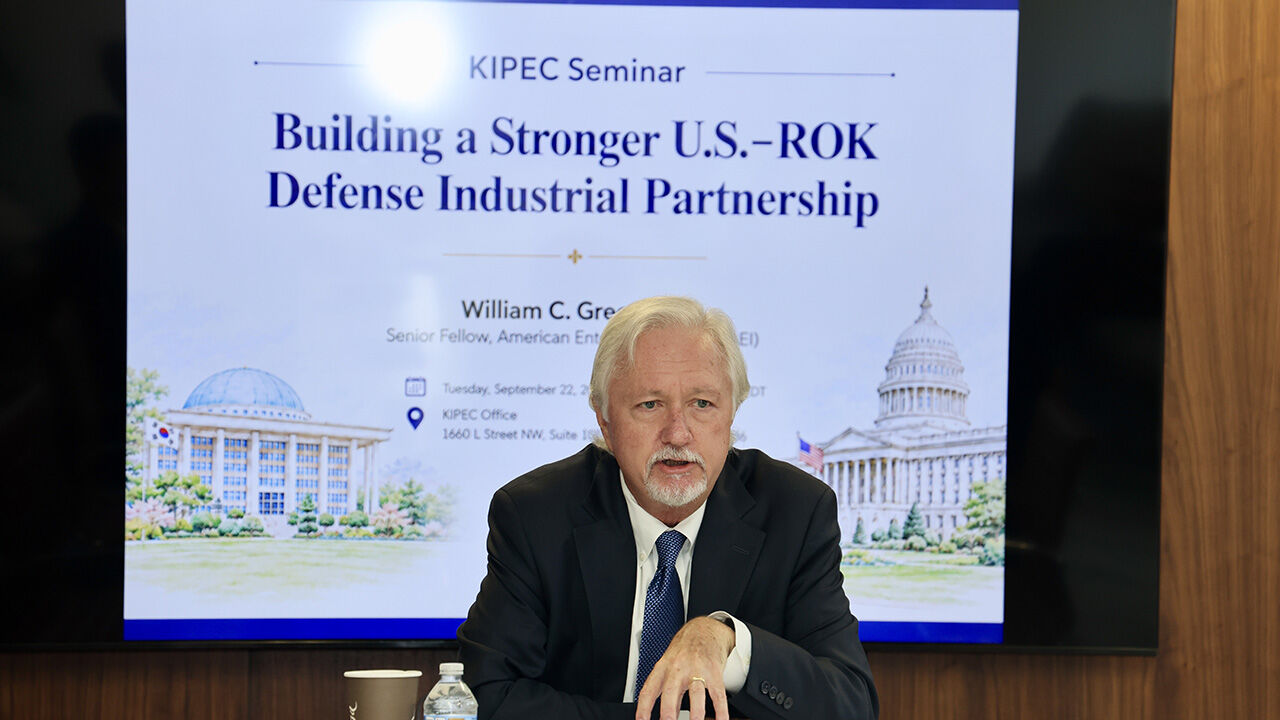
▲ Bill Greenwalt, senior fellow at the American Enterprise Institute (AEI)
A recommendation has been made that overhauling the United States' current regulatory framework, including intellectual property (IP) and export controls, is necessary to expand South Korea's shipbuilding industry's entry into and investment in the U.S.
Bill Greenwalt, a senior fellow at the American Enterprise Institute (AEI) who formerly served as deputy under secretary of defense for industrial policy and as a professional staff member for the Senate Armed Services Committee, made the remarks during a seminar held on the 22nd (local time) at the Korea-U.S. Legislative Exchange Center in Washington, D.C., stating, "Shipbuilding is probably one of the most politically sensitive industries in the U.S."
"We need to cooperate," he said, adding that rules must be put in place to draw South Korea's investment and knowledge into the U.S. and boost combined productivity.
He went on to emphasize that for South Korea-U.S. shipbuilding cooperation to yield tangible results, a new framework encompassing IP, export controls, investment incentives, and compliance mechanisms is required.
Addressing South Korean companies, Greenwalt advised, "Instead of simply saying, 'This won't work,' you need to specify what is needed to make it work and what rules must be changed to achieve the desired outcome. That is where negotiations begin."
Regarding South Korea-U.S. defense cooperation, he suggested that South Korean companies actively seek partnerships with Silicon Valley firms specializing in advanced technologies such as artificial intelligence (AI) and robotics.
"A natural partner for many South Korean companies are firms looking to completely revolutionize the U.S. defense market," Greenwalt said, calling collaboration with Silicon Valley companies a future cooperation model.
He pointed out that partnerships between South Korean companies and traditional U.S. defense contractors like Lockheed Martin are likely to face various barriers, including the International Traffic in Arms Regulations (ITAR).
In contrast, he explained that technologies prioritized by Silicon Valley companies—such as AI, robotics, and autonomous systems—are dual-use technologies utilized in both military and civilian sectors, making cooperation relatively easier compared to traditional weapon systems fields.
He also stressed that for South Korean companies to expand their footprint in the U.S. defense market, "they must develop new technologies superior to what the U.S. currently possesses."
(Photo provided by Washington correspondent corps, Yonhap News)
※ Please note: This article was translated by AI and may contain errors.


 Video News
 Video News

 Video News
