
 KOR
KOR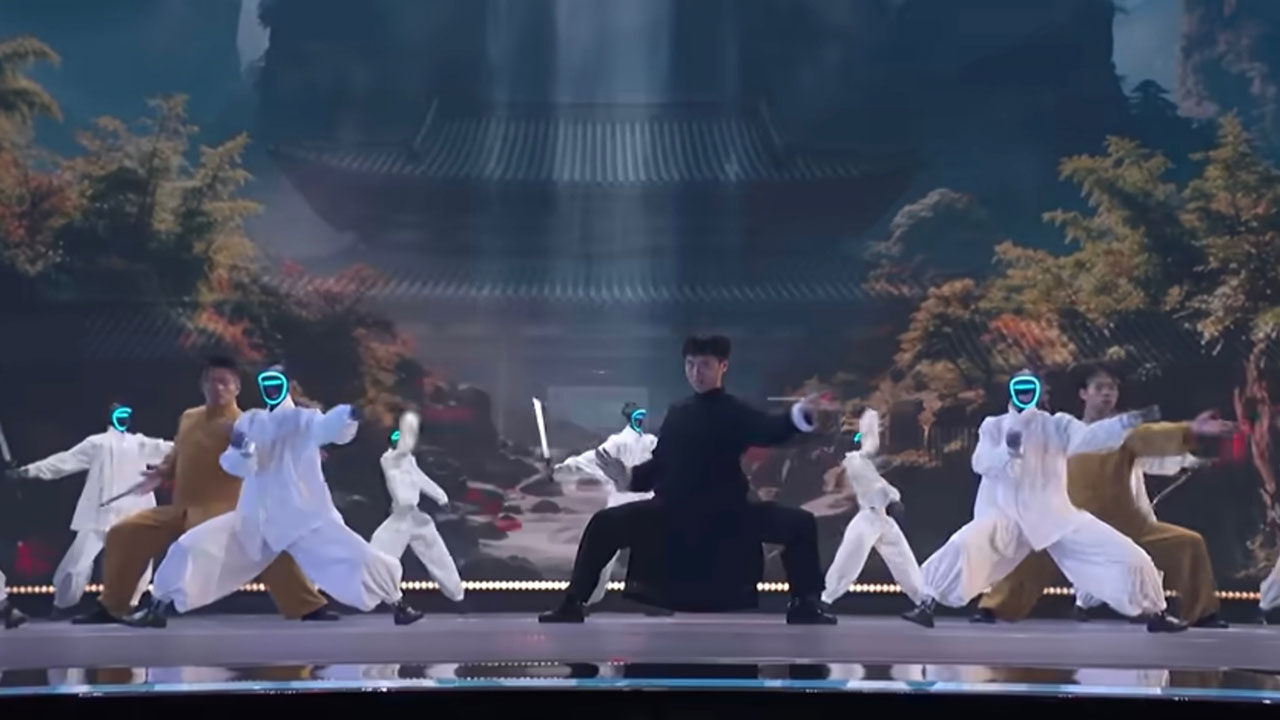
▲ The Chinese humanoid robot team performing on the stage of 'America's Got Talent' after advancing to the finals.
A street dancer who teamed up with a legion of Chinese humanoid robots has advanced to the finals of a major U.S. televised talent show.
According to AFP on September 22, the team 'Homies' led by 27-year-old street dancer Wu Yufei from China's southern Sichuan province has earned a spot in the finals of 'America's Got Talent' (AGT).
What drew attention to the Homies was not simply their exceptional dancing skills and oriental stage design.
Wu Yufei choreographed a group dance based on kung fu featuring robots from Unitree, a leading Chinese humanoid robotics company, earning favorable reviews from the judges and loud applause from the audience.
After watching Wu Yufei's team perform, a judge lavished praise by saying, "That is the craziest thing I have ever seen in my life," adding, "It is totally overwhelming."
Another judge pressed the advancing button, admitting, "Honestly, it's a little scary."
This marked the moment when the dazzling dance skills of Chinese humanoid robots, widely publicized through the Spring Festival special TV programs for two consecutive years last year and this year, were first imprinted on U.S. viewers.
In China, as performances by humanoids have gained popularity, it has become common to book robots for events big and small.
Wu Yufei, a dancer with 13 years of experience, said it felt "magical" to share the stage with the Unitree humanoid dance team.
Regarding the robots that trained alongside them for months, Wu added that they felt like much more than just "cold, lifeless machines."
Artistic director Fang Zhenghua, who oversaw the preparation for this performance, described teaching robots how to dance as being "similar to creating a soul."
To teach robots how to dance, every single movement of a human dancer must be inputted.
On-site collaboration with engineers is also essential to resolve issues in real-time during actual performances.
Choreography deemed too difficult for robots to handle is excluded from the start.
This is especially true for choreography where physical flexibility is crucial.
Furthermore, no matter how perfectly prepared, if the music suddenly changes on-site, robots cannot respond as flexibly as humans.
Despite these difficulties, putting robots on public stages is considered a golden opportunity for the Chinese industry to showcase their performance capabilities.
This is because it allows numerous startups to make a name for themselves.
However, many companies are struggling to find ways to commercially utilize robots in fields outside of entertainment.
It is projected that it will take a considerable amount of time for robots to become as common and useful a presence among the general public as AI chatbot models like ChatGPT.
(Photo: YouTube video capture, Yonhap News)
※ Please note: This article was translated by AI and may contain errors.



 Video News

!["Thought It Was a Bronze"... Dramatic Comeback Secured by 10.9-Point Bullseye [AG Video]](http://img.sbs.co.kr/newimg/news/20260922/202224917_300.jpg) Video News
Video News
 Video News