
 KOR
KOR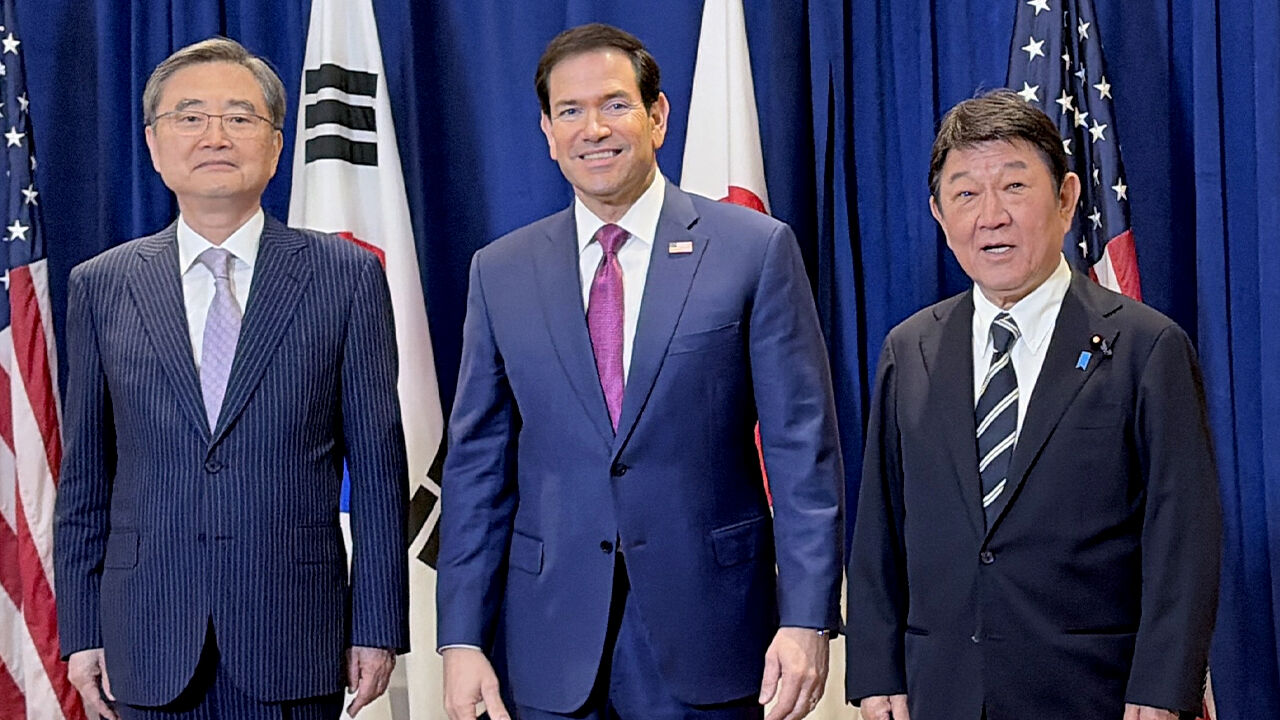
▲ Foreign Minister Cho Hyun, U.S. Secretary of State Marco Rubio, and Japanese Foreign Minister Motegi Toshimitsu take a commemorative photo prior to their meeting in New York on the 21st (local time).
Three days ahead of the US-China summit, the foreign ministers of South Korea, the U.S., and Japan have issued a warning message targeting China.
This appears to be a war of nerves right before the bilateral summit, with the U.S. rallying its allies, South Korea and Japan, to publicly keep China in check.
At the same time, they showed signs of somewhat adjusting their tone regarding the issues of Taiwan and the South China Sea, which Beijing considers internal affairs.
South Korean Foreign Minister Cho Hyun, U.S. Secretary of State Marco Rubio, and Japanese Foreign Minister Motegi Toshimitsu met and held talks in New York on the 21st (local time) where the UN General Assembly is taking place, releasing a joint statement.
The necessity of resuming dialogue with North Korea was stated at the very top of the joint statement.
It included the phrase, "We reaffirm that the path to dialogue remains open and urge North Korea to return to dialogue."
This is interpreted as reflecting President Donald Trump's willingness to pursue the resumption of dialogue with North Korean leader Kim Jong-un within the year, alongside the South Korean government's intent to play a "pacemaker" role.
The joint statement also included, "The ministers reaffirmed their firm commitment to the complete denuclearization of North Korea in accordance with relevant UN Security Council resolutions and to prohibiting revenue generation support for North Korea's nuclear and ballistic missile programs."
In effect, this sets the ultimate goal as North Korea's denuclearization while confirming the need to resume dialogue.
North Korea has repeatedly drawn a line, stating that denuclearization cannot be an agenda item for dialogue.
Along with the trilateral coordination on North Korea, the most noticeable part of the joint statement is the message targeting China.
The statement included the phrase, "We firmly oppose economic coercion and non-market policies and practices that cause harmful overcapacity and market distortion, including arbitrary export restriction measures that disrupt supply chains."
While China was not explicitly named, the statement incorporated many of the issues the U.S. has raised regarding China's industrial policies, including China's rare earth export controls, accompanied by a relatively high-intensity expression: "firmly oppose."
The joint statement also included phrases emphasizing the importance of maintaining peace and stability in the Taiwan Strait, encouraging a peaceful resolution of cross-strait issues, and opposing any unilateral attempts to change the status quo.
"Unilateral attempts to change the status quo" is an expression mainly targeting China's attempts to expand its sovereignty in the South China Sea.
However, the South China Sea was not explicitly specified in this joint statement, and some of the wording was softened.
The trilateral foreign ministers' statement issued on the occasion of the UN General Assembly in September of last year included the expression, "We oppose any attempts to change the status quo, including dangerous and destabilizing behavior in the Indo-Pacific waters, including the South China Sea."
Regarding Taiwan, the joint statement from a year ago newly added content expressing concern over "increasingly frequent destabilizing actions near Taiwan," which was omitted this time.
China views any mention of Taiwan and the South China Sea by South Korea, the U.S., and Japan as interference in its internal affairs.
When the trilateral foreign ministers' statement was released in September of last year, Beijing also expressed "strong dissatisfaction and firm opposition."
Analysts suggest that just three days before the US-China summit, the U.S. strongly pressured China by taking issue with economic coercion and non-market policies alongside its allies, while somewhat adjusting its tone on areas China considers its core interests to avoid provocation.
Earlier this month at the Group of 20 (G20) Finance Ministers' Meeting, the U.S. also engaged in a tug-of-war with China by pushing for the adoption of a joint statement targeting China's non-market policies.
Ultimately, due to China's opposition, the joint statement was not adopted, but the U.S. continued its war of nerves by releasing a chair's summary with the other participating countries.
(Photo: Yonhap News)
※ Please note: This article was translated by AI and may contain errors.


 Video News
 Video News
 Video News
 Video News
 Video News