
 KOR
KOR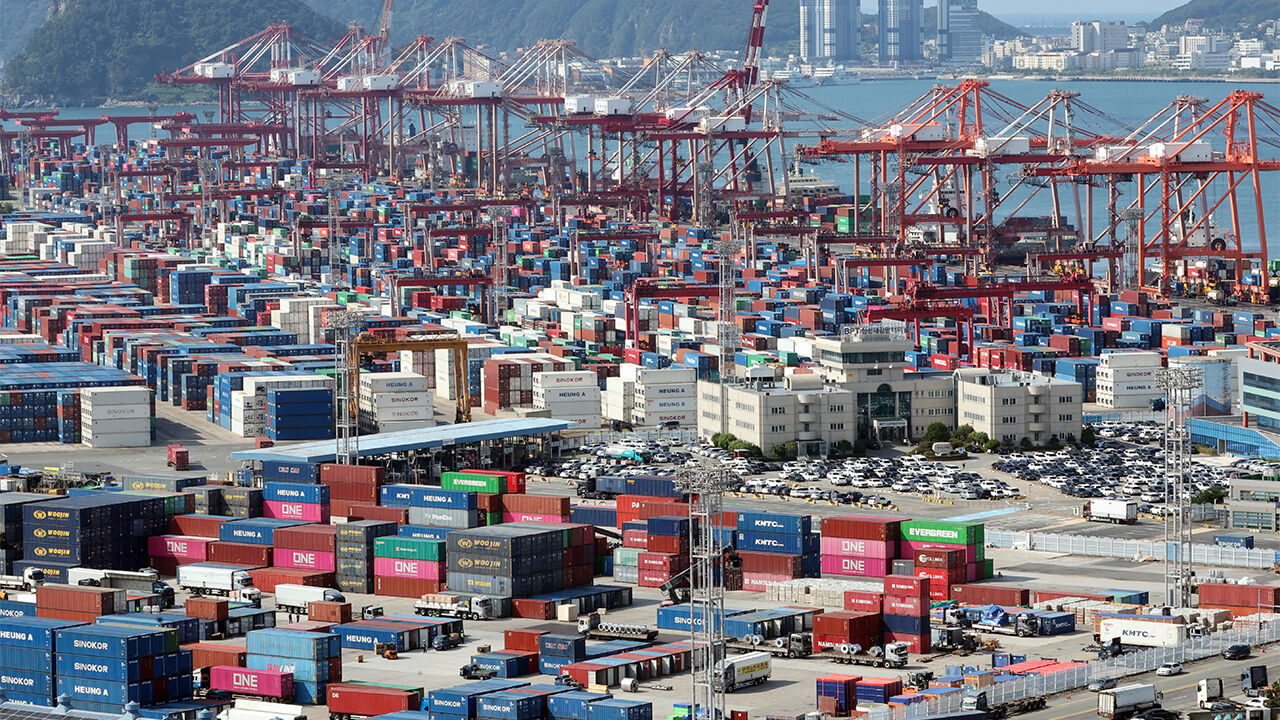
▲ Import and export cargo piled up at the Sinseondae Pier of Busan Port in August.
As the semiconductor industry rebounded from a slump in 2024, exports accounted for a larger share of South Korea's economy, data showed.
Driven by an increase in operating surpluses from exported manufactured goods, the value-added ratio rose for the second consecutive year, while import dependency declined due to lower prices for imported raw materials.
According to the 2024 Input-Output Tables released by the Bank of Korea on September 21, the total supply (total demand) of goods and services in the South Korean economy for 2024 reached 7,113.6 trillion won, an increase of 310.9 trillion won (4.6%) from the previous year.
Total output (domestic supply) and imports (overseas supply) accounted for 85.0% and 15.0%, respectively.
The proportion of external transactions, which combines exports and imports out of total supply, rose 1.5 percentage points from 29.6% to 31.1%.
This was driven by an increase in exports.
The export ratio (exports/total output) in 2024 stood at 19.0%, up 1.7 percentage points from the previous year.
Manufactured goods (34.1% to 37.1%) rose, led by assembled and processed products, while services (6.6% to 7.3%) also increased, centered around wholesale and retail trade and transportation services.
The import ratio was 15.0%, a level similar to the previous year (14.9%).
Boo Sang-don, head of the Input-Output Team at the Bank of Korea's Economic Statistics Department II, said, "The year 2024 had a significant impact on structural changes in the economy as the semiconductor industry emerged from its slump and showed a strong recovery." He added, "As semiconductor exports shifted to a sharp increase, the proportion of exports in our economy grew, and the share of production value-added induced by exports also expanded."
Looking at the industrial structure, the share of manufactured goods in total output edged up from 41.2% to 41.3%.
While the share of assembled and processed products, including computers, electronic and optical devices, increased significantly from 17.5% to 18.3%, the share of basic material products such as coal, petroleum, and chemical products decreased from 16.1% to 15.6%.
The share of services also rose from 48.1% to 48.5%.

In the composition of value added, the share of manufactured goods increased from 25.0% to 26.0%, whereas the share of services declined from 65.4% to 64.1%.
The value-added ratio (value added/total inputs) for 2024 was 42.0%, up 0.8 percentage points from the previous year.
Following increases from 40.1% in 2022 to 41.2% in 2023, this marks the second straight year of gains.
Factors contributing to this included the expansion of value added in assembled and processed products and lower prices for imported raw materials such as bituminous coal.
As a result, import dependency (input of imported intermediate goods/total inputs) fell from 13.6% to 13.3%.
In particular, import dependency in the electricity, gas, water, and waste sectors dropped sharply from 37.9% to 33.6%.
Boo said, "The value-added ratio increased due to rising operating profit margins in the semiconductor sector, and the share of manufactured goods in total value added also rose." He added, "As semiconductor exports have continued to surge into this year, the upward trend in the shares of exports and manufacturing is expected to strengthen."
Full-time equivalent employment in 2024 was 25.96 million, a decrease of 28,000 (0.1%) from the previous year.
Full-time equivalent employment is a statistic calculated by converting the labor volume of part-time workers into the standard of full-time workers, and includes wage workers (regular workers plus temporary and daily workers), self-employed individuals, and unpaid family workers.
By employment type, the share of regular workers rose from 61.0% to 61.3%, while the share of temporary and daily workers decreased (14.5% to 14.3%).
The share of female workers rose from 40.5% to 40.8%.
By sector, the employment share in services increased from 71.7% to 72.0%, while the shares in construction (7.2 to 7.1%) and agriculture, forestry, and fisheries (5.4 to 5.3%) declined.
The employment inducement coefficient stood at 7.8 persons, down from the previous year (8.2 persons).
The employment inducement coefficient refers to the number of jobs directly and indirectly induced across all industries when final demand increases by 1 billion won.
Boo noted, "Because the semiconductor sector has a relatively low employment effect, the number of induced jobs remained at a level similar to the previous year despite booming exports." He added, "As the number of workers in semiconductor manufacturing has been increasing into 2025, the positive impact of the semiconductor boom on employment is likely to expand compared to before."
(Photo: Yonhap News)
※ Please note: This article was translated by AI and may contain errors.




 Video News
 Video News