
 KOR
KOR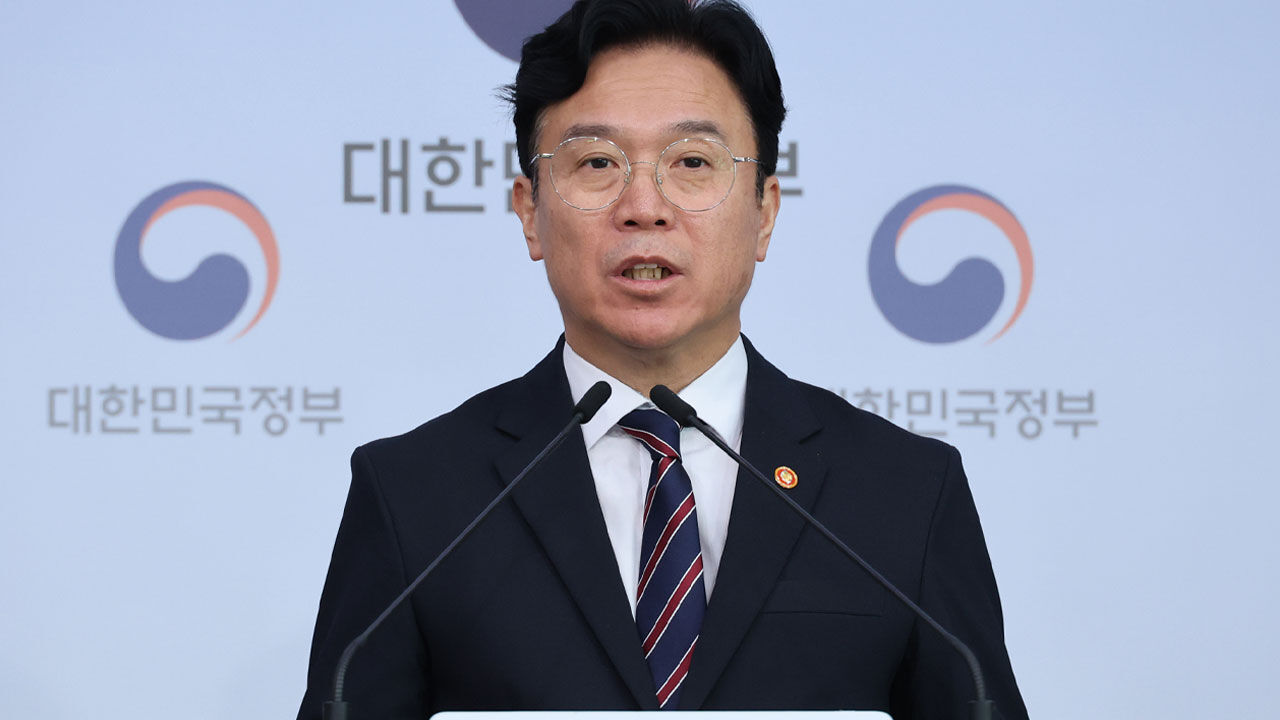
▲ Minister of Employment and Labor Younghoon briefs reporters on the "proposal for social dialogue regarding the Special Act on Mega-Special Zones" at the Government Complex-Seoul in Jongno-gu, Seoul, on September 15.
Following their initial introductory meeting for a "one-point social dialogue" to discuss labor deregulation within the Special Act on Mega-Special Zones, labor, management, and the government are set to launch full-scale working-level consultations this week.
According to the Ministry of Employment and Labor today (September 21), a vice-ministerial-level preliminary consultation for the one-point social dialogue involving labor, management, and relevant government ministries took place on September 18.
The preliminary consultation was attended by vice-presidential-level officials from the Federation of Korean Trade Unions (FKTU) and the Korean Confederation of Trade Unions (KCTU) representing the labor sector, as well as vice-presidential-level officials from the Korea Enterprises Federation (KEF) and the Korea Chamber of Commerce and Industry (KCCI) representing management.
Representing the government were the vice ministers of employment and labor, the Office for Government Policy Coordination, the Ministry of Economy and Finance, and the Ministry of Trade, Industry and Energy, along with a standing commissioner from the Economic, Social and Labor Commission.
The government and labor-management sides plan to hold a working-level meeting attended by director-general-level officials soon.
Considering that the Chuseok holiday begins on September 24, the meeting is highly likely to be held between September 22 and 23, ahead of the holiday.
An official from the Ministry of Employment and Labor explained, "We are coordinating the schedule with attendees to hold it within this week," adding, "Following the working-level meeting, we will enter into full-scale social dialogue."
The working-level meeting is expected to discuss key agendas to be addressed in the one-point social dialogue.
Key issues projected for discussion related to the Special Act on Mega-Special Zones include the "white-collar exemption," which would eliminate the 52-hour weekly work cap and exclude overtime, night, and holiday work allowances for high-income managers and R&D workers, and the "fixed-term 2+2" system, which would extend the allowable employment period for fixed-term workers from the current two years to an additional two years upon worker agreement.
Previously, Minister of Employment and Labor Younghoon proposed on September 15 to establish a one-point social dialogue involving labor and management to discuss labor special provisions that would ease labor regulations exclusively within mega-special zones.
After both labor and management expressed their intent to participate, a social dialogue including the KCTU was successfully arranged for the first time in six years, following the labor-management-government dialogue held in 2020 to overcome COVID-19.
The government and the ruling party aim to enact the Special Act on Mega-Special Zones within the year.
However, as sharp disagreements persist between labor and management, it remains uncertain whether a final agreement can be reached.
The business community maintains that the introduction of labor special provisions is essential to secure the global competitiveness of mega-special zones and attract investment.
On the other hand, the labor sector strongly protests, arguing that creating exception clauses within the zones will lead to nationwide relaxation of labor regulations and an overall retreat in labor rights.
Despite deep deliberation before deciding to participate, the KCTU expressed a strong determination to block the labor special provisions.
The KCTU emphasized, "We judged that participating in the dialogue and directly voicing our opposition is necessary to prevent the expansion of labor special provisions and the regression of labor rights."
(Photo: Yonhap News)
※ Please note: This article was translated by AI and may contain errors.


 Video News


 Video News
