
 KOR
KOR
Growth requires strength: the strength to remain unshaken and the strength to reach higher. The knowledge news program "Taking Care of Culture," which makes you smarter the more you listen, empowers you to grow into a cultured intellectual alongside top Contributors from Spff.
Advisor at Korea Investment & Securities
Former Head of FICC Research Center at NH Investment & Securities
Author of <Who Does Inflation Make Rich?>
The Federal Reserve raised interest rates in September. Burgeoning energy prices and inflationary pressures fueled by the war played a substantial role behind that move. If the war escalates, there is a strong possibility that oil prices will surge once again. When oil prices climb, inflation also rises. Therefore, the war should no longer be viewed merely as a diplomatic or security issue, but as a factor directly affecting interest rates. What is crucial is that this is not an issue that ends with a single move in September. It could continue to influence the Fed's rate decisions throughout the second half of this year and into next year.
In fact, we were already in a state of "sticky inflation." Simply put, once prices go up, they do not easily come back down. For this reason, we should not just look at the end of this year or early next year; we need to look ahead over the next 3 to 4 years. While inflation could gradually stabilize, we could also see repeated cycles of sharp spikes and declines whenever disruptions like wars or oil shocks erupt.
I see a higher likelihood of such cycles repeating. Looking back 10 or 20 years from now, the late 2020s may ultimately be remembered as an era when inflation was difficult to tame. That does not mean severe inflation like that of the 1970s is coming, but rather that the difficulty of containing prices could last longer than expected.
Bessent's 'Buyback' Failed to Work... Is the US Treasury Market Really in Crisis?
Q. The US Treasury Department reportedly expanded its long-term bond buyback program to $6 billion. That appears to be roughly a threefold increase from the previous $2 billion level, yet the 10-year Treasury yield rose even further. How do you assess the overall situation right now?
Every time you turn on the news, people express anxiety, saying that despite buybacks, interest rates went up instead of down, which will rattle markets and heavily impact the stock market. However, there is no need to think that way just by watching the daily news; one must look at it from a long-term perspective.
First, is the current market environment—the current situation for long-term US Treasuries—a stable one, or is it unstable and severe? What matters is determining whether the patient was near death in the emergency room and is now recovering, or whether things were normal and have merely become slightly unsettling.
We need to look at a longer timeline. We spent nearly 10 years in the emergency room following the 2008 global financial crisis, and then another two years during COVID-19. Problems that had accumulated over 30 years of neoliberal deregulation all exploded at once during the 2008 financial crisis. The system was rushed into the emergency room with critical conditions. Even after urgent surgeries and IV drips, it remained bedridden for over a decade.
The Fed released an enormous amount of money. Instead of traditional methods of lowering rates and injecting liquidity, it implemented non-traditional, unlimited quantitative easing for about a decade. Because rates were driven down nearly to zero during that period, existing bond investors may have benefited, but subsequent bond investments yielded a lackluster 1% or 2%, making them unappealing while other assets such as stocks thrived. Having grown accustomed to that, people now ask, "Isn't something wrong?" at the slightest hiccup. But that is not the case. Currently, about two years after COVID-19, prices and interest rates have risen, and we have normalized conditions by selling off bonds held through QT*—a period where rates once surged high and then retreated.
*QT (Quantitative Tightening): A monetary policy tool used by central banks to absorb market liquidity by choosing not to reinvest maturing bonds or selling held bonds prior to maturity. It serves as a major tightening measure alongside benchmark interest rate hikes.
Therefore, unlike the 2010s, although the Fed still holds a substantial amount of Treasuries, conditions have normalized considerably compared to the past. In this normalized state, the market is struggling to absorb the supply, and friction keeps spilling over. We should not compare today to the past. During that intervening period, the United States performed exceptionally well. Stocks soared for years, vast sums flowed in under America-first momentum, and Treasuries were absorbed smoothly. But now, with things creaking and the 30-year Treasury yield jumping to 5.3%, the US government attempted to stabilize the market via buybacks, only for critics to argue that this distorts a normal market.
From a long-term perspective, it is best to view this as a situation where the patient has left the emergency room and is walking down the street normally, but stopped to check on an issue that flared up. It is not like taking a day off work to be admitted to a hospital; it is more like stopping by for a brief checkup. If it were a grave crisis, the Fed would have stepped in or taken decisive action, but the situation has not reached that crisis level. The administration is trying to handle it, and when a misstep occurred, Bessent essentially said, "Trust me for now, as I think I can resolve this myself," while the market is issuing warnings that distorting it could worsen the underlying issues.
"The Center of Gravity of Money Is Shifting": The Real Reason a 5% 10-Year Yield Is Terrifying
Q. With the US 10-year Treasury yield threatening the 5% mark, it has become a major issue. How should we interpret the significance of that 5% figure?

The 10-year yield steadily declined over the past 40 years before heading back up starting around 2021, bringing 5% back into view.
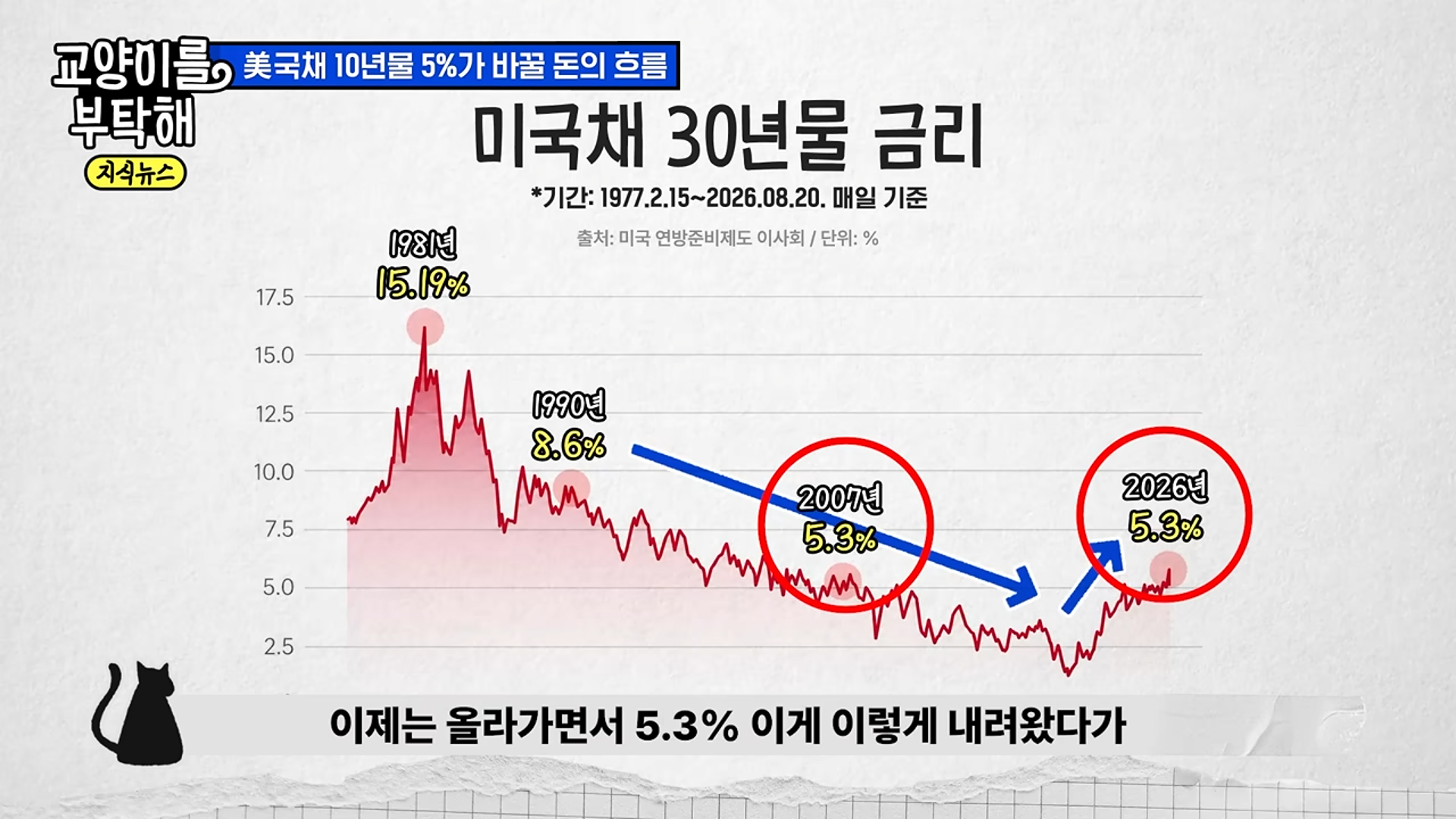
Just before the financial crisis, the 30-year yield stood at 5.3%, which was formidable. The 30-year Treasury was created around 1977. Before then, maturities extended only up to 20 years, but insurance companies demanded longer paper because their liabilities were long-term and required duration matching. When first issued, it yielded 7%, and in the 1980s when Paul Volcker raised rates to 21%, it yielded 15%—a time when one simply had to buy bonds. Over the subsequent 40 years, it slid continuously downward.
It reached 5.3% in 2007, subsequently fell, and has now climbed back up to 5.3%. It is not unusual for yields to fall and then rise due to inflation issues or other developments. They can fall, or they can rise driven by specific events.
The issue is that back then, US government debt amounted to merely 50% to 60% of GDP, whereas today it stands at nearly 100% of GDP, reaching $40 trillion in debt. That is daunting. Back then, growth rates were high, whereas today they are lower. Consequently, as the illusion surrounding the United States cracks, questions arise: Can the US really sustain $40 trillion in debt? Furthermore, that glorious Triple-A (AAA) rating was downgraded to AA+. This has fueled doubts about whether Treasuries truly qualify as safe assets.
For the 30-year bond, with the government signaling its desire to halt the rise around 5.3% through buybacks, a tug-of-war is likely to unfold here, while the 10-year Treasury could potentially touch 4.8% to 5%. Most Americans rely on 30-year mortgages. Because mortgage rates are tied to the 30-year Treasury yield, they reach the 7% range, meaning few people can afford to borrow at these rates to buy homes. High rates inevitably create a heavy burden.
Because corporations use the 10-year yield as a benchmark when issuing corporate bonds, the 10-year Treasury serves as an essential benchmark. The significance of 5% is that people had grown accustomed to rates of 0% to 1%—the abnormal rates from the emergency room era. Equity investors and business operators thrived under those conditions because they secured financing at 2%, 3%, or 4%. As rates rise, it becomes a major strain.
Equities, in particular, feel the strain. Under valuation models, cash flows must now be discounted at 5%. Previously, if an asset allocation stood at 50% equities, 40% bonds, and 10% alternatives, the ultra-low yields of the 2010 to 2020 period prevented investors from keeping 40% in bonds, leading them to slash bond allocations to 10%. They shifted 30% into equities and 10% into alternatives. That is precisely why the Nasdaq and S&P 500 soared—the power of liquidity. Capital in alternatives also flowed heavily into private credit and private equity. But once yields hit 5%, investors must reallocate back into bonds. If 20% is pulled from here and 10% from there, reducing 30% of the driving force that powered the S&P 500 over the past 15 years, can those past returns be sustained? This poses a serious challenge for stock investors. Whether from a valuation standpoint or a liquidity perspective—assuming identical liquidity—assets will shift more rapidly toward areas that carry such burdens, and higher discount rates will create an increasingly challenging environment.
Not Just National Debt: Four Headwinds Driving Up Long-Term US Yields
First, considerable focus is placed on US fiscal health, fiscal risks, and excessive national debt. That issue certainly exists. The national debt expanded drastically; over the past 10 to 20 years, massive sums were unleashed not only during COVID-19 but continuously since the financial crisis. As a result, the government debt-to-GDP ratio climbed steeply from 50% to 60% to nearly 100% over two decades.
Second, a major reason for the shortage of Treasury buyers is that hyperscalers, as well as nations like the UK, France, and Germany investing in defense and infrastructure, are unleashing 20 years' worth of deferred capital spending all at once. Consider the United States alone. Following massive investments during the dot-com bubble in 1999 and 2000, capital spending remained subdued for two decades after the bubble burst. Companies like Apple and Google used that cash to buy back shares or reward shareholders, which drove stock prices higher. Today, however, instead of shareholder returns, they are investing aggressively—and because cash on hand is insufficient, they are issuing corporate bonds and taking out private credit. Germany is also investing colossal amounts as it boosts military expenditures to enhance defense capabilities. With capital running short and funds poured into investment projects, vast supply is competing against Treasuries.
Third, inflation, which had stayed low, flared up again following the 2020 pandemic, and that sticky inflation has served as a primary driver pushing interest rates higher.
Fourth, emerging economies like China, Russia, and Brazil, which previously bought large volumes of 30-year US Treasuries, are no longer purchasing them. When Russia invaded Ukraine, the global geopolitical map shifted. The tacit post-World War II consensus preserving territorial integrity shattered, prompting the Biden administration to impose sweeping financial sanctions on Russia. Russia's dollar reserves and US Treasuries were completely frozen. Since then, neither China nor Russia has had any reason to buy US Treasuries. Emerging markets like Brazil and India also concluded that relying exclusively on the dollar poses risks, creating a potent geopolitical driver behind emerging nations shunning long-term dollar-denominated debt.
Q. These four issues do not seem easy to resolve in the short term. Should we assume that demand for 30-year Treasuries will continue to decline over the next 5 to 10 years?
That is how it must be viewed. In the early 2000s, there was a period when short-term rates rose while long-term rates fell rapidly. That was Greenspan's conundrum—a phenomenon where market yields fell despite hikes in policy rates. After 2000, China emerged and commodity-exporting emerging economies purchased massive amounts of long-term US debt. This led the United States to feel overly secure, assuming such demand would always be there. Washington should have managed it prudently, but complacency led to a severe mismatch when conditions reversed. At any rate, these four factors will remain crucial themes over the next 5 to 10 years.
Because demand for long-term US debt is weak, the government is attempting to raise funds by cutting the share of 30-year bonds and increasing short-term bill issuance through buybacks. However, the Treasury Borrowing Advisory Committee (TBAC) previously recommended a 20% cap on short-term debt issuance. When a company manages funds with excessive short-term concentration, any deterioration in short-term money markets can trigger an immediate liquidity crisis. That is why the advisory committee recommended staying at 20% without exceeding it, though it noted that depending on conditions, it could expand to around 25%. Currently, the proportion has likely risen from 20% to around 21% or 22%. The Treasury is stepping in to stabilize the market by adjusting within that 25% boundary.
If that fails, even larger interventions will emerge. Since that could result in an abnormal market, Bessent is saying, "Trust me for now," while the market—particularly bond vigilantes—is issuing warnings that distorting the market in such a manner will only amplify the problem.
Q. Is this a situation that needs to be monitored over the next several months?
Yes, we have to wait and see. It remains to be seen whether it will worsen significantly or achieve some stability through short-term remedies, but all these pressures happen to be converging at once. Financing demand from hyperscalers is also heavily concentrated right now. As they continually issue corporate bonds and draw on private credit, corporate yields rise alongside Treasuries, intensifying the competition between corporate debt and US Treasuries.
We have to discern whether Treasuries themselves are the core problem, whether fiscal health is genuinely critical, or whether this is the combined result of inflation, demand competition from hyperscalers, geopolitical issues, and emerging markets halting Treasury purchases.
"Buybacks Are Not 'Money Printing'"... Is Bessent Really Right?
Q. Some criticize buybacks as being quantitative easing in disguise. Bessent flatly denied that, but what is your take?
(Many people) seem to misunderstand, thinking, 'Ah, the Treasury Secretary is trying to do QE. He is trying to intervene in what the Fed does.'
Scott Bessent | US Treasury Secretary (September 8)
"I am not doing QE. When the market is in disequilibrium, my role is to bring the market back into equilibrium."
Buybacks are conducted by the Treasury Department as part of routine operations; they even have KPIs. In contrast, quantitative easing is conducted by the Federal Reserve, not during normal times, but in states of emergency. Yet conditions have not reached the point of being rushed to the emergency room. Calling buybacks quantitative easing is skipping too many steps.
There are three tools available in a crisis: Quantitative Easing (QE), Operation Twist (maturity swaps), and Yield Curve Control (YCC). Operation Twist* would come first.
*Operation Twist: A monetary policy whereby the central bank sells short-term government bonds and uses the proceeds to purchase long-term government bonds, aiming to lower long-term interest rates.
Shifting the Fed's holdings from short-term to long-term bonds does not alter the overall size of the balance sheet, but it differs from buybacks, which merely rob Peter to pay Paul. Operation Twist is executed directly by the Fed. In buybacks, the Treasury is repurchasing what it issued itself; the Fed is an issuing authority while the Treasury is an executive agency. If Bessent were to draw a comparison, he might argue that buybacks resemble the lowest tier of traditional measures the Fed can deploy, Operation Twist, but even then, buybacks sit a tier below that. Therefore, buybacks are fundamentally different from QE.
The next step the Fed could take is Yield Curve Control—declaring that it will buy unlimited amounts if the yield on a specific maturity hits 4.5%. That caps yields and prevents them from rising further. From this stage onward, measures represent potent, non-traditional monetary policy.
Quantitative easing is far more aggressive, effectively declaring, "We will buy as many US Treasuries as needed." Operation Twist can be viewed as a milder measure, while buybacks fall under the Treasury and Operation Twist onward falls under the Fed—they belong to entirely different domains.
Q. So buybacks cannot be described as printing money into the market.
It is inaccurate to view it as drastically expanding the money supply. However, people often get confused. When debt-to-GDP ratios are high and investors refuse to buy debt, if a government issues bonds and the central bank buys them all up, the expanding money supply weakens the currency and leads to hyperinflation—as seen in Latin America during the 1980s, such as Venezuela. People mistakenly worry that the US might be heading down a similar path.
The 1980s Latin American model involved the central bank directly purchasing bonds in the primary issuance market. That immediately injects cash without retaining assets on the central bank's balance sheet, unleashing pure liquidity into the economy. That results in hyperinflation and severe currency depreciation, which Venezuela and Argentina still experience today.
The US operates differently. When the US Treasury issues debt, the Fed is legally barred from buying bonds directly in the primary market. The Federal Reserve Act and the Banking Act of 1935 restrict bond purchases strictly to the open market, prohibiting direct underwriting from the Treasury. Amending this law requires congressional action, which is no easy feat. Therefore, during QE in the United States, the Treasury issues bonds, but the Fed can purchase only circulating secondary market paper. Rather than buying directly from the Treasury and retiring the debt, the Fed buys circulating bonds from the secondary market—such as 2-year, 10-year, and 20-year maturities—and retains them on its balance sheet. This distinction is critical.
Once conditions stabilize, the Fed sells them back. That is Quantitative Tightening (QT), where the Fed sells its Treasury holdings back into the market. When the Fed purchased Treasuries in the market, it did so through QE. Had it retired the purchased bonds, money supply would have expanded permanently, but instead, it holds them and subsequently unloads them back into the market. That difference explains why the Latin American approach spiraled completely into hyperinflation, whereas the US approach stopped short of hyperinflation. When governments in Venezuela, Bolivia, and historically Brazil and Argentina had no buyers for their debt, they monetized fiscal deficits this way. Because of the ensuing crises, regulatory bars were enacted across the board in the late 1990s to prohibit such practices when overcoming hyperinflation. Naturally, laws could change if dire circumstances dictate.
Furthermore, a central bank holding domestic sovereign bonds over long periods produces distinct effects. In a normal market, the Fed gradually winds down its Treasury holdings, which it had been doing steadily until recent unfavorable conditions emerged. As a result, the process is currently paused, with the Fed fine-tuning holdings up and down. When the Fed held few Treasuries and conducted no asset purchases, the market was functioning normally. But when crises emerged, it navigated them through QE. Had the US not addressed the 2008 financial crisis through QE and the liquidity injections orchestrated by Ben Bernanke, and instead followed orthodox methods of enduring recessions and restructuring, recovery would have taken vastly longer. The slump in equities and the broader economy would have dragged on, and China might have risen even more dramatically during that window. We cannot know for certain, but because we chose that path, we entered unprecedented territory after 2008. Still, rather than outright debt monetization, conditions were managed in this calibrated manner.
These methods date back to the 1935 framework, which the US deployed starting around World War II during earlier crises. Having tested these tools under stress, policymakers found them viable, and the current approach simply recycles and slightly expands them within that statutory framework.
Q. So even if the Fed intervenes down the road, inflation will not spike out of control?
Correct. The safeguards are already in place.
Q. If the market still fails to stabilize after the Fed takes such steps, could legal revisions be pursued as an option?
That possibility exists. If circumstances change due to war or a wartime footing, and existing measures prove insufficient, laws could be amended. However, if the Fed promises to reduce Treasury holdings via QT but fails to do so and maintains them indefinitely, their effectiveness will diminish, bordering on debt monetization. That is why policymakers must remain cautious and adhere to unwinding holdings during normal times. That is precisely why Kevin Warsh opposes the accumulation of Treasuries on the Fed's balance sheet.
"I believe we should proceed slowly and deliberately, but the central bank's balance sheet must be reduced. It took 18 years to build this bloated balance sheet, and I believe it has inflicted substantial harm on the Fed's credibility."
He argued that such methods are abnormal, advocating for a wind-down—though current momentum has somewhat stalled. Nevertheless, once normal conditions return, the Fed should rightfully trim its Treasury holdings.
Q. The reason so many people follow complex Treasury yields is that so many are invested in markets centered around AI.
That is correct. Subscribers are primarily concerned with whether AI will thrive so that SK Hynix and Samsung Electronics can perform well. When assessing stock valuations, sector analysts might quote a target of 2.5 million won, but macro analysts provide a reality check. While 2.5 million won makes sense in normal times, during periods of macroeconomic instability, they apply a discount, bringing it down to around 1.7 million won. We must consider the trajectory of the macroeconomy. In the first half of the year, despite the war involving Iran, expectations were set too high on the assumption that we would be fine.
From a macroeconomic standpoint, if Iranian geopolitical friction persists and the war in Iran continues to affect oil prices, inflation, and rising US interest rates, we must apply a greater discount and take a more conservative view.
※ This video was filmed on September 10, 2026.
https://youtu.be/2GCjWGvAIfM
Subscribe to the <Taking Care of Culture> YouTube channel to view more content.
※ Please note: This article was translated by AI and may contain errors.




 Video News

 Video News