
 KOR
KOR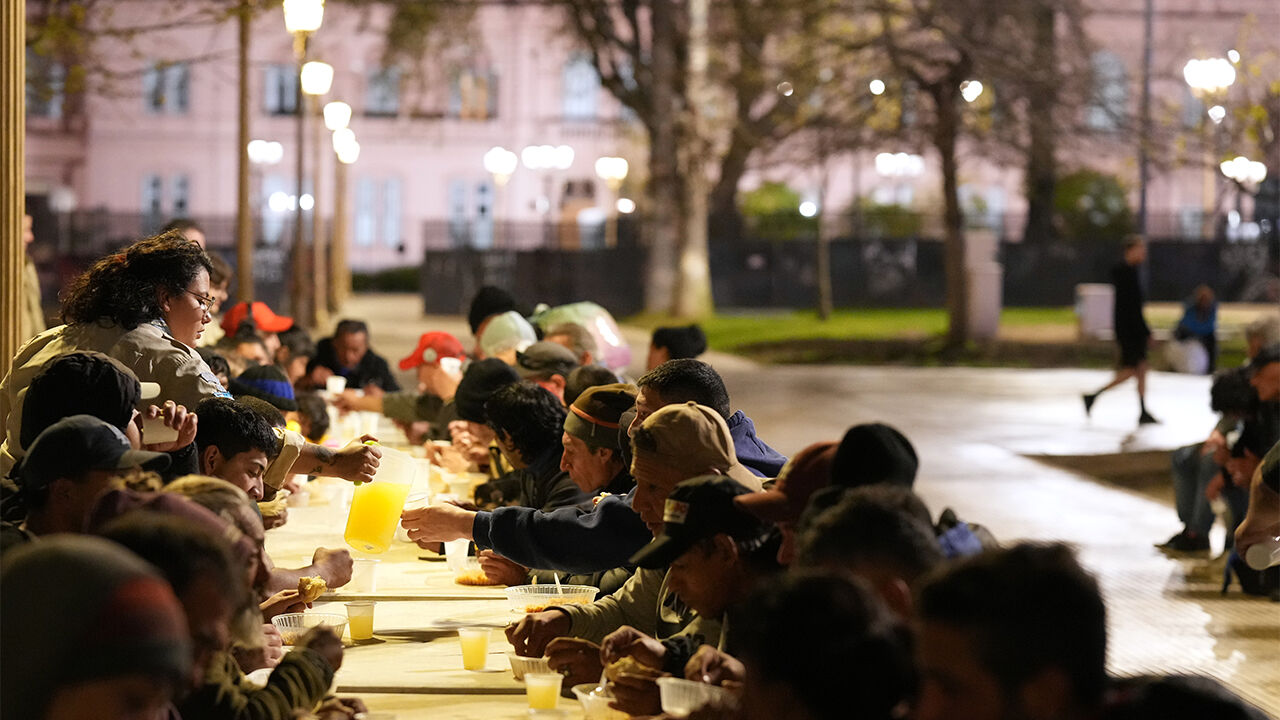
▲ A free food distribution event in Argentina (The photo above is not related to the article contents.)
A survey has shown that 6 out of 10 Argentines have taken out loans or fallen into debt over the past six months.
In particular, a significant portion of these loans was reportedly used not to purchase assets like homes or cars, but to cover basic living expenses such as groceries, medical bills, and utility fees.
As the recovery of households' real purchasing power remains sluggish amid slowing inflation, "subsistence loans" are emerging as a vital prop for household economies in Argentina.
According to a poll by Centrix released by Argentine economic media outlet Ámbito on the 20th (local time), 60.2% of respondents answered that they had taken on loans or debts over the past six months.
Among loan users, 55.6% borrowed money to cover groceries and medical expenses, while 20.4% used it for utility bills and service costs.
These four items directly linked to livelihood accounted for 76% of all borrowing reasons.
The cash situation for households was also tight.
65% of respondents answered that their income ran out before the 20th of every month, and 44.4% said they could not make it past the 15th.
12.2% reported that their money ran out before the 5th of the month.
The situation was even more severe among low-income households.
As many as 87.6% stated that their income was completely depleted before the 20th.
The proportion of low-income earners who took out loans over the past six months stood at 70.2%, higher than the overall average.
The loan utilization rate among young adults aged 18 to 39 was 67.1%.
Differences across income brackets were also observed in the purposes of the loans.
While more than 85% of low-income loan users spent the money on groceries, medical bills, utility bills, and service costs, high-income earners showed a relatively higher proportion of spending for other purposes, such as purchasing durable goods.
The focus of economic concerns has also shifted.
Responses citing income and wages as primary concerns were the highest at 50.1%, followed by economic uncertainty (49.8%) and unemployment (40.9%).
Inflation stood at 12.7%, the lowest among the 10 items.
This is interpreted as a result showing that the more immediate concern for households is no longer how much prices are rising, but whether they can maintain their actual livelihoods with the money they currently earn.
81.2% of respondents answered that wages failed to keep pace with the inflation rate, and 65.8% said that the official price index by the National Institute of Statistics and Census (INDEC) failed to properly reflect the inflation they felt in daily life.
In August, Argentina's inflation rate recorded 33.5% compared to the same month last year, which is much lower than the 160.9% under the previous administration, but still remains very high.
Respondents who evaluated the national economic situation as "bad" or "very bad" accounted for 59.4%, a slight decrease from July (61.8%).
Ultimately, despite the price stabilization and fiscal soundness improvements pursued by the Milei administration, household spending capacity and domestic demand recovery are failing to keep pace.
The survey was conducted from August 25 to 31 among 1,466 people nationwide in Argentina, with a sampling error of ±2.1 percentage points at a 95% confidence level.
(Photo: Yonhap News)
※ Please note: This article was translated by AI and may contain errors.


 Video News
 Video News
 Video News
 Video News
 Video News