
 KOR
KOR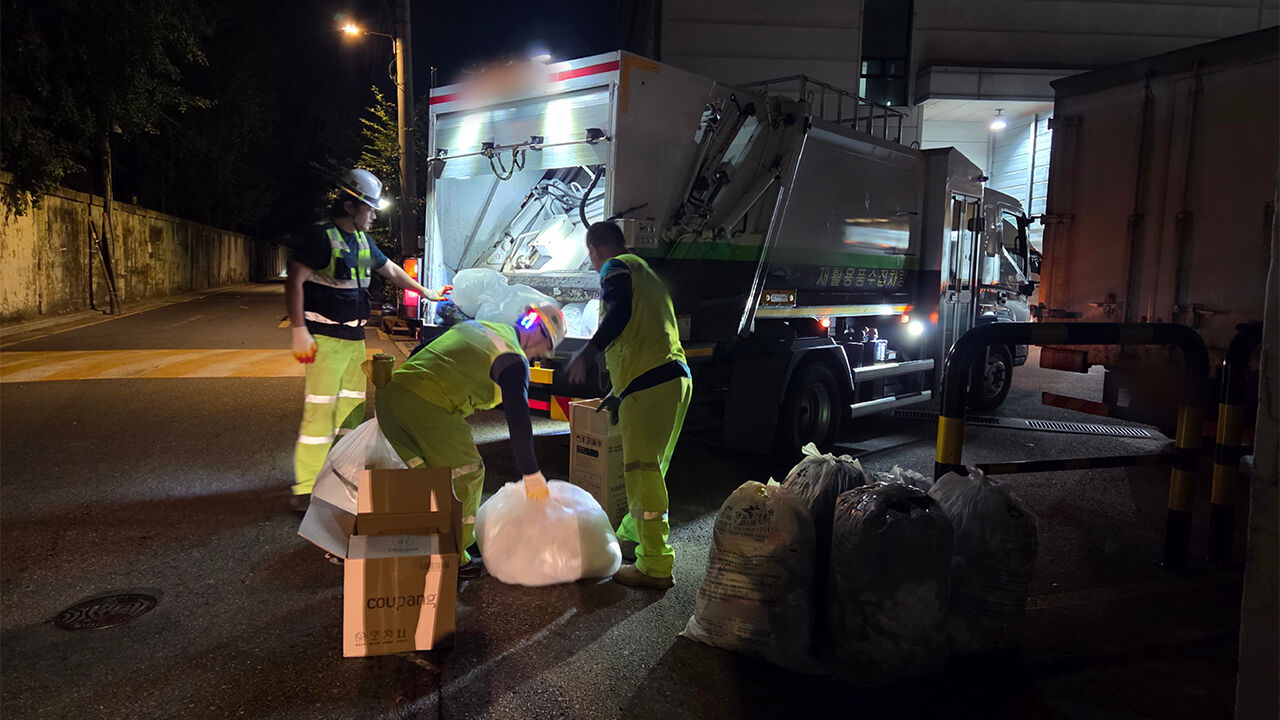
▲ Sanitation workers collecting recyclables
"All right, all right!"
At 1:00 AM on the 19th, while people were fast asleep,
a 3.5-ton recycling collection vehicle began making its way through every corner of a residential alley in Seoul, emitting a "beep-beep" reverse warning sound.
Every time the vehicle came to a stop, two collection workers jumped off with practiced movements.
Soon, bags of trash from the alley were tossed into the truck, and the workers hopped back on.
It took less than a minute.
This is a common night scene marking the start of the workday for Park, 47, a sanitation worker in his sixth year on the job.
Park, who was driving on this day, also got down from the vehicle to lend a hand when there was a large amount of waste.
The recycling collection truck moved back and forth through the alleys without a break, typically stopping at more than a dozen locations every 20 minutes.
This is due to the reality of having to process all the trash assigned to their zone within a limited working time.
In areas where it was difficult for trucks to enter, the workers even came out before commute hours and ran between alleys to gather the trash in advance.
There was not a single moment to rest until dawn broke and their shift ended at 8:00 AM.
Cases where they could work in teams of three were considered relatively better off.
When working in teams of two or alone, the work intensity becomes even more severe.
One sanitation worker, who worked in a two-person team with the vehicle driver on this day and finished collection alone, grabbed his waist and said, "I feel like I'm going to collapse."
When asked about the difficulties of night work, Park replied, "We jokingly say among ourselves that our lifespans are shortening..."
It was a remark that touched upon reality rather than being a joke.
He added that not long ago, one of Park's colleagues collapsed from a cerebral hemorrhage while working.
Injuries also occur frequently because sharp kitchen knives and other hazardous items are mixed among the waste.
It is even more dangerous during the dark night hours when visibility cannot be secured.
Unable to see beneath their feet, workers sometimes miss their footing while climbing onto the vehicle.
Sanitation workers have to lift trash bags weighing close to 30 kg dozens of times a day.
Although some autonomous districts have set weight limits of 13 kg (for 50L) and 19 kg (for 75L) for a safe working environment, workers unanimously testified that these limits are ineffective in the field.
This is because they cannot simply leave the trash behind just because it is heavy.
Night work is cited as a major factor increasing the risk of safety accidents and illnesses among sanitation workers.
This is because visibility is poor and the risk of accidents caused by cumulative fatigue increases.
Safety standards for the collection and transportation of municipal waste stipulate "daytime work in teams of three (including the driver)" as a rule, but exceptions can be made in cases corresponding to "reasons stipulated by ordinance."
According to a report titled "Industrial Safety Status and Protection Measures for Municipal Waste Sanitation Workers in Busan" by the Busan Labor Rights Center, the proportion of sanitation workers who worked for two hours or more at night (from 10:00 PM to 6:00 AM the following day) reached 91.7%.
Fatal accidents involving sanitation workers actually happen frequently during late-night hours.
Around 3:00 AM on the 7th of last month, in an alley in Changsin-dong, Jongno-gu, a sanitation worker in his 60s collecting waste was hit by a waste collection truck and died.
On the 19th of the same month, in Yeongcheon, North Gyeongsang Province, a 25-ton dump truck and a garbage truck collided during dawn hours, claiming the lives of three sanitation workers riding in the garbage truck.
According to data submitted through the office of Democratic Party lawmaker Park Hae-chul from the Korea Workers' Compensation and Welfare Service, the number of industrial accident applications by sanitation workers in 2025 stood at 8,995.
Among them, 7,456 cases (82%) were approved.
As of July this year, the number of applications stood at 3,080 (with 2,165 cases approved).
Experts point out that the actual scale of accidents during work is likely much larger, as many field workers are reluctant to even apply for industrial accidents out of concern that their wages will be reduced.
Choi In-seop, head of the Geumcheon Environment Branch of the Korean Public Service and Transport Workers' Union Seoul Headquarters, said, "If you cannot work due to an industrial accident, the leave benefit is around 70% of the average wage," adding, "Because of livelihood concerns, some workers endure pain and keep working or give up applying for industrial accidents themselves."
He added, "It is necessary to improve wage compensation and the occupational disease recognition system to fit reality so that workers can return to the field healthily after receiving sufficient treatment."
Studies continuously emerge arguing that improving the working environment is necessary to prevent recurring industrial accidents among sanitation workers.
A study titled "A Study on the Development of Work Safety Scenarios and Risk Assessment for Sanitation Workers," published in the academic journal "Safety Culture Research," suggests that providing additional manpower and introducing shift work are necessary to reduce the risk of safety accidents caused by fatigue accumulation from excessive continuous work.
A final report of the "Research Forum for Preparing Improvement Measures for Sanitation Worker Work Safety," conducted as an assignment by the Ministry of Environment (currently the Ministry of Climate, Energy and Environment), also pointed out, "In cases of work where safety accidents frequently occur due to manual labor during night work, it is necessary to first adjust working hours to daytime work through labor-management consultations and cooperation with residents."
(Photo: Yonhap News)
※ Please note: This article was translated by AI and may contain errors.


 Video News

 Video News
 Video News
 Video News