
 KOR
KOR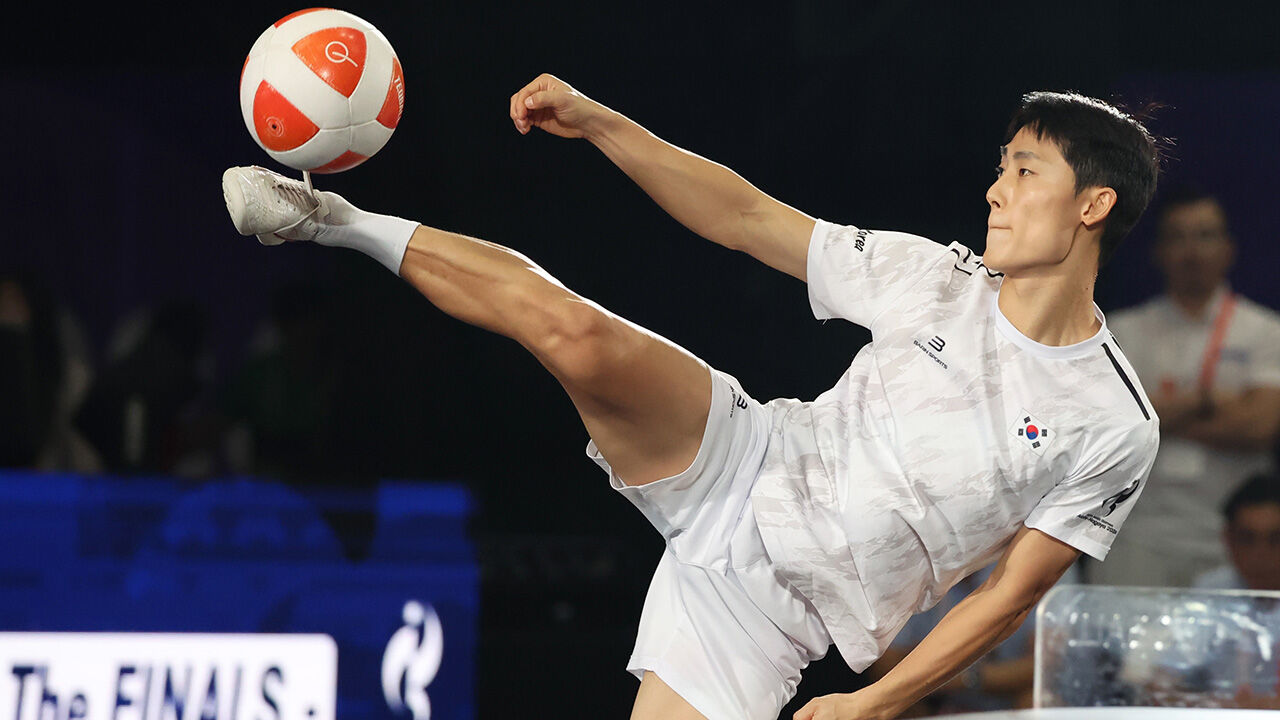
▲ South Korea's Lee Joon-seok and Iraq's Ali Jalil Mezher Al-Eleyawi compete in the men's singles teqball final at the 2026 Aichi-Nagoya Asian Games at the Higashi Sports Center in Nagoya, Japan, on the 20th, with South Korea's Lee Joon-seok attacking.
Teqball national team captain Lee Joon-seok started playing football when he was in elementary school.
Like other friends, he dreamed of wearing the Taegeuk mark and stepping onto the stages of the Asian Games, Olympics, and World Cup.
However, Lee's dream did not come easy.
Pushed out of fierce competition, he brought an end to his football career at the age of 21 after playing in the K4 League, which is considered the fourth tier of professional football.
Failing to quench his thirst for wearing the Taegeuk mark, Lee transitioned to jokgu, but that path did not work out smoothly either.
It was then that teqball, a newly emerged sport, caught his eye.
Invented in Hungary in 2012, teqball is a sport where players hit a football back and forth across a curved special table. It initially gained attention as football players mostly enjoyed it for training purposes, and it began to establish itself as a professional sport with the founding of the International Federation of Teqball (FITEQ) in 2017.
After balancing his livelihood with teqball player life, Lee heard the news in February of this year that teqball had belatedly been selected as an official event for the 2026 Aichi-Nagoya Asian Games. He then quit his job as a contract production worker at a major corporation to dedicate himself to training.
Although the teqball national team prepared for the tournament in poor conditions without being able to enter the Jincheon National Training Center unlike other national athletes, Lee's dream toward a medal was no different from athletes in other sports.
Lee's stage moved to the teqball table, which is about 1/1,400th the size of a football field, but his desperation for a medal was by no means small.
Lee said, "When I first started teqball, my mother spent a large sum of 2 million won to buy me a teqball table despite our difficult financial situation."
He added, "I prepared for this tournament thinking of my mother, and I endured with the tenacity that I must win a medal."
Ahead of the tournament, Lee used his own money to head to Hungary, where he reached out blindly to Hungarian players via social media to receive private coaching.
Lee was desperate.
He explained, "I thought that winning a medal in this tournament would widely publicize the sport of teqball and create a stepping stone for colleagues who, like me, gave up their livelihoods to continue their athletic careers without worry."
Lee passed the group stage with a clean sweep without conceding a single set, and secured a ticket to the final after his opponent Zaid Aidan retired during the semifinal held on the 19th due to a left thigh muscle tear injury.
Lee stood on the stage of his dreams.
He faced Iraq's powerhouse Ali Jalil Mezher Al-Eleyawi, who was considered a favorite to win, in the men's singles teqball final of the Aichi-Nagoya Asian Games held at the Higashi Sports Center in Nagoya, Japan, on the 20th.
Although he seemed to fall behind by conceding three consecutive points early in the first set, he regained his concentration and won with a set score of 2-0 through flawless game management.
It was the moment when his eagerly awaited dream came true.
(Photo: Yonhap News)
※ Please note: This article was translated by AI and may contain errors.




 Video News
 Video News