
 KOR
KOR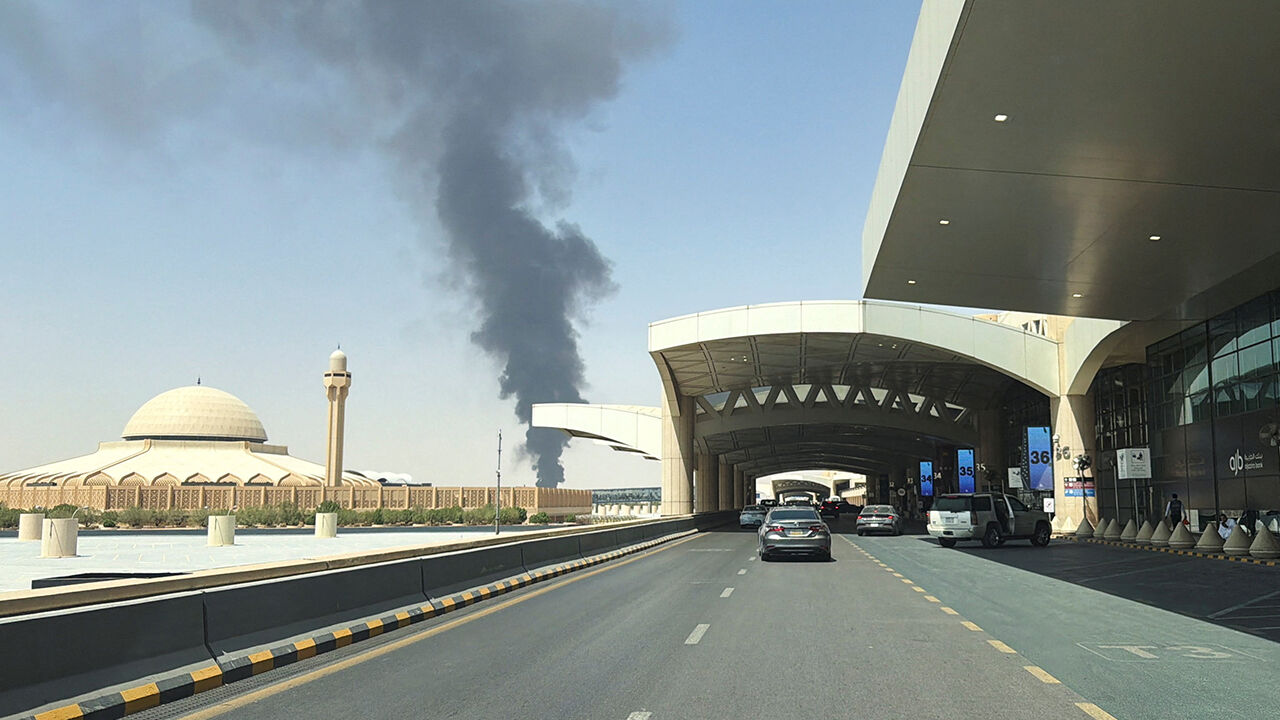
▲ Smoke rises from a fuel storage facility at King Khalid International Airport in Riyadh, Saudi Arabia, on September 19.
Discontent is growing among Middle Eastern nations over the U.S. government's reluctance to intervene militarily as the Iran-backed Houthi rebels in Yemen threaten Red Sea shipping lanes and intensify their offensive against Saudi Arabia, CNN reported on the 19th (local time), citing local sources.
With the situation already destabilized by the war with Iran, Saudi Arabia, the leader of the Arab world, has shown its limits in halting the Houthis. This has sparked growing skepticism toward the United States, particularly among Gulf nations, along with concerns over a prolonged global energy crisis.
U.S. President Donald Trump has maintained his existing stance of providing intelligence and targeting data to Saudi Arabia while drawing the line at direct physical military strikes by U.S. forces against the Houthis.
A U.S. official drew the line to CNN, stating, "There will be no offensive strikes."
Instead, President Trump provoked backlash from allies by saying, "The Houthis called us to say they don't want to fight," adding, "They much prefer that we stay out of it, and they are letting most ships pass through."
Saudi Crown Prince Mohammed bin Salman reportedly made two direct phone calls to President Trump to request airstrikes, but was turned down.
Barbara Leaf, former U.S. Assistant Secretary of State for Near Eastern Affairs, described President Trump's remarks to CNN as "shocking," pointing out that it is "a very harsh approach that appears to prioritize a deal with a designated Foreign Terrorist Organization (FTO) over a close partnership."
A combination of shifting Middle Eastern strategies and limits on military firepower underlies the U.S. avoidance of a direct clash with the Houthis.
Having experienced a failure to oust Houthi strongholds in Yemen despite months of bombing, and with military and financial burdens already accumulated from direct clashes with Iran, the United States faces a constrained environment.
Ultimately, pragmatic calculations appear to have prevailed, suggesting that maintaining a truce-like state with the Houthis is more advantageous for preserving U.S. military resources.
On the other hand, Saudi Arabia, which has intervened in the civil war in Yemen for the past decade, has laid bare the limits of its unilateral response as it failed to block the Houthi advance into coastal cities on its own.
With its core critical infrastructure, including oil facilities and pipelines, exposed to drone and missile attacks, Saudi Arabia has been driven to request support from France, the Kingdom's allies, the United Kingdom, Pakistan, and Egypt to make up for a shortage of missile interceptor batteries.
The recent movements of the Houthis have expanded beyond a mere regional conflict to threaten global logistics and entire petroleum transport routes.
The Houthis recently seized strategic islands in the Red Sea, seeking to gain control of the Bab el-Mandeb Strait, a vital waterway connecting Europe and Asia.
As the Houthis exert unexpected and powerful influence, the situation in the Middle East, intertwined with the war with Iran, is expected to sink deeper into a deadlock.
A planned meeting between the Gulf Cooperation Council (GCC) and Iran, which was initially intended to discuss opening the Strait of Hormuz, was abruptly canceled due to Saudi Arabia's absence.
Saudi Arabia apparently concluded that it had no tangible incentive to readily compromise with its "patron," Iran, while Houthi attacks continue.
Joy Hood, a former U.S. ambassador to Middle Eastern countries, also warned that "the Houthi advance into the Red Sea is emboldening the Iranian Islamic Revolutionary Guard Corps."
Experts believe that without ground troop deployment or a forward-leaning provision of deterrence by the United States, it is nearly impossible for Saudi Arabia to oust the Houthis on its own.
With the prevailing skepticism that military strikes alone can only weaken rather than completely destroy Houthi forces, suggestions have even emerged that Saudi Arabia should pursue truce negotiations with the Houthis.
A Middle East source remarked, "Deterrence against the Houthis can only exist if there is at least the shadow of potential U.S. intervention," adding, "If (President Trump's remarks) unnecessarily squander this, it will only crush the morale of the Yemenites."
Former Assistant Secretary Leaf pointed out, "Officials in the Middle East are expressing confusion rather than anger toward Saudi Arabia, asking, 'What on earth is the U.S. trying to accomplish here?'"
(Photo: Yonhap News)
※ Please note: This article was translated by AI and may contain errors.




 Video News
 Video News